Find the ingredient you are about to cut in the lists below. Each guide shows the everyday cuts for that one ingredient, such as slices, dice, wedges or strips, and the order to make them in so the piece stays steady on the board while you work.
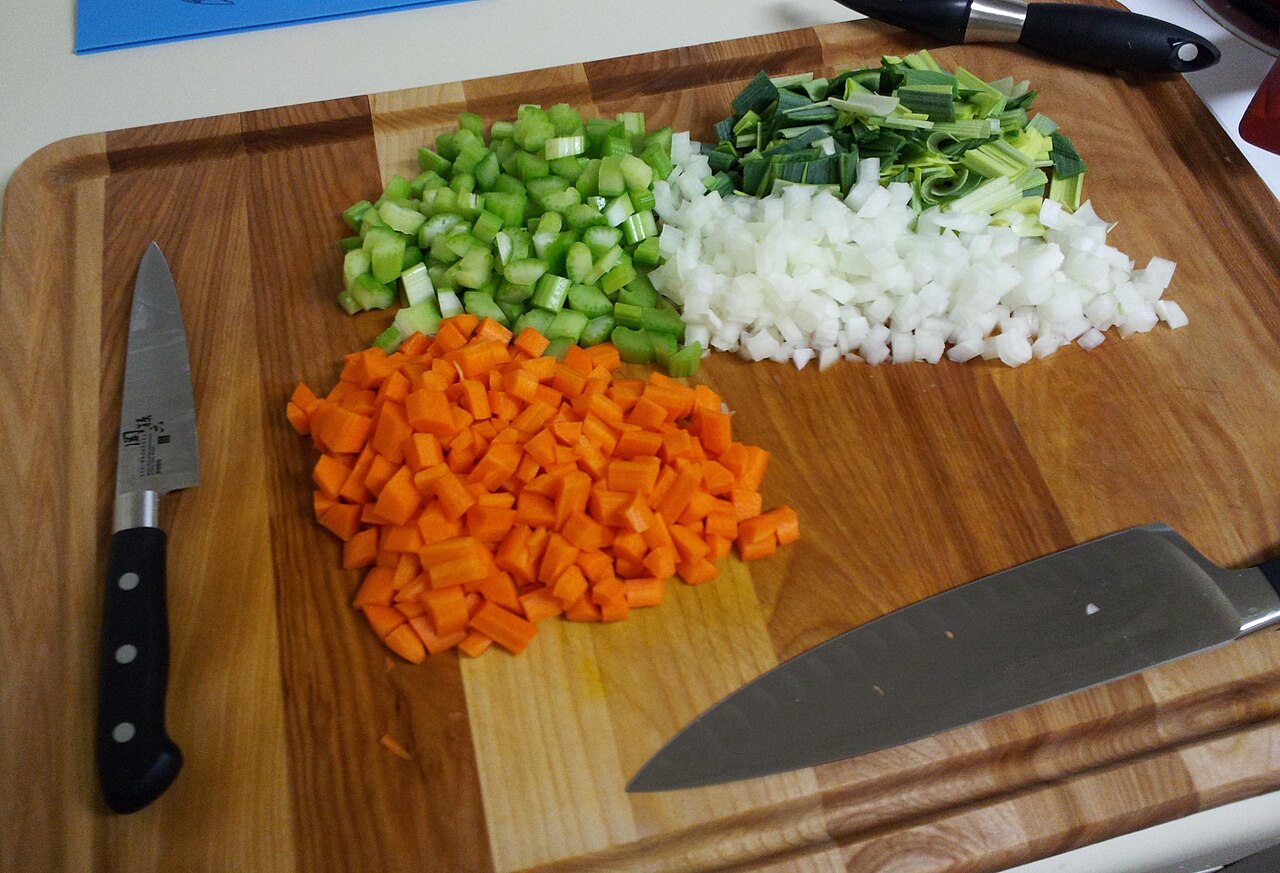
Every cut here starts from the same three habits. The board must not slide: a damp, wrung-out cloth laid flat under it is the quickest fix. The guiding hand tucks its fingertips into a claw. And the edge must be sharp enough to start a cut without force. Our knife skills for beginners guide covers the basic cut sizes and a short practice plan, and how to hold a Japanese knife covers the pinch grip.
If a recipe asks for a Japanese shape such as rangiri (an angled roll cut), sengiri (fine strips) or hangetsugiri (half-moons), see Japanese vegetable cutting techniques for what each name means.
The page has four ingredient groups: vegetables, fruit, herbs and aromatics, and poultry and roasts. Below them is the full list of cutting guides, oldest first, which grows as new guides are published.
Find a guide by ingredient
Pick the group, then the ingredient. Each line says what that guide shows you how to make.
Start here: basic cuts and a practice plan, the pinch grip, using a nakiri on vegetables and Japanese vegetable shapes.
Vegetables and tofu
- Cut potatoes for fries, cubes or wedges
- Cut sweet potatoes into wedges, sticks or cubes
- Cut parsnips, turnips, rutabaga and beets to roast evenly together
- Cut carrots into coins, bias slices, roll cuts, sticks or roasting wedges
- Julienne carrots into classic matchsticks
- Cut daikon into rounds, half-moons or matchsticks
- Peel and cut butternut squash
- Cut acorn, spaghetti or kabocha squash
- Cut cabbage into shreds, slices or wedges
- Cut napa cabbage for slaw, stir-fries or braising
- Cut bok choy, with the stems and leaves kept apart
- Halve, quarter or shred Brussels sprouts
- Separate broccoli florets and use the stem
- Cut cauliflower into florets or steaks
- Make cauliflower rice with a grater, processor or knife
- Cut a bell pepper into strips, dice or rings
- Cut a tomato into slices, wedges or dice, and remove the core
- Cut a cucumber into slices, dice or julienne
- Cut zucchini into coins, half-moons, sticks or ribbons
- Cut eggplant into rounds, planks or cubes
- Cut celery into sticks, crescents or dice
- Trim and core fennel, then slice it or cut wedges
- Slice or quarter mushrooms and prepare portobello caps
- Cut tofu into cubes, slabs or triangles
Fruit
- Slice or cube an avocado and remove the pit
- Cut an apple into wedges, slices or pieces for pie
- Cut an orange into slices, wedges or segments
- Cut lemons and limes into wedges, wheels or twists
- Halve a grapefruit or cut it into segments
- Slice, halve or peel a kiwi
- Cut a mango into slices or dice around the pit
- Cut a pineapple into rings, spears or chunks
- Get the seeds out of a pomegranate with less mess
- Cut a watermelon into wedges, cubes or sticks
- Cut a cantaloupe into wedges, slices or cubes
Herbs and aromatics
- Dice an onion without it falling apart
- Peel, slice, dice or mince shallots
- Mince garlic with a knife
- Cut green onions into rounds or bias slices
- Clean grit from leeks and cut rings or half-moons
- Peel ginger, then slice, julienne or mince it
- Trim lemongrass, then bruise, slice or mince it
- Cut a jalapeño into rings, strips or dice
- Cut fresh herbs: leaves, sprigs and stems
Poultry, roasts and carving
- Cut up a whole chicken into eight pieces
- Carve a roast chicken: legs, wings, then breast
- Carve a whole roast turkey
- Carve a turkey breast off the bone
- Carve a spatchcock turkey
- Carve roast beef and prime rib into thin, even slices
- Slice brisket across the grain, flat and point
- Slice tri-tip as its grain changes direction
- Carve a bone-in, spiral or country ham
- Carve a leg of lamb, bone-in or boneless
Before the first cut: board, grip and edge
Use a board big enough to hold the whole ingredient and the pieces you cut from it, but one you can still wash, dry and put away; the cutting board size guide measures the four spaces that decide it. If the board slides, lay a damp, wrung-out cloth under it, or see cutting board feet and non-slip grips for a permanent fix.
Keep one board for raw meat, poultry and seafood, and another for produce, bread and anything that will not be cooked; choosing a cutting board for raw meat explains the split. For roasts and whole birds, choose a carving board by the size of the roast and how it handles the juices.
If the edge skates on a tomato skin or a carrot before it bites, check its sharpness before you blame the technique. How to check if a kitchen knife is sharp sets out food and paper checks that never put a finger on the edge.
When the knife fights the food
Three problems turn up again and again in these guides. If the blade starts a cut in a carrot or potato and then sticks partway down, the blade body is pushing the cut sides apart: see why a sharp knife wedges in carrots and potatoes. If thin, moist slices cling to the side of the blade, that is food release, not dullness; why food sticks to a kitchen knife covers it. If the cut drifts to one side, check the grind, your grip and the board with why a kitchen knife cuts crooked.
Which knife for which job
Most of these guides work with any sharp chef’s knife. Where a particular shape helps:
- Vegetables in quantity: a nakiri or a santoku, both suited to a straight push cut. Santoku vs nakiri explains which to choose.
- Dense squash and large heads of cabbage: a gyuto long enough to finish the first cut; what size gyuto to buy weighs 180, 210 and 240 mm against your board and counter.
- Small work in the hand, shallots and citrus: a petty knife; see what a petty knife is for.
- Poultry joints: a honesuki, which works around bone rather than through it; see what a honesuki is.
- Long slices from a roast: a sujihiki, a long, narrow slicer for boneless meat; see what a sujihiki is.
- Cleavers: a Chinese vegetable cleaver and a meat cleaver are built for different work; Chinese cleaver vs meat cleaver sets out which one may meet bone.
If you are fitting a new wa handle to one of these knives, the wa handle size guide matches the handle size to the blade length.