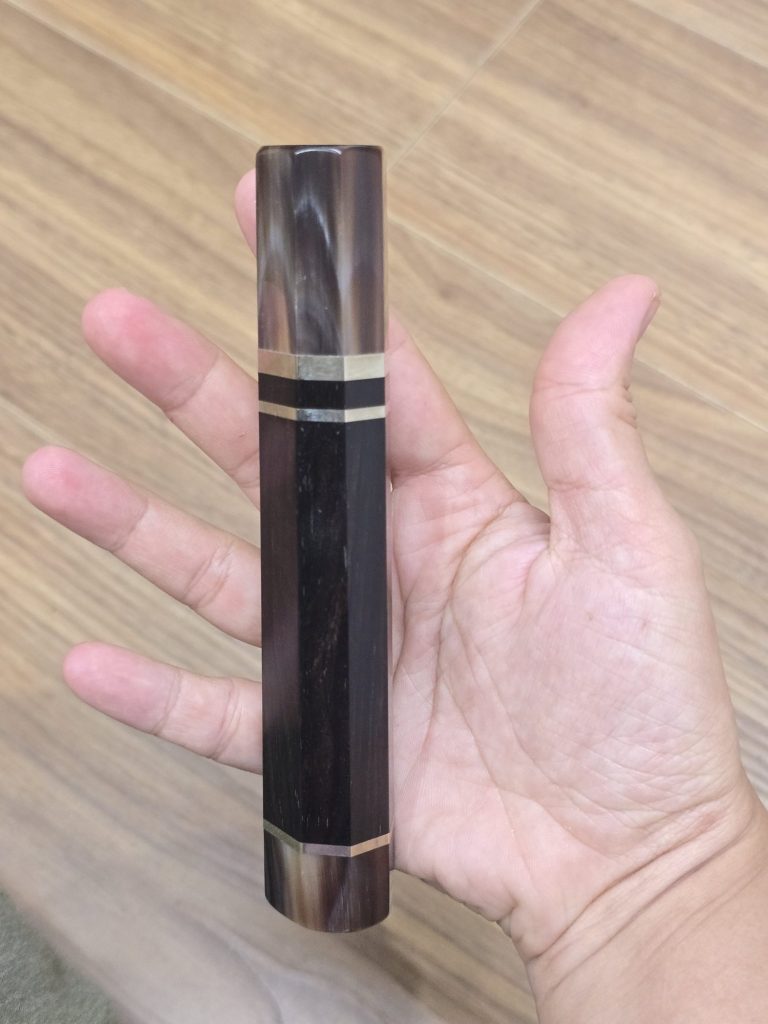
Short answer: Horn & Grain currently offers more than one rosewood path, and they should not be collapsed into a single material claim. The public catalog identity field declares standard “Rosewood” as Dalbergia spp.; it is shown as available for custom orders and appears in black-horn and blonde-horn product listings. “Siamese Rosewood” is separately declared as Dalbergia cochinchinensis and has a Deba-specific listing. “Curly Rosewood” is displayed as a request material. These catalog declarations are not supplier or batch proof, and the product pages do not publish finished weight or full dimensions, so choose from the actual handle and verified order details.
If you are shopping today, begin with the three current product directions below, then confirm the exact piece, fit, finish, and material record. Catalog pages can remain online while individual natural blanks or sizes change.
Current Horn & Grain rosewood paths
Rosewood & Buffalo Horn
- Currently verified: purchasable octagonal product page; public identity field declares standard Rosewood as Dalbergia spp.
- Confirm: species within the genus, supplier or batch evidence, actual-piece dimensions and weight, finish, and current blank.
Rosewood & Blonde Buffalo Horn
- Currently verified: purchasable octagonal product page; public identity field declares standard Rosewood as Dalbergia spp.
- Confirm: species within the genus, supplier or batch evidence, horn shade and figure, actual-piece dimensions and weight, finish, and current blank.
Deba Octagonal — Siamese Rosewood
- Currently verified: separate Deba-oriented product page; public identity field declares Dalbergia cochinchinensis.
- Confirm: supplier or batch evidence, exact dimensions and weight, ferrule color, finish, and compatibility with the individual deba.
Curly Rosewood custom direction
- Currently verified: visible in the material system as a distinct figured rosewood label.
- Confirm: request-only availability, species, figure, blank, documentation, and lead time.
What does “rosewood” mean on a handle?
It is a commercial name, not a species certificate. Royal Botanic Gardens, Kew recognizes Dalbergia as a genus with hundreds of accepted species, many of which have acquired local or trade names involving rosewood, palisander, blackwood, or related terms. Other woods outside Dalbergia have also been sold under rosewood-like names. Color is not a reliable botanical test.
Horn & Grain’s public catalog identity field currently says Dalbergia spp. for the standard Rosewood option. That means “a species within the genus is intended,” not “the finished handle has been identified to species.” The visible black-horn and blonde-horn product titles use the shorter Rosewood label, while the page also renders catalog-reference fields for origin and density. Those fields describe the catalog material reference; they are not supplier or batch proof of provenance or a measured density for the individual blank.
The public catalog identity field maps the separate Siamese Rosewood option to Dalbergia cochinchinensis, a name Kew accepts for a species native to Indo-China. That declaration is more specific than the visible Deba product title, but it still is not supplier or batch proof. If the identity is important for sourcing or cross-border shipping, request documentation for the actual material rather than relying on the catalog field alone.
Choose the actual handle, not an idealized species
Rosewood can be red-brown, chocolate, purple-brown, nearly black in places, straight-grained, or strongly figured. A page that shows one warm, saturated photograph cannot guarantee the next blank. Natural buffalo horn varies too. Use photographs of the exact ready-to-shop handle when possible. For a custom handle, ask to approve the blank and ferrule together if color is a deciding factor.
Review photographs in neutral light and from more than one side. Octagonal facets can expose different grain directions. Also ask whether the image represents a finished surface: oil, wax, or a film finish can deepen color and contrast. Screen brightness and white balance can make the same handle appear redder, lighter, or more uniform than it is in the kitchen.
Black horn or blonde horn?
Black buffalo horn gives a clear dark boundary before the blade and usually makes warm wood appear more saturated by contrast. It is the quieter, more formal pairing and is easier to judge from the current black-horn product page.
Blonde buffalo horn creates a lighter transition and can reveal amber, cream, translucent, or marbled areas. Because it is natural material, “blonde” is a range, not a paint code. Confirm whether the photographed ferrule is the ferrule supplied. Ferrule color is a visual choice; it does not by itself make the joint stronger or improve tang fit.
For a deba build, prioritize cross-section, tang fit, and control of the heavier blade before choosing the rarest horn color. The current Siamese Rosewood Deba listing uses the general label “Buffalo Horn,” so the exact ferrule appearance should be confirmed.
Fit: there is no universal “standard wa tang”
Many product listings describe a handle as fitting a “standard wa tang.” Treat that as a category description, not a dimensional guarantee. Handmade and production Japanese knife tangs vary in height, width, taper, length, shoulder geometry, and intended insertion depth. An opening that is too small may require controlled fitting; one that is too large may not align or secure correctly.
Before ordering, collect:
- knife type and blade length;
- current handle length and cross-section;
- tang width and height near the shoulder and farther back;
- available tang length and desired insertion depth;
- side and spine photographs showing alignment and any machi gap;
- the current balance point and the change you want.
Use the wa handle size guide for conservative starting ranges. Use the replacement guide if an old handle must come off first. Neither process should begin with force, uncontrolled heat, or an assumption about the old adhesive.
Weight and balance need finished measurements
“Rosewood is dense” is not enough to predict the knife. The standard option is declared only at the Dalbergia genus level and lacks supplier or batch confirmation of a species within it; the current product pages also do not publish finished weights or full dimensions. Horn, spacers, end caps, handle volume, taper, and bore depth all contribute to mass. A smaller rosewood handle can weigh less than a larger handle made from a nominally lighter wood.
If you want to calm a blade-forward knife, ask for the candidate handle’s finished weight and dimensions rather than requesting the heaviest rosewood. If you want to preserve nimbleness, specify that goal and compare a restrained rosewood build with a measured walnut or lighter-wood candidate. The rosewood-versus-walnut guide explains that decision without pretending a trade name supplies the grams.
Care and finish
Keep any natural-wood handle out of the dishwasher and standing water, wash the blade without soaking the grip, and dry the wood, ferrule, and blade junction promptly. USDA Forest Products Laboratory guidance shows that wood still exchanges moisture and that finishes slow this process rather than eliminating it.
Ask which finish is on the actual handle before oiling. An unfinished or oil-finished surface and a cured film finish do not share one care schedule. Do not use oil to disguise a widening ferrule gap, loose tang, crack, swelling, dark wet line, or sour odor. Those are inspection or refit questions.
Sourcing and travel questions
Many Dalbergia materials are covered by CITES listings and annotations. Requirements can depend on species, product form, shipment type, and destination, and the rules can change. Horn & Grain should preserve supplier and batch documentation and answer the specific order rather than make a blanket “CITES safe” claim. Buyers planning international travel or shipment should consult the current CITES Appendices and relevant national authorities.
A useful rosewood order brief
Send the knife and tang measurements, the preferred shape, the desired balance change, and one or two product photographs that show the color direction. Then ask four direct questions: What is the actual material identity? Is this the exact blank and ferrule? What are the finished dimensions and weight? What finish and care instruction will be supplied? Those answers are more valuable than a long list of generic rosewood virtues.
Reviewed 7 August 2026. Method: current public catalog identity fields, product pages, purchasability, and configurator availability were checked against Kew records. Catalog declarations are reported separately from supplier or batch proof; trade-control guidance points to CITES; no volatile price, continuous stock, unpublished measurement, or species within the standard Dalbergia declaration was inferred.
Primary references
- Royal Botanic Gardens, Kew: Dalbergia
- Royal Botanic Gardens, Kew: Dalbergia cochinchinensis
- CITES Checklist
- USDA Forest Products Laboratory: Wood–Moisture Relationships
- USDA Forest Products Laboratory: Finishing of Wood
Build a rosewood direction from your actual knife, tang, and color requirements