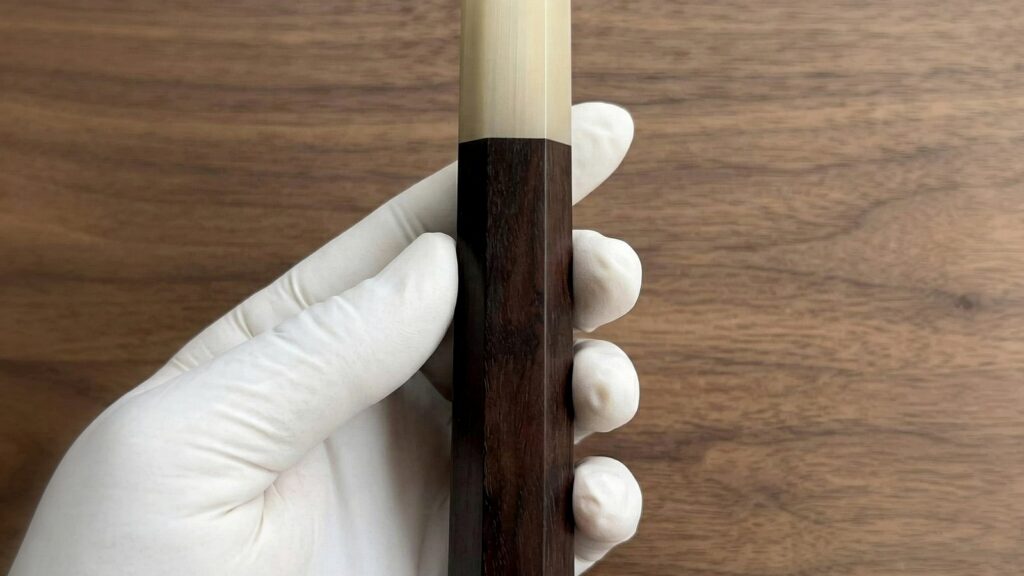
A bocote handle is golden brown, crossed by irregular dark streaks that can look restrained on one piece and almost painted on another. The important part is that this figure does not sit like a flat print. Turn the handle and the grain changes with it; on an octagonal handle, every facet presents a different figure. Underneath that visual movement, bocote is solidly dense and hard-wearing—not a decorative wood chosen at the expense of practicality. It is a warm, substantial handle wood whose appearance keeps changing in the hand.
The ground and the streaks
Bocote’s figure begins with contrast: a golden-brown ground and irregular, much darker streaking. The dark lines do not follow standard spacing or form a repeatable stripe. In some pieces they are relatively restrained. In others they gather into a busy, almost painted pattern.
That range is the honest way to buy this wood. “Restrained to almost painted” describes natural variation from board to board; it is not a menu of selectable grades. We build each handle to order and hold no stock, so figure cannot be chosen or previewed. A finished handle will belong unmistakably to the same visual family as the listing, but it will not copy its particular map of lines.
Our published species is Cordia elaeagnoides, with origin listed as Mexico and Central America.
The turn: why facets matter
Bocote makes most sense when thought of as figure in three dimensions. A product photograph can freeze one side, but the handle is not experienced from one side. As it rotates, the direction of the grain and dark streaking changes. A line that dominates one view can run away at an edge; the next face meets the same piece of wood on a different plane.
That is especially visible on our default octagonal profile. Its eight faces do not repeat a single printed pattern. Each facet reveals a different section of the grain, so the handle moves between views rather than presenting one “best side.” The facets turn natural variation into part of the shape itself.
This is also why profile changes the visual reading, not only the outline in the hand. An oval or round profile lets the pattern flow through a continuous curve; an octagon breaks that turn into distinct views. Our octagonal vs oval comparison explains the profile choice more broadly. D-shape and round are also available, but octagonal gives bocote’s changing figure the clearest stage.
The wood beneath the figure
Bocote is not just a pretty surface. The density we publish on the product page is 0.86 g/cc. We treat that as a solid mid-heavy handle wood: dense, hard-wearing, and clearly not lightweight. It suits someone who wants visual energy with a substantial material character.
If low weight is the priority, bocote is the wrong direction; curly maple or teak are our genuinely lighter routes. Density is useful context, but we do not turn it into a promised finished-handle weight because every handle is made for a particular fit.
There is no universal calendar for oiling a wa handle. First identify the handle’s finish, then follow the maker’s maintenance guidance for that finish.
The horn at the front
The ferrule is the collar at the blade end of the handle. Here it is marbled buffalo horn. Its shifting light and dark areas make sense beside bocote because neither material reads as a uniform colour block: the ferrule carries variation into the front of the handle without trying to imitate the wood.
The same honesty applies to both materials. Buffalo horn is natural, so its marbling varies from piece to piece. We cannot promise that a ferrule will reproduce the exact patches or balance shown in an image, just as we cannot promise a particular arrangement of bocote streaks. The pairing is consistent; the individual pattern is not.
Who bocote is—and is not—for
Choose bocote if you enjoy contrast, irregularity, and a handle that rewards being turned. It is more animated than a plain, even-toned wood, yet warmer and more golden than the near-black direction of ebony. It also suits a buyer who is comfortable receiving a unique figure within a known range rather than selecting an exact pattern.
If you want something quieter, start with the plainer options in our wood guide. If you want dark drama rather than golden-brown contrast, look to the ebony family. If you want genuinely light wood, compare curly maple or teak. And if one exact streak layout is essential, bocote is probably not the right made-to-order choice: its figure cannot be selected or previewed.
From knife details to finished handle
Every bocote handle is made to order with a bocote body, marbled buffalo horn ferrule, and your choice of octagonal, oval, D-shape, or round profile. On the product page, the size recommender uses your knife type and blade length to select the appropriate size tier. For more context before ordering, our size guide explains how those tiers relate to different knives.
Every measurement and photo is optional before buying. After payment, your order page holds the details; add or correct numbers and photos until we start at the bench. We review every knife before work starts.
Bocote is also available in our custom configurator if you want to compare it within a broader build. If this pairing is already the one you want, see the bocote handle.