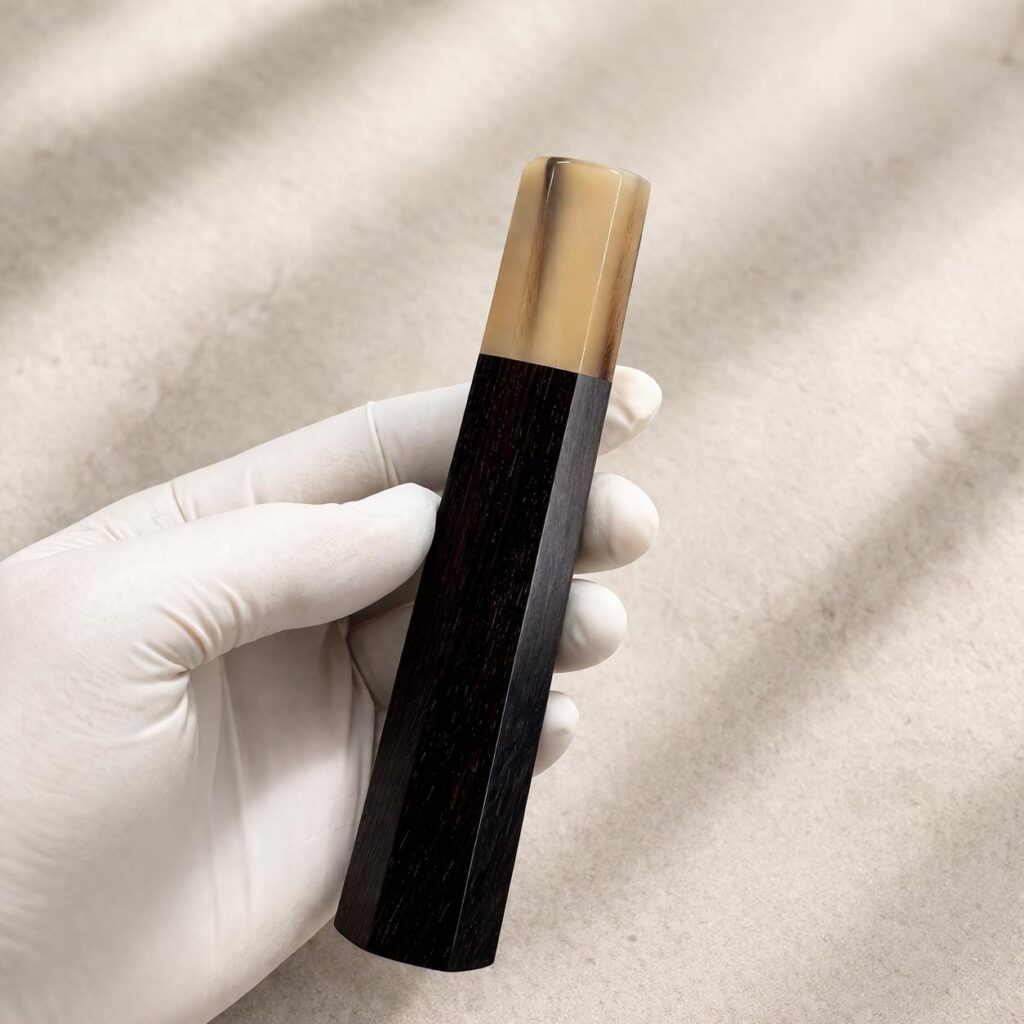
African blackwood offers a dark option for a made-to-order wa handle, but the wood name alone does not predict the finished handle’s weight or the knife’s balance. Handle dimensions, the particular blank, ferrule and end-cap choices, bore depth, blade geometry, and tang construction all matter. Choose it for its appearance and the complete build rather than for a guaranteed handling change.
What can density tell you about the finished handle?
African blackwood is a dense handle wood, but general reference values do not establish the mass of a particular handle. The actual blank, handle length and cross-section, ferrule, spacers or end cap, and bore all affect the finished result.
The installed knife’s balance also depends on the blade and tang. Two handles sold under the same wood name can differ, so a common name is not enough to promise a planted feel or a particular shift toward the hand.
Balance preference is personal, and there is no universally correct balance point. Consider the complete build rather than treating wood density as a performance score or a reliable prediction of where the finished knife will balance.
How should African blackwood be matched to a knife?
African blackwood can work on a gyuto, santoku, nakiri, petty, slicer, or other knife when the handle is sized and fitted for that blade. Knife category or blade length alone does not establish how the completed knife will balance.
For a compact or larger knife alike, consider the proposed handle dimensions and construction together with the blade and tang. Do not assume that African blackwood will make every small knife handle-heavy or that every large blade needs it as a counterweight.
Handle size still matters alongside material. Our size guide explains the usual relationship between knife type, blade length, and handle tier, but treat it as a starting point rather than a promise of one particular balance.
What does African blackwood look and feel like day to day?
African blackwood is chosen for its dark appearance, but the exact color and grain vary from blank to blank. Expect natural variation rather than one guaranteed shade or grain pattern.
The named product is hand-shaped and polished to a near-mirror finish, with a white buffalo horn ferrule contrasting against the dark body. Wood and horn are natural materials, so the exact shade and markings can vary.
Care is simple: hand-wash the knife, dry the blade and handle promptly, and never leave it soaking.
Where does it sit among our other dark, dense woods?
African blackwood is Dalbergia melanoxylon, while ebony refers to woods in the Diospyros genus; they are not the same wood. Both can be dark and dense, but neither common name fixes a finished handle’s weight, balance, or exact appearance. Our ebony vs African blackwood comparison explains the distinction, and the wood guide places them among the broader handle choices we offer.
How does buying a made-to-order blackwood handle work?
We make each handle to order rather than holding finished stock. The African blackwood body is paired with a white buffalo horn ferrule and can be shaped in an octagonal, oval, D-shape, or round profile. Each one is hand-shaped and polished to a near-mirror finish.
On the product page, the size recommender uses your knife type and blade length to suggest a starting size tier. Measurements and photos are optional before purchase; after payment, the order page remains open for additions or corrections until bench work starts.
We review each knife before work starts. If the handle is secure, leave it installed: height and thickness at the visible junction and clear ruler photos are useful partial evidence, not hidden tang dimensions. If the tang is already exposed, the three primary measurements are usable length from the shoulder or seating line to the tip, height near the shoulder, and face-to-face thickness at the same station, all in millimetres. Maker, model, blade length, handle length, and wider knife photos are optional context. For an eligible knife, a deliberately small starter socket filed to fit by you is another after-payment route; single-bevel knives, deba, honesuki, usuba, and yanagiba need hand review.
African blackwood also appears in our custom configurator’s wood list if you want to combine it with a different ferrule or other made-to-order choices.
Choose African blackwood for its dark appearance and the design of the complete build, not for a guaranteed handle weight or balance shift. You can start with the African blackwood and white buffalo horn handle, then use the fit workflow for your individual knife.