A buffalo horn ferrule is the collar at the blade end of a wa handle. It surrounds the tang opening and forms the front transition between the wooden handle body and the knife. In one documented traditional Sakai construction method, that collar also helps prevent the wooden portion from cracking while a heated tang is inserted. It does not, by itself, prove that a finished handle is waterproof, correctly fitted, or built for a particular service life.

The documented role in traditional construction
Takahashi Kusu’s description of the Sakai knife-making process identifies the kuchiwa, or collar, as the part that prevents the wooden handle from cracking when the heated tang is inserted. It calls a buffalo-horn version tsunomaki. This gives the ferrule a specific construction role: supporting the front of the wooden handle during that traditional fitting process.
That account should not be turned into a universal explanation of every wa handle. Modern custom handles may use different bores, fitting sequences and attachment methods, and it is not a recommendation to heat or remove a handle at home. A contemporary example from Hitohira/Taihei shows horn and wood worked as separate solid parts and emphasizes fitting them according to their individual material. Its workmanship and durability statements apply to those maker-specific handles, not to every horn ferrule.
What the ferrule changes on a finished handle
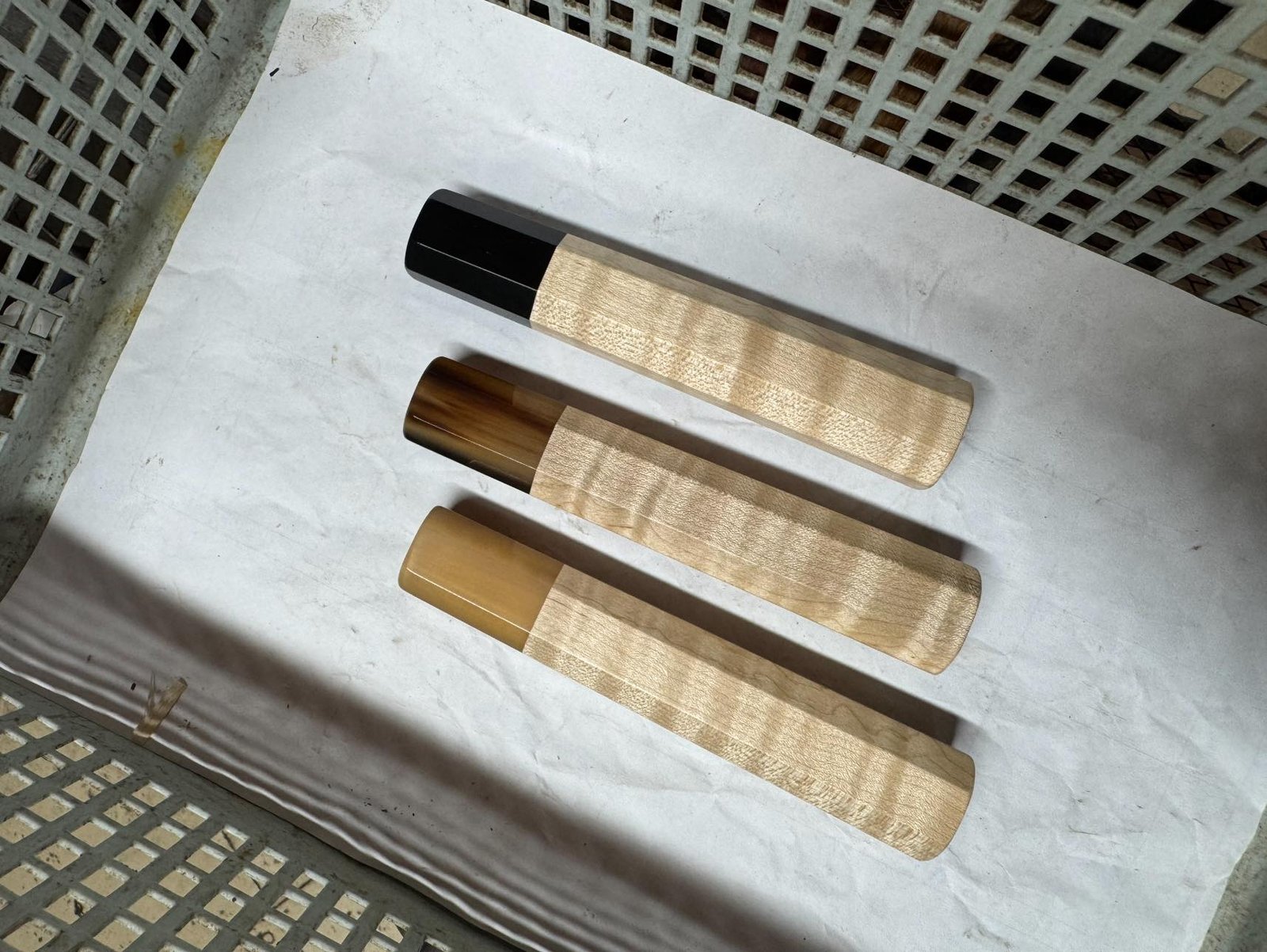
The ferrule creates the first visible transition from blade to handle body. Its colour can blend with the wood, contrast with it, or connect several tones in figured material. It can also provide a smooth surface near a pinch grip. Those visual and tactile effects remain separate from the quality of the joint.
Inspect the transition from every face. The ferrule and wood should meet cleanly, without an unintended sharp step, spreading crack or newly opened seam. The tang opening and blade alignment also require their own checks. Attractive horn cannot correct a misplaced bore, an oversized handle or a poorly seated tang.
Planning a replacement handle?
Compare available combinations in the handle configurator, review available handles, and consult the current ordering guide for the fit information appropriate to your knife.
Colour is not a strength grade
Buffalo horn naturally varies in colour and pattern. Korin’s traditional-handle catalogue documents water-buffalo horn used as the bolster on magnolia handles and notes natural colour variation. Black, blonde, brown and marbled appearances are therefore visual descriptions, not rankings of strength, fit or longevity. When exact appearance matters, assess the actual piece and how its pattern meets the handle faces.
What horn does not prove
- Waterproofing: a horn collar does not make the tang opening soak-proof or dishwasher-safe.
- Correct fit: the bore, tang, intended seating position and blade alignment still have to match.
- Service life: material choice alone cannot predict workmanship, use conditions or future maintenance needs.
- Superior strength by colour: a darker, lighter or more unusual pattern is not evidence of better performance.
- A particular attachment method: visible horn does not reveal whether or how the hidden tang was burned in, bonded or otherwise fitted.
Care and inspection limits
Wipe the handle after use, dry the blade-side transition promptly, and avoid soaking, dishwashers and direct heat. Do not force oil, wax or adhesive into the tang opening as routine maintenance. Dry-looking wood alone does not show that a particular treatment is compatible; follow the maker’s finish instructions.
Check a new gap, crack, movement or persistent moisture mark before continuing normal use. If the construction or attachment is uncertain, ask the maker or a qualified fitter rather than trying an unverified removal, heating or bonding method.
Fit information for a replacement
Leave a secure existing handle installed; it should not be removed merely to obtain hidden tang measurements. Photographs and visible junction height and face-to-face thickness can provide partial evidence, but they are not the hidden tang dimensions. Consult the current ordering guide for the information needed at the enquiry stage.
If the tang is already exposed and dimensions are requested, provide exactly three primary measurements in millimetres: usable length from the shoulder or seating line to the tip, height near the shoulder, and face-to-face thickness at that same station. Blade type, blade length, maker/model and wider photographs can be supplied as optional context.
Where to compare the broader options
Use the custom handle configurator or browse the made-to-order handle collection when planning a build. For broader material and design choices, continue to the maintained ferrule materials and colours guide and the wa handle woods guide.
The useful conclusion is narrow: in documented traditional Sakai fitting, the collar helps protect the wooden front from cracking during tang insertion. On a finished knife, buffalo horn also supplies a distinct visual and tactile transition. Neither role replaces careful fitting, sound workmanship, appropriate care or inspection of the actual joint.