A wa handle ferrule is the front section where the wooden body meets the blade and tang opening. It frames the handle visually, but its practical value comes from a clean transition, accurate bore, stable fit, and a surface that is comfortable in a pinch grip. Choose ferrule material and color together with the wood, handle shape, and knife measurements.
Ferrule options at a glance
| Option | Visual effect | Best reason to choose it | What to check |
|---|---|---|---|
| Black buffalo horn | Dark, quiet, and continuous | Blend with ebony, African blackwood, wenge, or dark rosewood | Surface, color, and the transition to the body |
| White buffalo horn | Bright contrast | Create a clear break against a dark body | Natural color variation shown in the actual piece |
| Marbled buffalo horn | Mixed cream, grey, brown, or black movement | Echo several tones in figured wood | Pattern placement and how it meets each handle face |
| Wood ferrule or mono-wood front | Minimal and continuous | Keep attention on one wood and clean geometry | Precise bore, front-wall strength, and finish |
| Spacer or ferrule ring | A narrow accent line | Separate similar colors or repeat a blade/wood tone | Ring thickness, alignment, and whether it improves rather than crowds the design |
What a ferrule actually does
The ferrule surrounds the front of the handle and helps form the transition around the tang opening. It is not a guarantee against water, a replacement for correct installation, or permission to soak the knife. A good ferrule is accurately fitted to the handle body, has a clean and comfortable joint, and leaves enough material around the tang opening for the intended build.
The bore and final handle dimensions must follow the knife. A decorative ferrule cannot correct an oversized handle, a poorly positioned tang, or an installation gap.
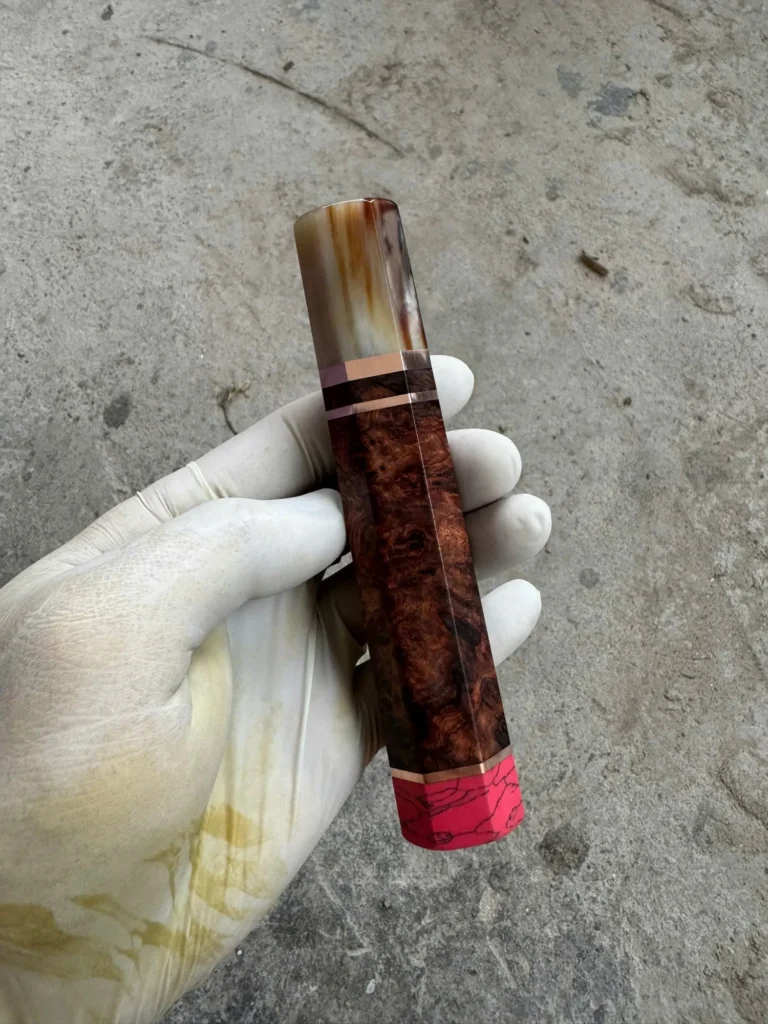
Buffalo horn: natural variation is part of the material
Buffalo horn is a natural material, so black, white, and marbled categories describe a range rather than a paint code. Black horn may show faint lighter lines. White horn can move from cream to honey or grey. Marbled pieces may be quiet on one face and more active on another. Ask to see the actual handle when a precise color match matters.
Horn can take a smooth polish, which makes it useful at the pinch-grip end of an octagonal handle. Comfort still depends on the transition and corner treatment. A visible glue line, sharp step, or uneven face is a workmanship issue, not a normal consequence of using horn.
Choosing the color relationship
Blend
Use black horn with African blackwood, ebony, wenge, or a dark rosewood when you want the body and ferrule to read as one restrained form. The grain appears gradually rather than being interrupted by a bright front section.
Contrast
Use white horn against a dark body when the ferrule should be a clear design feature. This can visually shorten a long dark handle and highlight the octagonal geometry. On pale curly maple, black horn creates the opposite contrast and gives the front of the handle a strong boundary.
Connect
Marbled horn can connect several tones in rosewood, zebrawood, walnut, or figured maple. Because the pattern is variable, review it face by face. The best pairing usually repeats one or two colors from the body instead of competing with every grain line.
Ferrule rings and spacers
A thin ring can separate materials with similar value, repeat a warm or cool accent, or make a transition more intentional. More rings are not automatically more premium. On a small petty handle, several accents can consume too much visual space. On a larger gyuto or slicer, a restrained ring can be easier to proportion.
Specify the ring thickness and material during design. The ring should remain aligned across every face of an octagonal handle, and the finished joint should feel continuous under a fingertip.
Front ferrule, rear end cap, and horn at both ends
The ferrule is the front section around the tang opening; a rear end cap is material at the butt of the handle. A build can use horn in either position or both. In one documented example, a maker explicitly identifies both a marble-horn ferrule and an end cap, showing that the terms describe separate positions (Boogwa product specification). If you request “double horn,” specify horn at the front and rear, the intended colour relationship, any spacers, and the relative proportions. The phrase does not guarantee one standard layout.
How rear material changes feel
Material at the rear affects mass distribution. Because the balance point depends on mass and its location, adding rear mass can move it toward the hand while also making the complete knife heavier, following the general centre-of-mass principle. It does not make the knife lighter or guarantee comfort. Use the handle weight and balance guide to decide whether a rearward change is wanted.
Choose from the actual colours
Brown belongs within horn’s natural colour variation; it is not, by itself, a stronger grade or a promise of a separate option. Approve the actual piece when exact tone or pattern matters. For any named wood, compare the body’s light or dark value, warm or cool cast, and grain activity. Then choose a ferrule that blends, contrasts, or connects those traits, and consider how its pattern meets each handle face.
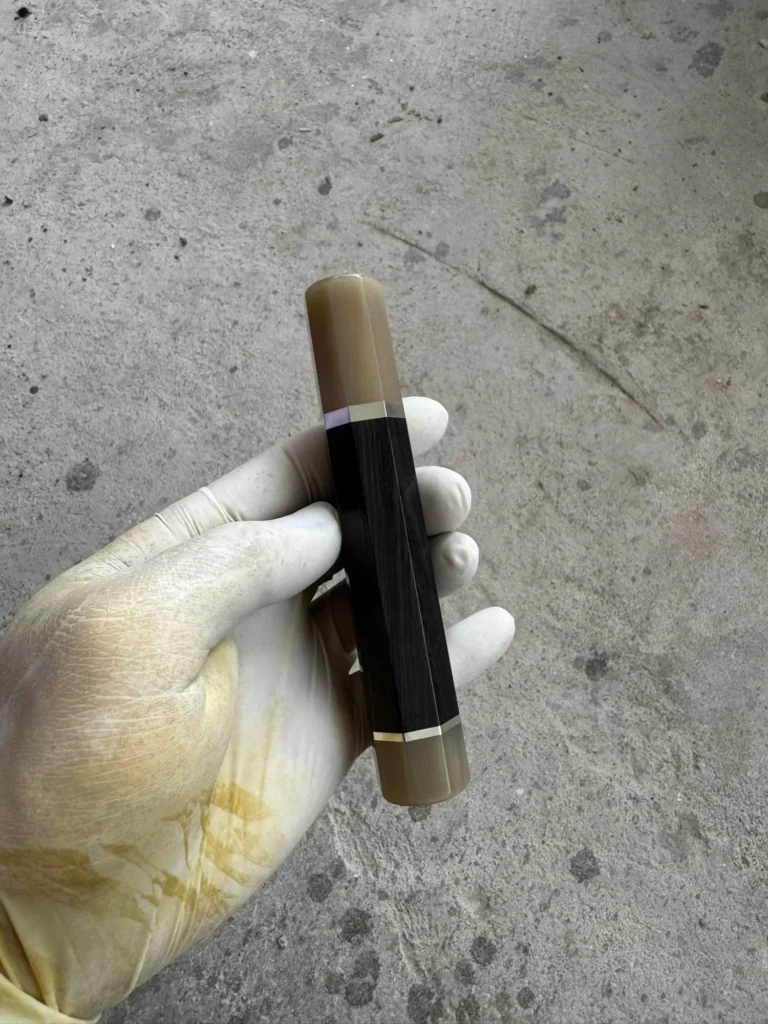
Match the ferrule to the knife and handle size
The front cross-section, tang opening, and overall handle length should follow the knife. If its handle is secure, leave it installed; clear photographs plus visible junction height and face-to-face thickness provide partial fit evidence, not hidden tang dimensions. If the tang is already exposed, provide exactly three primary measurements in millimetres: usable length from the shoulder or seating line to the tip; height near the shoulder; and face-to-face thickness at the same station. Blade type and length, handle length, and maker/model are optional context rather than substitutes for those measurements. Read the wa handle size and fit guide before choosing a large ferrule or multi-ring build.
For a compact petty, a simple ferrule often keeps the proportions calm. A 210 mm or 240 mm gyuto provides more visual room, but the build still needs to preserve comfortable pinch-grip clearance. Heavy-looking materials do not require an oversized handle.
Care at the ferrule and tang opening
- Wipe the handle after use and dry the front transition promptly.
- Do not soak the knife or put it in a dishwasher.
- Do not force oil, wax, or glue into the tang opening as routine maintenance.
- Inspect a new gap, movement, crack, or persistent moisture mark before continuing to use the knife.
- Follow the maker’s finish instructions; horn and wood may not need the same treatment.
See the care guide and installation guide for the full workflow.
How to specify a custom ferrule
- If the handle is secure, leave it installed and send clear photographs plus visible junction height and face-to-face thickness as partial fit evidence. If the tang is already exposed, send exactly three primary measurements in millimetres: usable length from the shoulder or seating line to the tip; height near the shoulder; and face-to-face thickness at the same station. Blade type and length, handle length, and maker/model may be added as optional context.
- Choose whether the ferrule should blend, contrast, or connect the body colors.
- Choose black, white, marbled, wood, or mono construction from actual available material.
- State whether you want a spacer and approve its thickness.
- Confirm the final handle dimensions and fit plan before work begins.
Use the Horn and Grain configurator to compare the available combinations. Custom handles are reviewed against the submitted knife and tang information before production.
Frequently asked questions
Is a horn ferrule waterproof?
No ferrule makes a wooden wa handle dishwasher-safe or soak-proof. Correct fit, finish, installation, and prompt drying work together.
Is black or white horn more durable?
Color alone is not a useful durability ranking. Evaluate the actual material, wall thickness around the bore, fit, transition, and workmanship.
Can I choose the exact marbling?
When individual pieces are available, photographs are the best way to approve pattern and face orientation. Natural material cannot be matched like a printed color.
Do I need a ferrule ring?
No. A ring is a design choice. Use it when it improves separation and proportion, not simply to add another material.