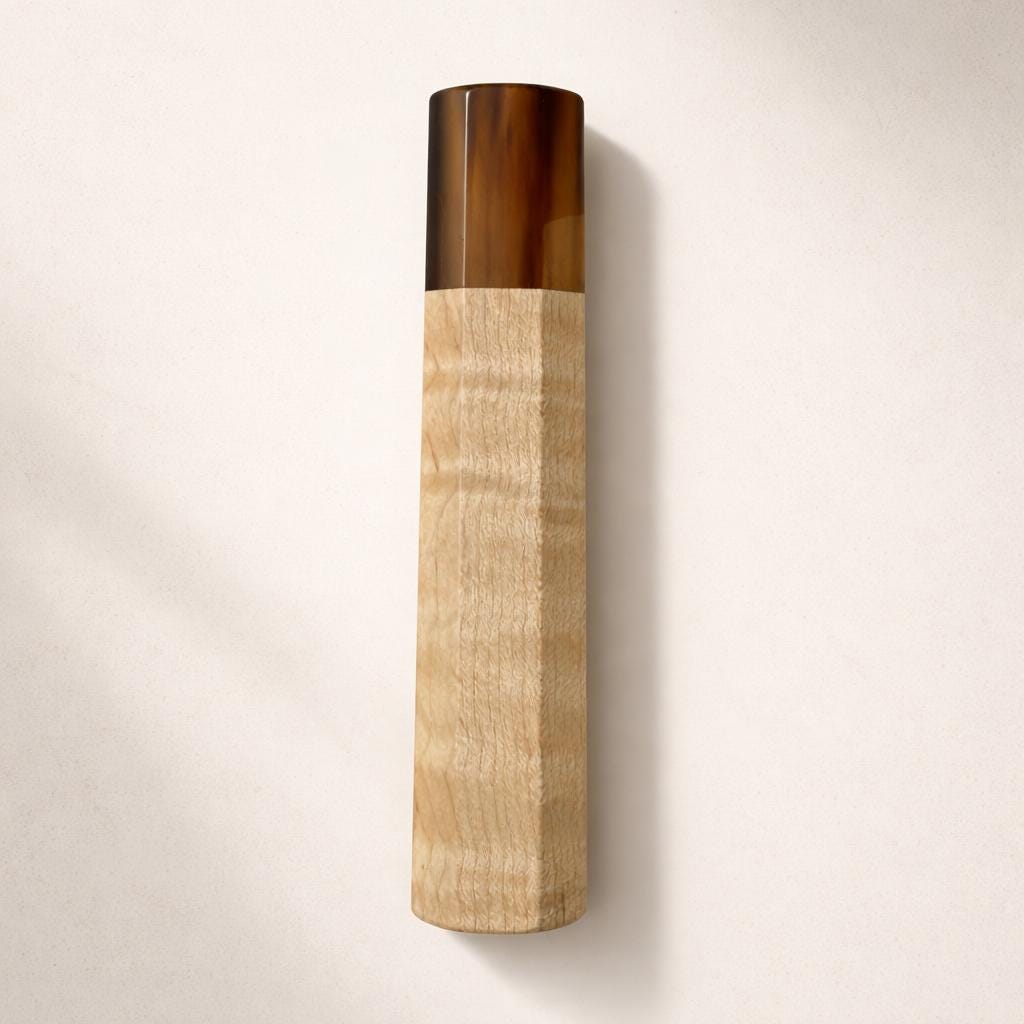
Curly maple is chosen for its pale color and shifting figure, but the name alone is not a strength grade. It does not by itself identify the Acer species, establish that every piece is hard maple, or document the strength or soundness of an individual blank. Finished weight, installed balance, and appearance over time depend on the actual piece, dimensions, construction, finish, and knife.
What causes the curl?
Curly maple’s shimmer comes from waves in the direction of the grain. In Understanding Wood, wood technologist R. Bruce Hoadley describes curly figure as the visual effect produced when undulating grain reflects light differently across the surface.
That shifting reflection is called chatoyance. Turn the handle in your hand and light moves across the grain, making the figure appear three-dimensional. It can look like ripples beneath the surface even though the wood is smooth.
Those waves are part of the figure, but they are not enough to certify the condition or suitability of a particular blank. The finished handle remains wood: do not soak it, put it in a dishwasher, or leave it wet on the counter. Wipe it clean and let it dry normally.
What does “hand-selected for figure” mean?
We select curly maple for the intensity of its chatoyant shimmer. That is a promise of visible, shifting figure—not a promise that every handle will reproduce one particular photograph or ripple pattern.
One piece may show broad, softly rolling bands. Another may have tighter lines or a more irregular movement. The apparent depth can also change with the angle and lighting. These differences are part of figured wood rather than flaws to be standardized away.
Each handle has a curly maple body paired with a black, white, or marbled buffalo horn ferrule. A black ferrule gives the pale, moving grain a clean dark edge without competing with it. Because every handle is made to order, the piece you receive will have its own figure rather than being selected from finished stock.
What determines finished weight and balance?
The wood name alone does not determine a finished handle’s weight or the knife’s installed balance. The actual blank, handle length and cross-section, ferrule or end cap, bore and tang, and the blade’s geometry all contribute.
For that reason, curly maple is not automatically a match for a petty, gyuto, honesuki, or any other knife type. Size and construction need to be matched to the individual blade and to the feel you prefer. Our size guide explains how handle size and blade dimensions work together.
Choose curly maple for its pale color and moving figure, then evaluate weight and balance from the complete build. A darker or denser wood name alone does not guarantee a more rear-weighted result, just as curly maple does not guarantee a particular final mass or a neutral feel.
How does pale curly maple live in a kitchen?
New curly maple is pale and warm, with a brightness that dark woods cannot provide. It looks especially clear beside a dark blade or black finish, while the buffalo horn ferrule creates a strong transition at the front of the handle.
Its appearance may change with time and use, but the direction and degree of that change are not fixed. The individual piece, finish, and care all matter, so an amber patina or deeper-looking curl should not be promised for every handle.
A pale handle may show surface changes more readily than a very dark one, but no exact aging pattern is guaranteed. Before applying oil or conditioner, identify the finish and follow the maker’s guidance. Condition—not a weekly or monthly schedule—should determine whether a compatible product is needed.
Who is curly maple for?
Curly maple is often a comfortable first custom handle. It offers pronounced figure at our Standard price point, so the reason to choose it can be straightforward: you want shimmer, a pale wood, and clear contrast against the blade. Our guide to the best entry-level handle woods places that price point in context.
For a gift, curly maple offers visible movement in a pale wood without assuming that the recipient wants a particular finished weight or balance. No two pieces have the same exact pattern, and the apparent depth of the figure can vary with the piece, angle, and lighting.
If you are comparing maple with other visual or construction choices, our wood guide offers a broader comparison. Curly maple makes the most sense when its brightness and shifting figure are the attraction; the finished weight and installed balance still need to be assessed from the complete build.
How buying works
Every curly maple handle is made to order. The product page can use your knife type and blade length to suggest a size tier, but measurements and photos are optional before purchase. After payment, you can add or correct them on the order page until bench work starts. Keep a secure handle installed: measurements at the visible junction are useful partial evidence, not hidden tang dimensions. If the tang is already exposed, the three primary measurements are its usable length from the shoulder or seating line to the tip, height near the shoulder, and face-to-face thickness at that same station, all in millimetres. An eligible knife can use a deliberately small starter socket, filed to fit by the owner; if no measurements or photos are received within three days after payment, the order follows that route. Single-bevel knives, deba, honesuki, usuba, and yanagiba require hand review.
You can choose an octagonal, oval, D-shape, or round profile. Each handle is built with a hand-selected curly maple body and a black, white, or marbled buffalo horn ferrule, then hand-shaped and hand-finished. Curly maple is also available within our custom configurator if you want to combine it with other available choices.
The result is a made-to-order wooden handle centered on pale color and shifting figure. Its final mass, balance, and aging cannot be inferred from the wood name alone; they depend on the individual piece, construction, finish, and knife. If that visual character is what you want, you can order the curly maple handle.