Wa handle dimensions by knife type
These handle lengths are starting ranges, confirmed against the customer’s own knife before the build begins.
| Knife type | Starting handle length | Feel and proportion |
|---|---|---|
| Petty / utility | 105–115mm | A petty handle stays slim and light, a little under 20mm across the front and growing slightly toward the butt. |
| Santoku / nakiri / bunka | 115–125mm | These handles stay comfortable and moderate, with a gentle taper and no unnecessary rear bulk. |
| Gyuto | 125–135mm | A gyuto handle feels balanced and substantial enough for an all-purpose pinch grip without becoming bulky. |
| Gyuto / sujihiki | 130–145mm | Longer blades can take more handle presence, with proportion and rear weight adjusted to the blade. |
| Deba | 125–150mm | We review deba individually by blade weight and task rather than auto-assigning a tier; a heavy 165–180mm deba can need more handle than its length suggests. |
| Yanagiba | 125–135mm for Chef; 140–150mm+ for Long | Yanagiba follows blade length: 240–255mm takes Chef, while 256–360mm takes Long. |
We confirm cross-sections through supplied evidence, the owner’s review or an eligible starter socket, publishing feel and proportion rather than fixed width and height figures.
Find your size
For knives covered by the automatic recommender, tell us your knife type and blade length — that is the whole sizing decision.
On Horn & Grain product pages, enter those two details and the size recommender picks the handle tier for you automatically. You do not need to work out whether your knife is “small,” “medium,” or “large” first.
This page shows the exact rule behind that recommendation. Use it if you want to check why a size was selected, or if you are researching the right handle size before you start shopping.
| Knife type | Blade length | Recommended size |
|---|---|---|
| Petty / utility | 105–155mm | Compact · petty, small utility |
| Petty / utility | 156–185mm | Mid-size · santoku, bunka, nakiri |
| Santoku | 150–190mm | Mid-size · santoku, bunka, nakiri |
| Bunka | 150–200mm | Mid-size · santoku, bunka, nakiri |
| Nakiri | 150–190mm | Mid-size · santoku, bunka, nakiri |
| Gyuto | 150–195mm | Mid-size · santoku, bunka, nakiri |
| Gyuto | 196–255mm | Chef · gyuto, kiritsuke |
| Gyuto | 256–285mm | Long · sujihiki, yanagiba |
| Kiritsuke, double bevel | Same bands as gyuto | Same size as gyuto |
| Sujihiki | 210–255mm | Chef · gyuto, kiritsuke |
| Sujihiki | 256–360mm | Long · sujihiki, yanagiba |
| Yanagiba | 240–255mm | Chef · gyuto, kiritsuke |
| Yanagiba | 256–360mm | Long · sujihiki, yanagiba |
The knife names in each size label describe that tier’s most typical home. They are not a complete list of every knife that can land there.
That matters most with gyuto. A ~180mm gyuto rides with the santokus on Mid-size · santoku, bunka, nakiri . From ~200mm, a gyuto takes Chef · gyuto, kiritsuke .
The same principle applies to long slicers. A 240mm yanagiba sits on Chef · gyuto, kiritsuke . From ~270mm, both yanagiba and sujihiki take Long · sujihiki, yanagiba .
Knives we fit individually
A petty under ~105mm, or a deba, honesuki, usuba or single-bevel kiritsuke at any length, is fitted individually by hand by the owner after checkout rather than auto-sized.
The same applies when the knife type is “other,” “not sure,” or its blade length falls outside the ranges above.
This is a normal fit path. You can still order the handle; measurements and photos are optional before buying, and the owner’s individual fitting replaces the automatic size recommendation.
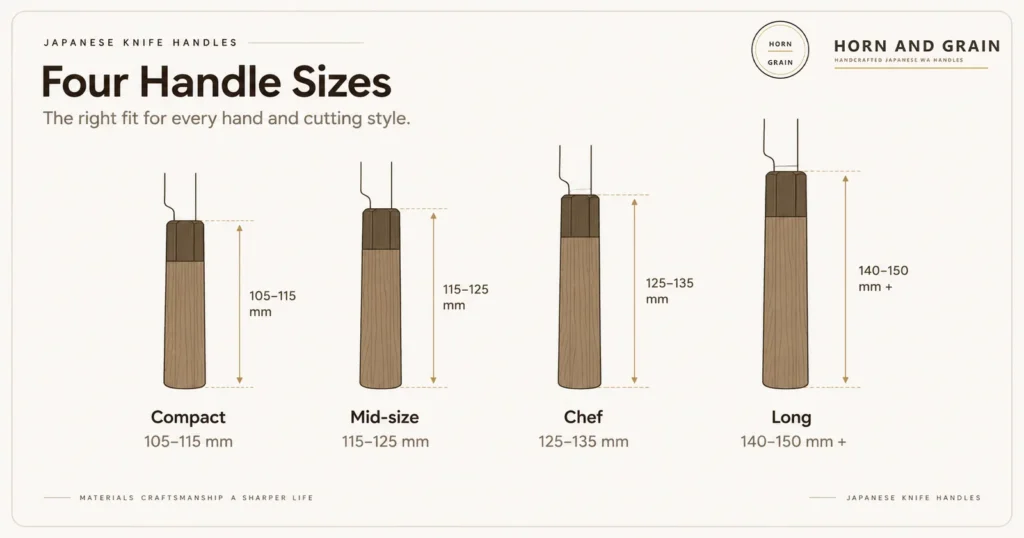
What the four sizes mean in the hand
| Size | Typical handle length |
|---|---|
| Compact · petty, small utility | ≈ 105–115mm |
| Mid-size · santoku, bunka, nakiri | ≈ 115–125mm; small-gyuto builds often run ~125–130mm |
| Chef · gyuto, kiritsuke | ≈ 125–135mm |
| Long · sujihiki, yanagiba | ≈ 140–150mm+ |
These are starting ranges, not ceilings.
Landing in a size tier does not lock the knife to one exact handle length. Blade weight, grind, tang, handle material and the balance you want can all move the final dimensions within or slightly beyond the typical range.
The size tier gives the starting proportion. The actual knife still decides the final build.
Blade length versus handle length
If you want to look beyond the four recommendation tiers, blade length gives a useful finer-grained starting point:
| Blade length | Starting handle length | Use this range when |
|---|---|---|
| 120–150mm | 105–115mm | The knife is a petty, utility, paring or small prep knife where agility matters most. |
| 165–180mm | 115–125mm | The knife is a santoku, nakiri, bunka or mid-size all-purpose blade. |
| 210mm | 125–135mm | The knife is a gyuto or workhorse chef knife used with a pinch grip. |
| 240mm | 130–145mm | The knife is a longer gyuto or slicer where rear balance and leverage matter more. |
| 270mm and longer | 140–150mm+ | The knife is a long sujihiki, yanagiba or specialty blade and needs task-specific balance checks. |
Handle length is not a strict ratio. Two knives with the same edge length can differ in blade thickness, tang, grind and weight. Material also shifts balance: a dense handle and a lighter handle of the same dimensions will not feel identical on the same blade.
How to measure a Japanese wa handle
Measuring the tang itself? Step-by-step: how to measure a knife tang →
For most knives covered by the recommender, knife type and blade length are enough to determine the starting size tier .
Measurements become useful when you want to compare the existing handle, check the outside proportions more closely, or when the knife is being fitted individually.
- Handle length: measure from the ferrule face to the butt end.
- Ferrule width and ferrule height: measure the front of the handle where it meets the blade.
- Butt width and butt height: measure the back of the handle; many wa handles taper wider and taller toward the butt.
- Mid-handle feel: note whether the handle feels slim, tall, round or palm-filling where your last fingers rest.
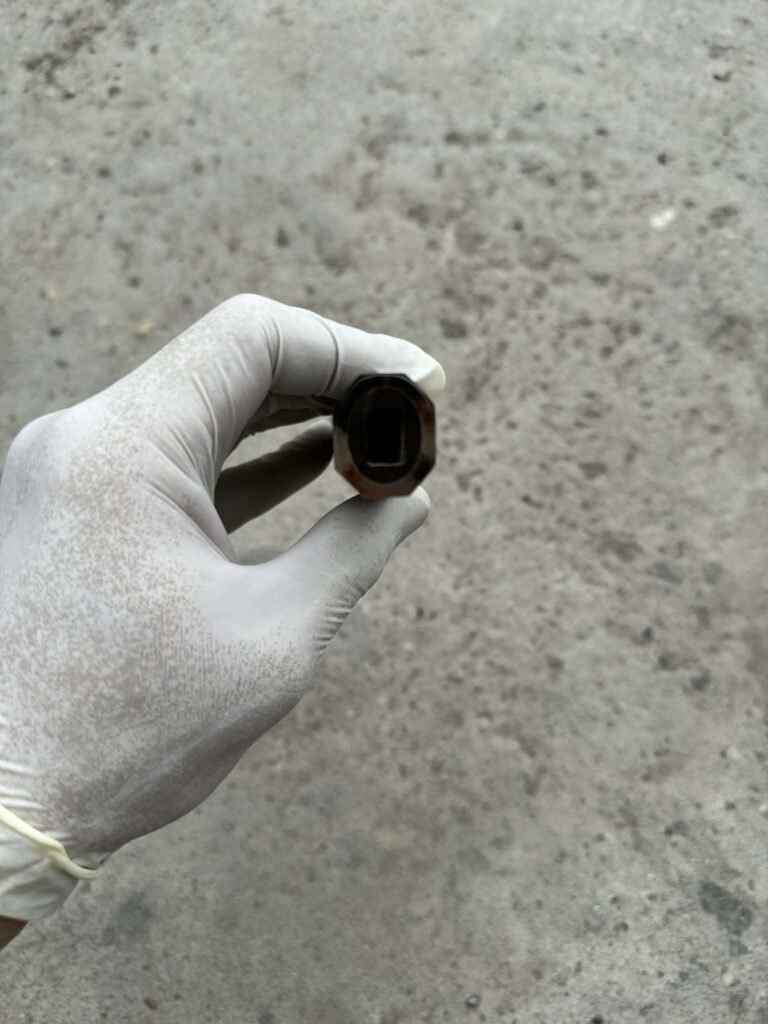
- Tang fit: if the tang is already exposed, record three measurements in millimetres: usable length from the shoulder/seating line to the tip, height near the shoulder, and face-to-face thickness at the same station.
For replacement handles, outside dimensions are only half the job. A handle can look correctly proportioned and still need a different internal fit, installation depth or ferrule fit.
If the current handle is still installed, measure what you can rather than guessing what is hidden inside.
Tang fit and installation depth
Already fitted, and the tang has worked loose? How to correct a loose tang at home →
The automatic recommender chooses the external handle size from knife type and blade length. That does not mean every Japanese knife of that type has an identical tang.
Tang dimensions vary by maker and knife design.
For an individually fitted handle, an already exposed tang provides three primary measurements in millimetres: usable length from the shoulder/seating line to the tip, height near the shoulder, and face-to-face thickness at the same station. Current handle length and notes about looseness or previous repair can provide additional context. Installation depth also affects strength and balance, especially when the tang is thick, tapered or offset from the blade centerline.
If the current handle is still securely installed, leave it in place; height and thickness at the visible junction are useful partial fit evidence, not hidden tang dimensions. Clear photos can help when measuring is impractical. If the tang is already exposed, record three primary measurements in millimetres: usable length from the shoulder/seating line to the tip, height near the shoulder, and face-to-face thickness at the same station.
The aim is to fit the actual knife rather than an average version of its category.
Shape changes how the same dimensions feel
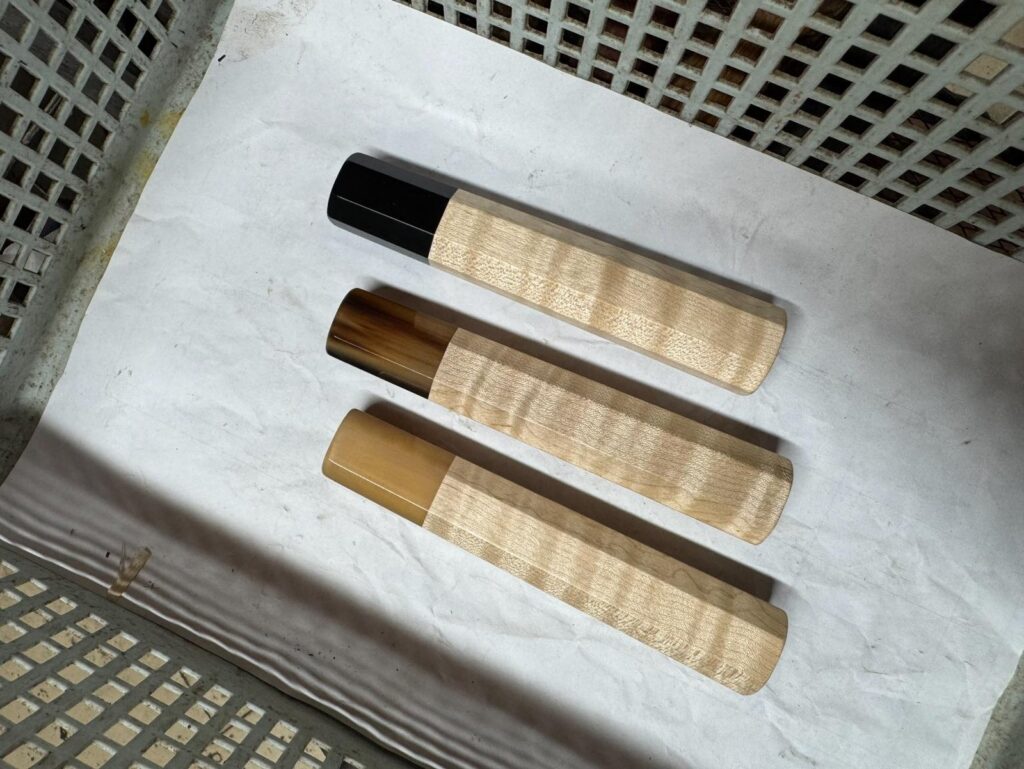
| Handle shape | Dimension note | Best-fit reason |
|---|---|---|
| Octagonal | Measure width and height across the flats; the facets can make the same dimensions feel more precise and indexed. | Strong edge orientation, secure pinch grip and clear control. |
| Oval | The same length can feel fuller because pressure is spread across a softer curve. | Comfort during longer prep and an easy all-purpose grip. |
| D-shape | Check handedness before sizing; the palm index changes how thick the handle feels. | Directional control for single-bevel knives or cooks who prefer a fixed reference point. |
| Round or shield | Round handles need diameter checks; shield handles need top and bottom width checks. | Useful when you want an ambidextrous feel with either soft rotation or gentle indexing. |
Do not choose a larger handle simply because it looks more substantial. The same cross-section that feels steady on a large gyuto can feel bulky on a petty.
Balance and material weight
A larger handle adds rear presence, but material density can change the result as much as the dimensions.
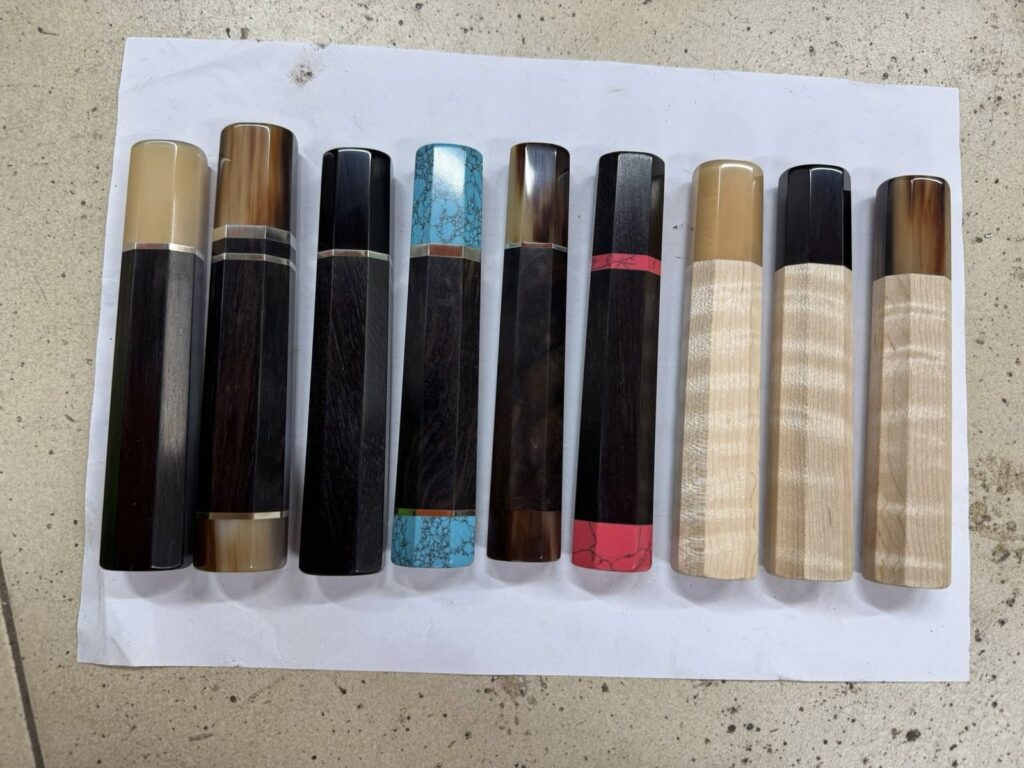
Ebony, African blackwood, desert ironwood and macassar ebony can add more rear weight at a given size. Walnut, maple, cherry, teak and lighter rosewood builds can preserve a more blade-forward feel.
End caps and metal accents also affect rear weight, so size should be settled before using them to fine-tune balance.
For a blade-heavy knife, the useful question is not simply “can the handle be larger?” but how far back you want the balance to move. For a nimble petty, santoku or nakiri, too much handle can make the knife feel slower.
Ordering checklist
Start with the information that identifies the knife:
- knife type and blade length
- brand or model if known
- current handle dimensions if you want to reproduce or change its proportions
- if the tang is already exposed, three measurements in millimetres: usable length from the shoulder/seating line to the tip, height near the shoulder, and face-to-face thickness at the same station
- any balance problem you want the new handle to address
- preferred handle shape
For the fitting process itself, use the installation guide. For the broader custom-order process, see the custom ordering guide. Once size is settled, compare materials in the wood guide or continue in the handle configurator.
Frequently asked questions
What size wa handle fits a 210mm gyuto?
A 210mm gyuto falls in Chef · gyuto, kiritsuke .
A useful handle-length starting range is 125–135mm, comfortably proportioned for an all-purpose pinch grip; we confirm cross-section before building through supplied evidence, owner review or an eligible starter socket.
What size wa handle fits a 240mm gyuto?
A 240mm gyuto also falls in Chef · gyuto, kiritsuke .
For the finer-grained dimensions, a 240mm gyuto often starts around 130–145mm in handle length. A thin blade may need less rear presence than a thicker workhorse even though both receive the same Chef size recommendation.
Are Japanese knife handle dimensions standardized?
No. Wa-handle dimensions and tang fit vary by maker, knife style, design, handle shape and intended balance.
The recommendation table on this page is a sizing system for Horn & Grain handles, not a universal Japanese manufacturing standard.
Why can a gyuto be Mid-size when “gyuto” is written on the Chef label?
The knife names in the labels describe each tier’s most typical use; they are not strict category boundaries.
A ~180mm gyuto is closer in proportion to the knives in Mid-size · santoku, bunka, nakiri , while a ~200mm or longer gyuto moves into Chef · gyuto, kiritsuke .
That is why the recommender uses knife type and blade length together , rather than asking you to choose a label yourself.
Do octagonal and oval handles use the same dimensions?
They can use similar length ranges, but they do not feel identical. Octagonal facets give stronger orientation, while an oval profile spreads pressure across a softer curve.
Can a larger handle fix a blade-heavy knife?
Sometimes, but size is only one lever. Handle length, material density, tang insertion depth and any rear accents all affect balance.
The better target is a handle that gives the knife the control you want, not simply the largest handle that will fit.