How your custom order works
Every handle is made to order. We review every knife before work starts.
- Order Pick a design in the shop or build your own.
- Your knife Knife type now; measurements or photos after payment.
- At the bench 5–10 business days once we have what we need
- Shipping usually 7–15 business days tracking number by email
No measurements or photos? We go ahead with a deliberately small starter socket for your knife type, filed to fit by you. Some knives, like single-bevel ones, need hand review; we email you instead.
Made for your knife. Same-brand knives can differ in length, height and thickness. With your numbers or photos we cut the socket to your knife’s own measurements, not to a standard: less filing, less packing.
Cut to your knife · no change-of-mind returns · faults always covered
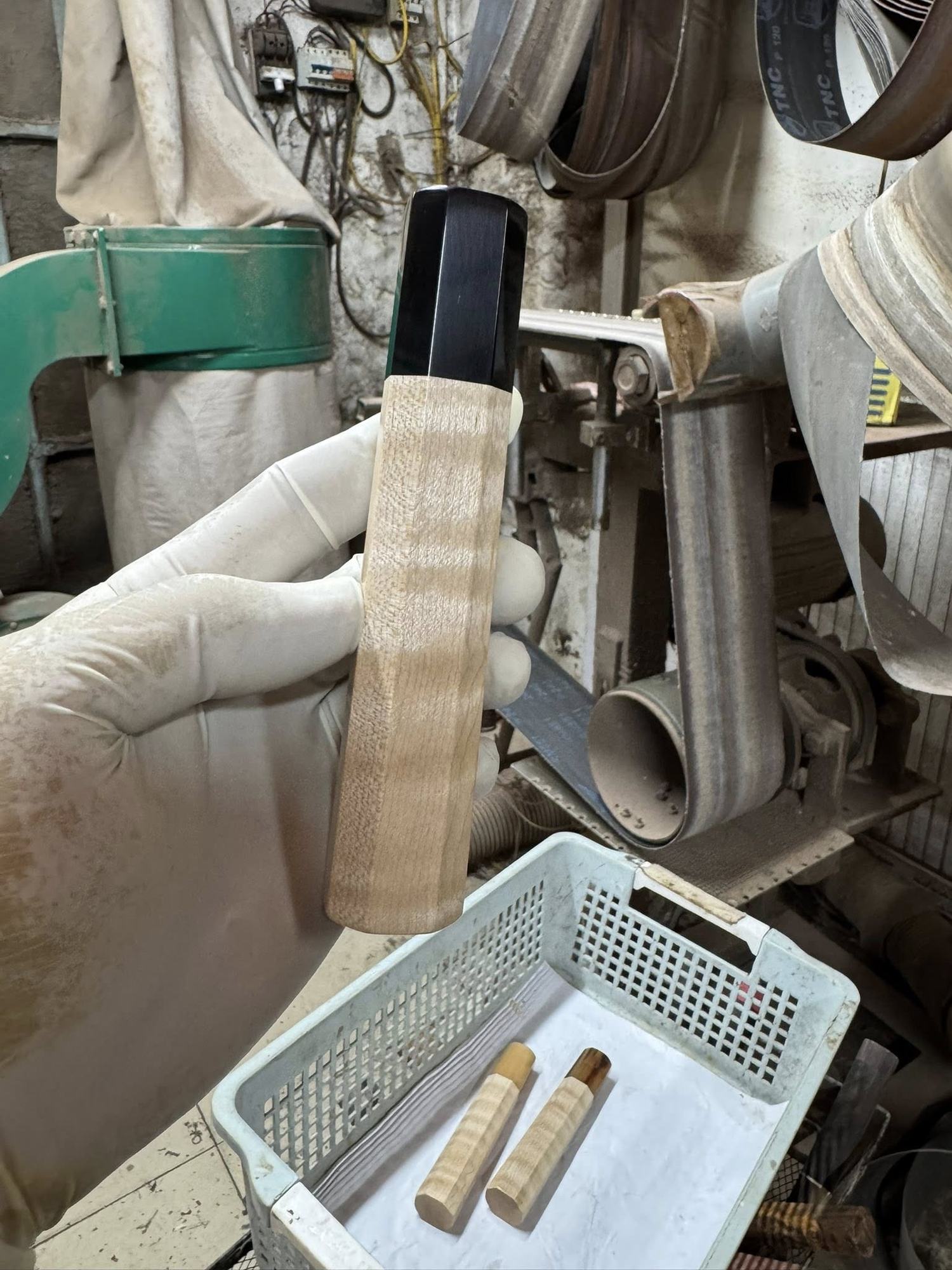
Choose the build direction
- Balance · lighter, neutral, or more rear-balanced
- Shape · octagonal, oval, D-shape, or round
- Wood · dark and formal, warm and natural, pale and clean, strongly figured, or restrained
- Ferrule · black, white, or marbled horn, or an accent build
This order prevents a beautiful material choice from creating the wrong balance.
Useful details for your order page
- Blade type and blade length, such as 210mm gyuto, santoku, nakiri, petty, deba, or sujihiki.
- Current handle length and any balance problem you want to solve.
- Handle still fitted · leave it in place. Measure the visible metal at the blade–handle junction, or send photos with a ruler in frame; we’ll read the numbers.
- Handle already off · three numbers in mm: length from shoulder to tip, height near the shoulder, thickness face to face at the same point.
The measuring guide shows both.
Common ordering mistakes
- Choosing the heaviest wood because it sounds premium.
- Choosing the brightest contrast before checking the blade finish.
- Treating an inspiration photo as proof of tang fit.
- Ignoring care habits when choosing pale, figured, or horn-heavy builds.
Next step
Use the size guide, ferrule guide, and wood guide to narrow your choices. Choose a design from the shop, or select your wood, ferrule and shape in the custom handle configurator.
When the time comes to fit your handle, the installation guide covers that process.