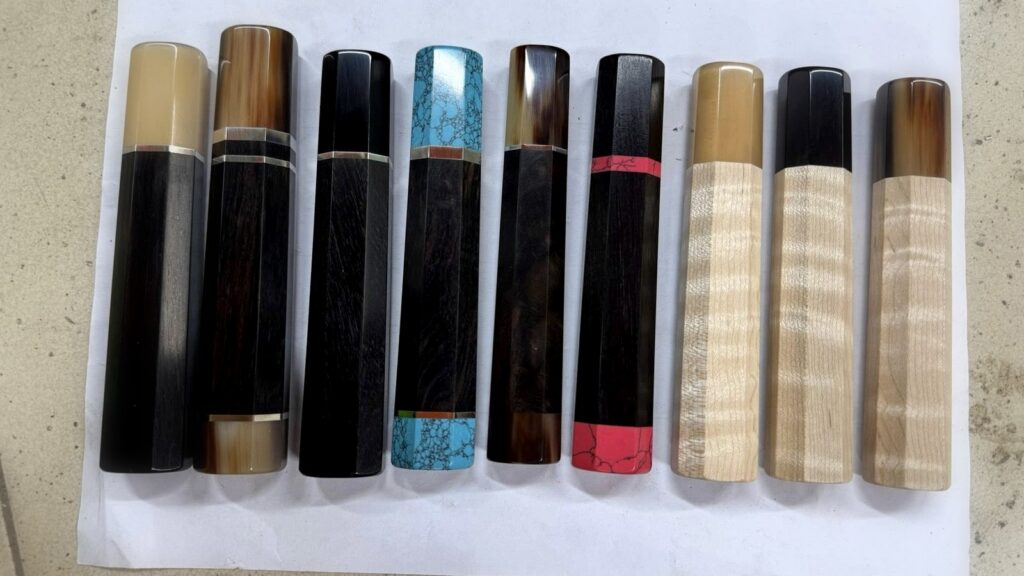
No—African blackwood is not ebony. African blackwood is Dalbergia melanoxylon, a member of the legume family. “Ebony” is a trade and common name used for woods from the Diospyros genus. They can look similarly dark in a finished wa handle, but they are botanically different woods with different grain, color variation, and sourcing questions.
African blackwood vs ebony at a glance
| Question | African blackwood | Ebony |
|---|---|---|
| Botanical identity | Dalbergia melanoxylon | Several Diospyros species; the exact species matters |
| Typical appearance | Very dark brown to black, often with subtle brown or purple grain | Varies by species and board, from near-black to strongly striped |
| Visual character | Dark and understated, with grain that often appears in changing light | Can be uniform and graphic or visibly figured, depending on the ebony |
| Handle feel | Usually substantial and smooth when finely finished | Also substantial; the finished size and individual blank determine the result |
| Best reason to choose it | You want darkness with restrained natural grain | You want the particular color and figure of a clearly identified ebony |
Why the names are often confused
Both woods can finish almost black, and African blackwood has historically been sold under names that include the word “ebony.” Color is not a botanical test. The Royal Botanic Gardens, Kew records African blackwood as the accepted species Dalbergia melanoxylon. Kew places it in Fabaceae, the legume family.
True ebonies belong to Diospyros. That genus contains many species, so “ebony” alone is incomplete buying information. For example, Kew records African ebony as Diospyros crassiflora in Ebenaceae. Macassar ebony and other commercial ebonies are different species again. A useful product description should therefore state the species when it is known instead of treating every dark board as the same material.
How the difference shows up in a wa handle
Color and grain
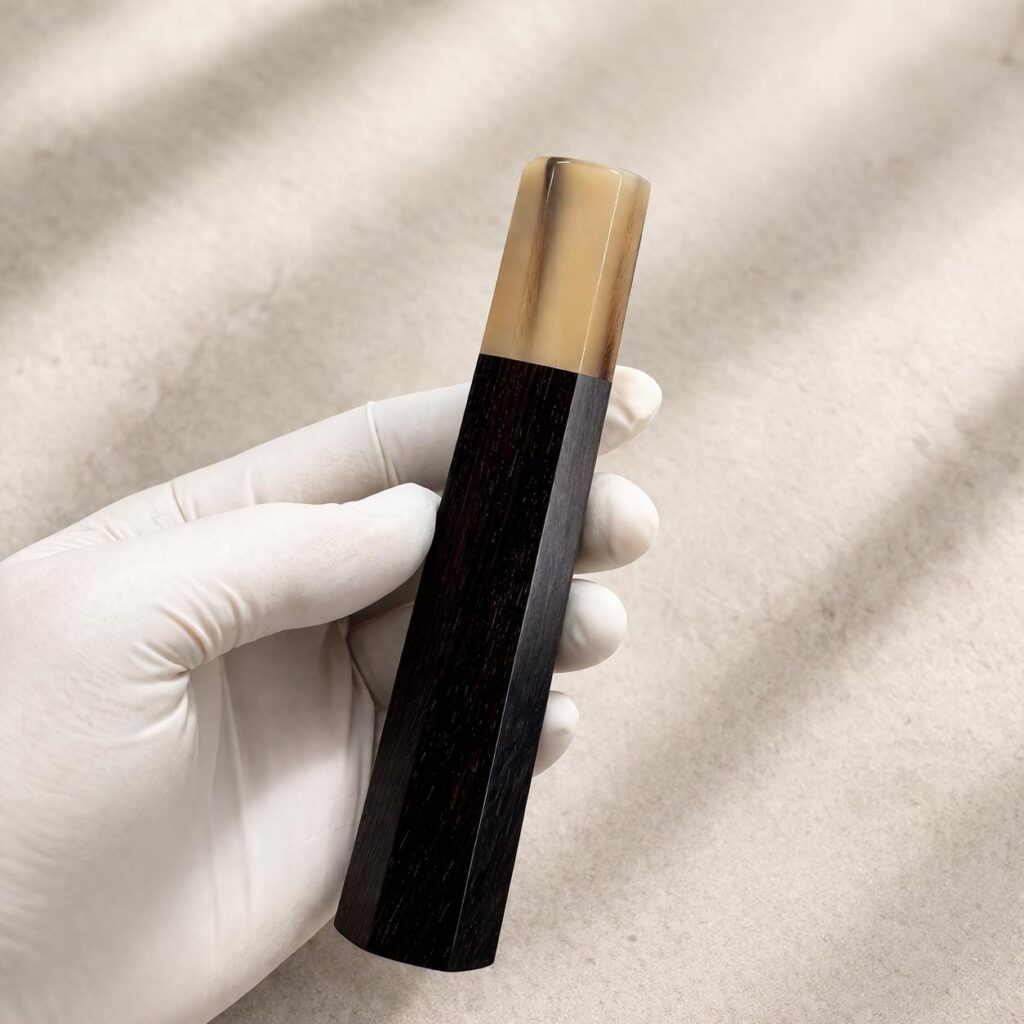
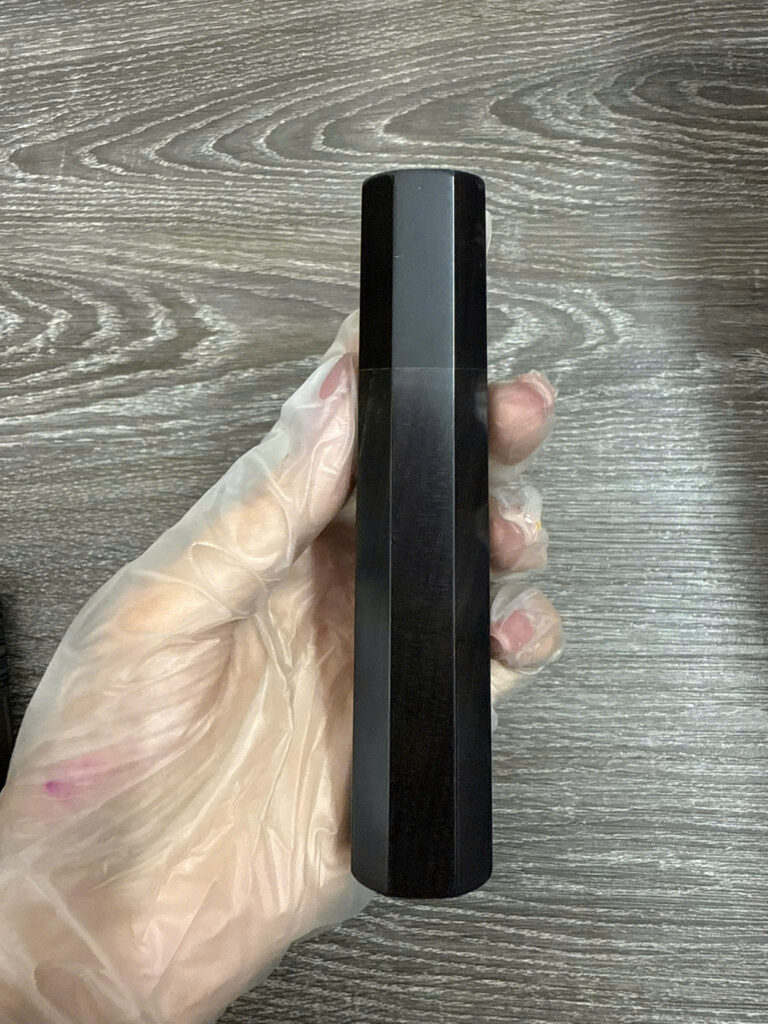
African blackwood is rarely a featureless flat black. In daylight, a finished piece may reveal deep brown, charcoal, or purple-brown lines. That quiet grain works well when you want a dark handle that still looks unmistakably wooden. Ebony varies more because the name covers multiple species. One blank may be nearly uniform; another may have brown, tan, or black striping. Product photographs of the actual handle are more useful than a generic color label.
Compare the wood bodies in these two finished handles. The African blackwood example has a light horn ferrule; the ebony example has black horn. Grain and color vary between pieces.
Weight and knife balance
Both are dense handle choices compared with many lighter-colored woods, but it is not responsible to promise that one finished handle will always be heavier than the other. Blank-to-blank variation, handle length, cross-section, ferrule, spacers, end caps, and the depth of the tang all affect final balance. A precisely sized handle in either wood can work on a gyuto, santoku, nakiri, petty, or slicer when the build is matched to the blade.
If you are replacing an existing handle, tell us what you want to change: more blade-forward, more neutral, or more handle presence. Use the two-path tang measuring guide to share fit evidence for the knife as it is; keep a secure handle installed.
Surface feel and finish
African blackwood and ebony can both take a very smooth finish. The practical difference a cook feels is often created as much by the octagonal facets, transitions, corner softness, and final finish as by the species. A crisp octagonal handle gives reliable orientation; slightly eased arrises make long prep sessions more comfortable. Those choices should be specified with the wood, not after it.
Care in a working kitchen
Neither material makes a wooden handle dishwasher-safe. Wipe the handle after use, dry it promptly, and do not leave the knife soaking in a sink. Avoid repeated high heat and strong cleaners. If the finish eventually looks dry, follow the maker’s care instructions rather than flooding the tang opening with oil. Our wa handle care guide explains a safe routine.
Which should you choose?
Choose African blackwood when…
- You want a dark handle with subtle natural grain rather than a perfectly flat black surface.
- You prefer a restrained, traditional look that pairs easily with black, pale amber, or mottled brown buffalo horn.
- You are happy to evaluate the actual blank or finished-handle photographs instead of buying from the name alone.
Choose ebony when…
- You want the specific appearance of an identified ebony, such as near-black or striped figure.
- You want strong contrast with a pale amber or mottled brown ferrule or a visually continuous dark build with black horn.
- The seller can tell you which ebony is being offered and show the piece you will receive.
Ferrule pairings
Black buffalo horn creates a continuous, quiet transition with either wood. Pale amber horn makes the boundary deliberate and highlights the dark body. Mottled brown horn sits between those two effects and can echo brown or grey lines in the wood. The ferrule is not only decoration: its fit, bore, transition, and finish are part of the handle’s durability and comfort. Compare the options in our wa handle ferrule guide.
Sourcing and species identification
Dark tropical woods require more care than a color-based product name. Ask for the botanical name, source or country of origin, and any documents appropriate to the shipment. CITES lists Dalbergia melanoxylon under the broader Appendix II controls for Dalbergia; the exact rules and annotations can change, and ebony controls depend on species and origin. The official CITES-listed species database is the right place to verify current listings rather than relying on a marketplace nickname.
For a finished handle, species identity and traceable purchasing are more meaningful than claims such as “genuine black wood.” If a seller cannot identify the material beyond “ebony color,” treat that as a color description, not a botanical guarantee.
The Horn and Grain recommendation
Choose by the actual piece and by the balance you want, not by the idea that one dark wood is automatically more premium. African blackwood is the better fit when you want near-black color with quiet grain. An identified ebony is the better fit when its particular figure is the reason for the build. In both cases, accurate tang measurements and an appropriate handle size matter more to the finished knife than the species name alone.
Browse made-to-order wa handles, or use the custom handle configurator to compare wood, ferrule, shape, and blade-length pricing bands. We review the knife and tang information before work begins.
Frequently asked questions
Is African blackwood a type of ebony?
No. African blackwood is Dalbergia melanoxylon; ebonies are species in the Diospyros genus.
Is ebony always pure black?
No. Appearance depends on species and the individual board. Some ebony is nearly uniform, while other pieces have visible brown, tan, or black figure.
Which wood makes the heavier handle?
You cannot determine final handle weight reliably from the common name alone. Ask about the actual handle dimensions, construction, and blank. The blade and tang also influence the installed balance.
Which is better for a gyuto?
Either can work. A 210 mm or 240 mm gyuto needs a handle sized to the blade and tang, then the wood and ferrule can be chosen to fine-tune the desired balance and look.