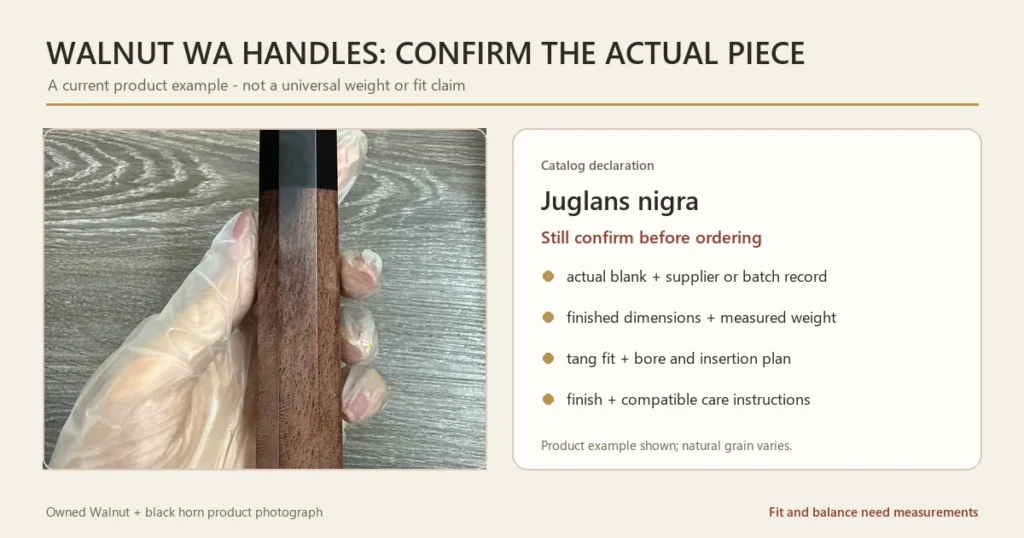
Quick answer: walnut is a strong wa-handle direction when you want restrained brown grain and an actual finished handle whose measurements preserve the balance you like. Horn & Grain currently shows Walnut as available in its configurator and sells a Walnut & Buffalo Horn handle. Its public catalog identity declares black walnut, Juglans nigra. That declaration is useful, but it is not supplier or batch proof for an individual handle. The current pages also do not publish the finished weight or complete dimensions, so walnut should never be sold as the universal “lightest” option.
The practical choice is piece-specific: compare the photographed handle or blank, its finish, dimensions, mass, ferrule and intended tang bore. A smaller handle in another wood can weigh less than a larger walnut build, while a horn end cap or metal spacer can add mass that the wood name alone cannot predict.
Is a walnut wa handle right for your knife?
Choose walnut as a direction when
- You prefer chocolate, grey-brown or subtly purplish grain rather than a near-black or highly figured handle.
- You want to preserve a nimble or blade-forward feel and can compare the actual candidate’s finished weight.
- You are comfortable wiping natural wood dry and following the maker’s finish-specific care instructions.
Confirm before ordering
- Does the supplier or batch record support the catalog’s Juglans nigra declaration?
- Is the photograph the exact piece, and what are its finished weight and dimensions?
- Which finish, ferrule, spacers, end cap and tang-bore dimensions are included?
Pause when
- The recommendation depends only on walnut being “light,” “stable” or “low maintenance.”
- The knife’s tang, current handle and balance point have not been measured.
- A stock photograph is being used to promise the color or figure of a different blank.
What Horn & Grain currently offers
Walnut is marked available in the current Horn & Grain configurator. The configurator also lets a buyer select ferrule, optional rings and end cap, shape, and a blade-length pricing band. Those bands are not universal handle dimensions: Horn & Grain says final length, cross-section and tang fit are confirmed from the knife’s measurements.
The current Walnut & Buffalo Horn product page supplies a real visual direction: warm walnut against a dark ferrule in an octagonal profile. It does not publish a finished weight, complete cross-section, length, finish schedule or a supplier record visible to the buyer. Treat it as a current product example, not a specification for every walnut handle.
Natural blanks and horn vary. Ask whether a product photograph shows the exact handle that will ship or only the combination. For custom work, request photographs of all faces under neutral light. Sapwood, heartwood, grain direction and finishing can change the apparent color far more than a material swatch suggests.
What “black walnut” means here
Horn & Grain’s public identity field declares Walnut as Juglans nigra. The Royal Botanic Gardens, Kew accepts Juglans nigra and records its native range from southeastern Canada through central and eastern parts of the United States. The USDA Forest Products Laboratory describes black walnut heartwood as light to dark chocolate brown, sometimes with a purplish cast and darker streaks; sapwood can be nearly white. It also records straight grain as common while noting that irregular growth can produce varied figure.
Those sources describe the species. They do not identify a Horn & Grain blank. The accurate buying language is “catalog-declared Juglans nigra,” followed by confirmation from the relevant supplier or batch when botanical identity matters. A color match is not species proof, and the word “walnut” alone can refer to more than one species in trade.
Weight and balance: measure the finished build
Black walnut is often discussed as a less dense alternative to very dark tropical woods. That can be a useful starting hypothesis for equal volumes, but a wa handle is not an equal-volume wood sample. Its length, taper, cross-section, bore depth, ferrule, rings and end cap all affect mass. Moisture content also affects wood properties. No responsible comparison can turn a species average into the weight of a finished handle that has not been measured.
First record what the knife does now. Place it safely on a narrow support to locate the current balance point, note where you pinch-grip, and weigh the complete knife if you can do so accurately. Then describe the desired change: preserve the current balance, move it slightly toward the hand, or keep it blade-forward. “Make it lighter” is incomplete unless you mean the handle, the whole knife or the perceived balance in use.
Ask for the following matched information when comparing candidates:
- finished handle weight, measured on the same scale;
- overall length and the height and width at ferrule and butt;
- ferrule, ring and end-cap materials;
- tang-bore size and intended insertion depth;
- whether the quoted weight is before or after final finishing.
A measured walnut candidate can be an excellent way to preserve a quick-feeling petty, santoku or gyuto. It can also be too large or too small for one of those knives. Use the wa handle size guide as a starting framework, then let the actual tang and balance goal determine the build.
Grain, ferrule and shape
Walnut’s visual strength is restraint. A dark horn ferrule creates a clear front boundary and works well when the blade already has hammered cladding, a forge finish or a strong patina. A lighter natural horn can make the transition brighter, but natural horn is variable. Ask for the actual ferrule rather than choosing from the name alone.
Shape changes grip information independently of wood. Octagonal facets provide obvious orientation; an oval or round profile feels smoother in rotation; a D-shape is handed and should be ordered for the primary user. The current configurator supports those directions, but corner easing and final cross-section still determine comfort. Tell the maker your dominant hand, grip, hand-size concern and where the current handle creates pressure.
Care follows the finish
USDA guidance explains that wood exchanges moisture with its environment and that moisture affects performance. A finish can improve appearance, protection and cleanability, but it does not make a natural-wood handle immune to water. Keep the handle out of the dishwasher and standing water, wipe it after washing the blade, and dry the ferrule and blade junction promptly.
Do not apply oil on a fixed calendar without knowing the existing finish. Ask whether the handle is unfinished, oil-finished, waxed or film-finished and which maintenance product is compatible. If the surface looks dry, follow the maker’s recommendation. If you see a growing gap, movement, swelling, a crack or persistent odor, stop using the knife for wet prep and have the fit inspected; more oil is not a structural repair.
A buyer-ready walnut request
Send the maker the knife type and blade length, tang height and width near the shoulder, intended insertion depth if known, current handle dimensions, dominant hand, preferred shape, present balance point and the one change you want. Add clear side, spine, choil and tang-opening photographs with a ruler in frame. Then ask for the actual walnut candidate’s photos, measurements, finished weight, finish and identity record.
If the maker cannot provide every measurement before shaping, ask what can be confirmed now and what will be approved before final installation. That is more useful than requesting “the lightest walnut” or assuming a catalog photo fixes the grain and balance.
Reviewed 8 August 2026. Method: the current Horn & Grain configurator, Walnut & Black Buffalo Horn product page and public catalog identity field were checked against Kew and USDA Forest Products Laboratory references. Catalog declaration, species-level reference facts and individual-handle proof are reported separately. No unpublished stock duration, finished weight, dimensions, finish or supplier record was inferred.
Primary references
- Royal Botanic Gardens, Kew: Juglans nigra
- USDA Forest Products Laboratory: Black walnut (Juglans nigra)
- USDA Forest Products Laboratory: Moisture relations and physical properties of wood
- USDA Forest Products Laboratory: Finishing wood
- Horn & Grain: rosewood versus walnut, using actual-piece evidence
Configure a walnut direction and submit your knife measurements for fit review