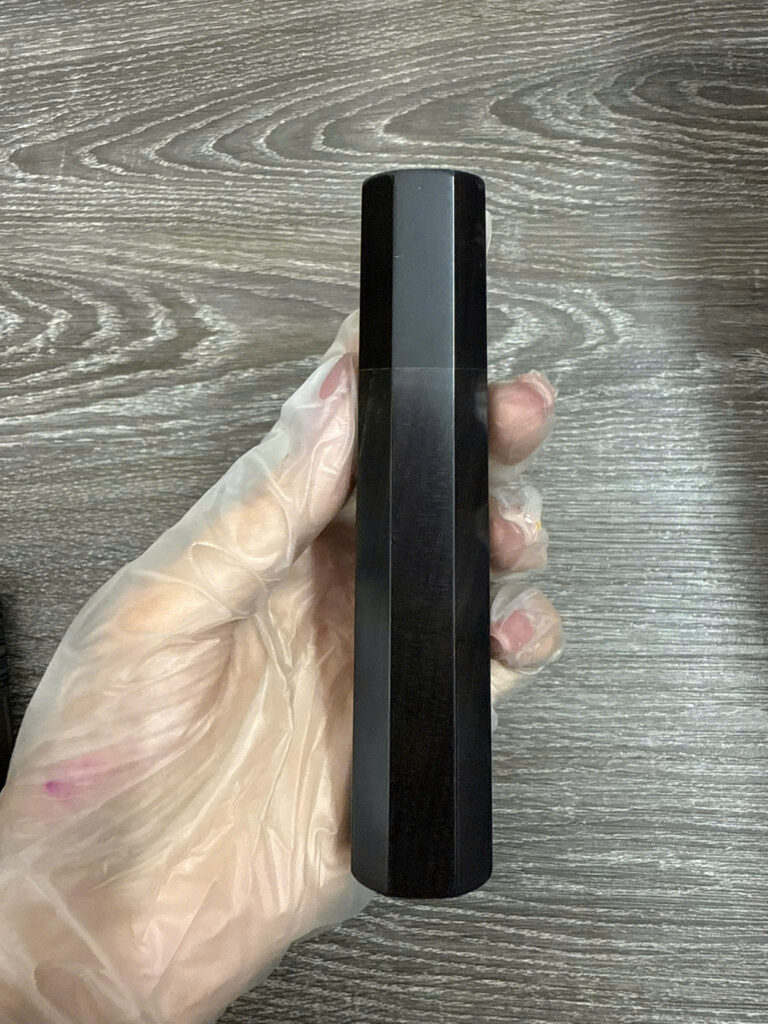
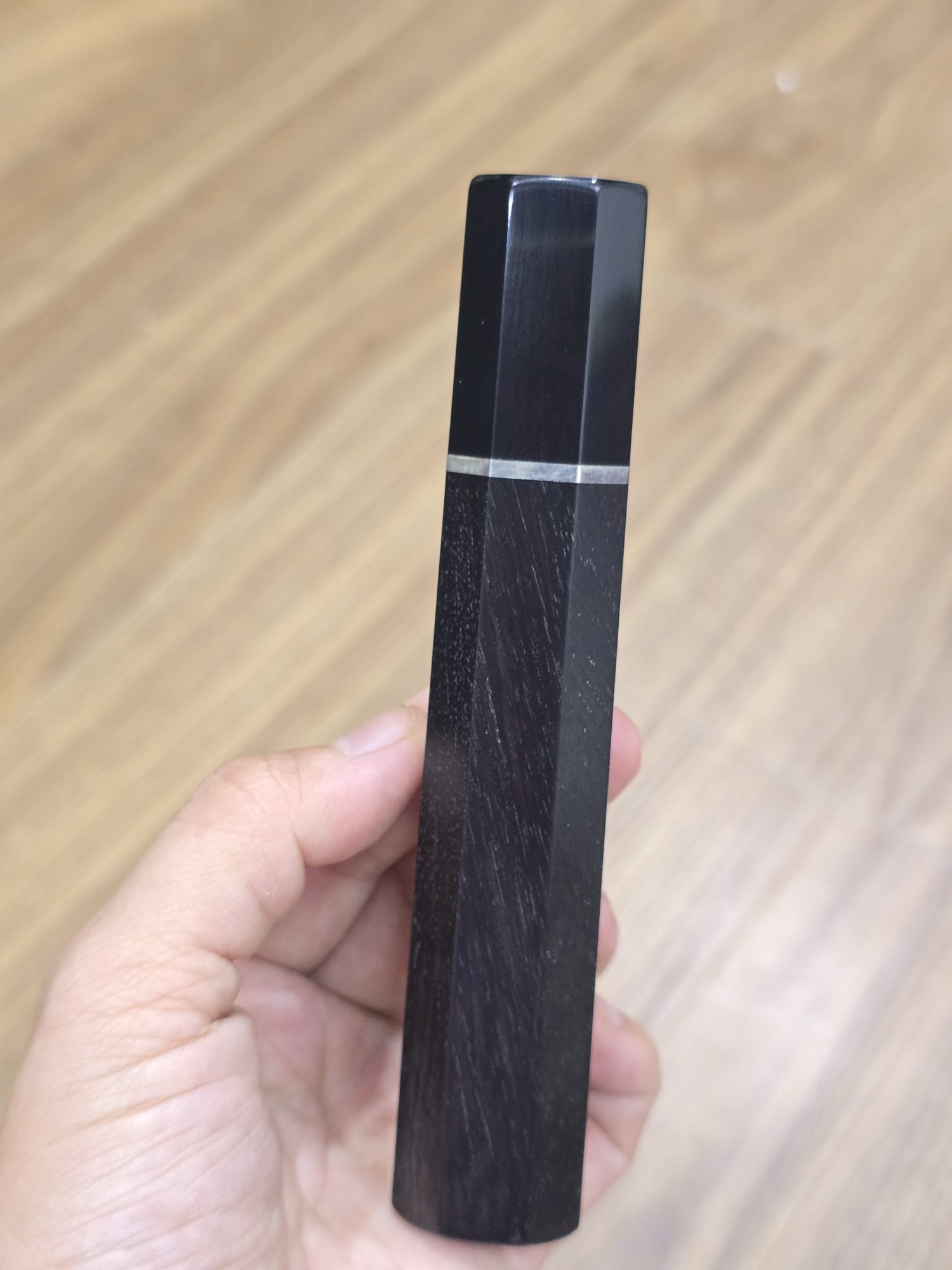
Ebony is often chosen for a deep, sometimes near-uniform dark appearance and a fine-looking surface, but the name does not guarantee one colour or grain pattern. “Ebony” is a trade and common name for woods in the Diospyros genus, and species, blank and finish can all change the finished look. This guide starts with the actual blank and the complete build when asking whether ebony suits a particular knife.
Ebony is a dense handle choice, but the common name alone does not determine finished weight or balance. The blank, handle length and cross-section, ferrule, spacers or end cap, bore and tang depth, plus blade geometry all matter. The useful question is whether the proposed handle is matched to the knife.
Should your knife wear ebony?
The short version: choose ebony when you like the actual blank’s dark, restrained appearance and the proposed dimensions and construction suit the knife. Some finished ebony looks close to uniform black; other blanks show colour or grain variation. Knife length alone does not establish whether its finished weight or balance will be right.
Keep the fit check concrete without removing a secure handle. Close side and spine photographs of an installed handle’s junction can show visible height, thickness, alignment and condition, but not the hidden tang. If the tang is already exposed, record three primary measurements in millimetres: usable length from the shoulder or seating line to the tip, height near the shoulder, and face-to-face thickness at that same station. Blade type, length, current balance and wider photographs are optional context.
Where ebony earns its place
| Decision point | What to check for ebony | Buyer note |
|---|---|---|
| Fit | Installed-junction observations or exposed-tang dimensions, with blade and build context | Finished weight and balance depend on the actual blank, dimensions, construction, blade and tang. |
| Feel | Actual texture, finish, facet geometry, and palm contact | Check the specific blank and finish; colour, grain, and surface appearance can vary. |
| Care | Finish type, cleaning, drying, water exposure, and heat | Identify the finish before using any care product; there is no universal oil schedule. |
| Sourcing | Species and responsible supply | Ask what species and source information is available for the actual blank. |
Match ebony to the complete build
Use the configurator to choose wood, ferrule, shape and size, and compare ebony with alternatives. Measurements and photos are optional before purchase; fit details can be added or corrected on the order page before bench work begins.
Ebony suits you when
- You want a dark, restrained handle and accept that the actual blank may show colour or grain variation.
- The proposed dimensions, construction, blade and tang have been considered together for the balance you want.
- You value the polished, formal look shown by the specific blank and finish.
Reconsider ebony when
- You are choosing by knife length alone without checking the proposed handle dimensions and construction.
- You want pronounced grain movement that the available ebony blank does not show.
- You need species or source information that is not available for the actual blank.
Optional fit details to share
- If the tang is already exposed, give three primary measurements in millimetres: usable shoulder-or-seating-line-to-tip length, near-shoulder height, and face-to-face thickness at that station.
- Preferred shape, grip style, and whether the knife should feel lighter, neutral, or more planted.
- If a secure handle remains installed, leave it in place; optional side and spine photos of the junction show only accessible features, not hidden tang dimensions.
- Optional context includes blade type and length, current handle dimensions, maker or model, wider knife photos, and any balance preference.
Finished weight: assess the whole build
Ebony is a dense wood choice, but the label alone does not tell you the finished handle weight or the direction or size of any balance change. The actual blank, handle dimensions and cross-section, ferrule, spacers or end cap, bore and tang depth, and blade geometry all contribute to the result.
Knife length alone cannot decide suitability. A precisely sized ebony handle can be matched to a gyuto, santoku, nakiri, petty or slicer when the complete build suits the blade. Compare the actual dimensions and construction rather than applying a rule that ebony belongs only on large knives.
How the actual blank and finish look
Many ebony handles are chosen for a fine-looking texture and polished appearance, but “ebony” does not guarantee one surface, colour or pore pattern. The species, individual blank, shaping and finish all affect how smooth the surface looks and how clearly the facets read.
Some ebony blanks read as nearly uniform and dark; others show colour or grain variation. If pronounced texture is the goal, compare the actual blanks and finished examples available. The wenge vs ebony comparison lays out that visual choice side by side.
Choosing a ferrule for a dark ebony handle
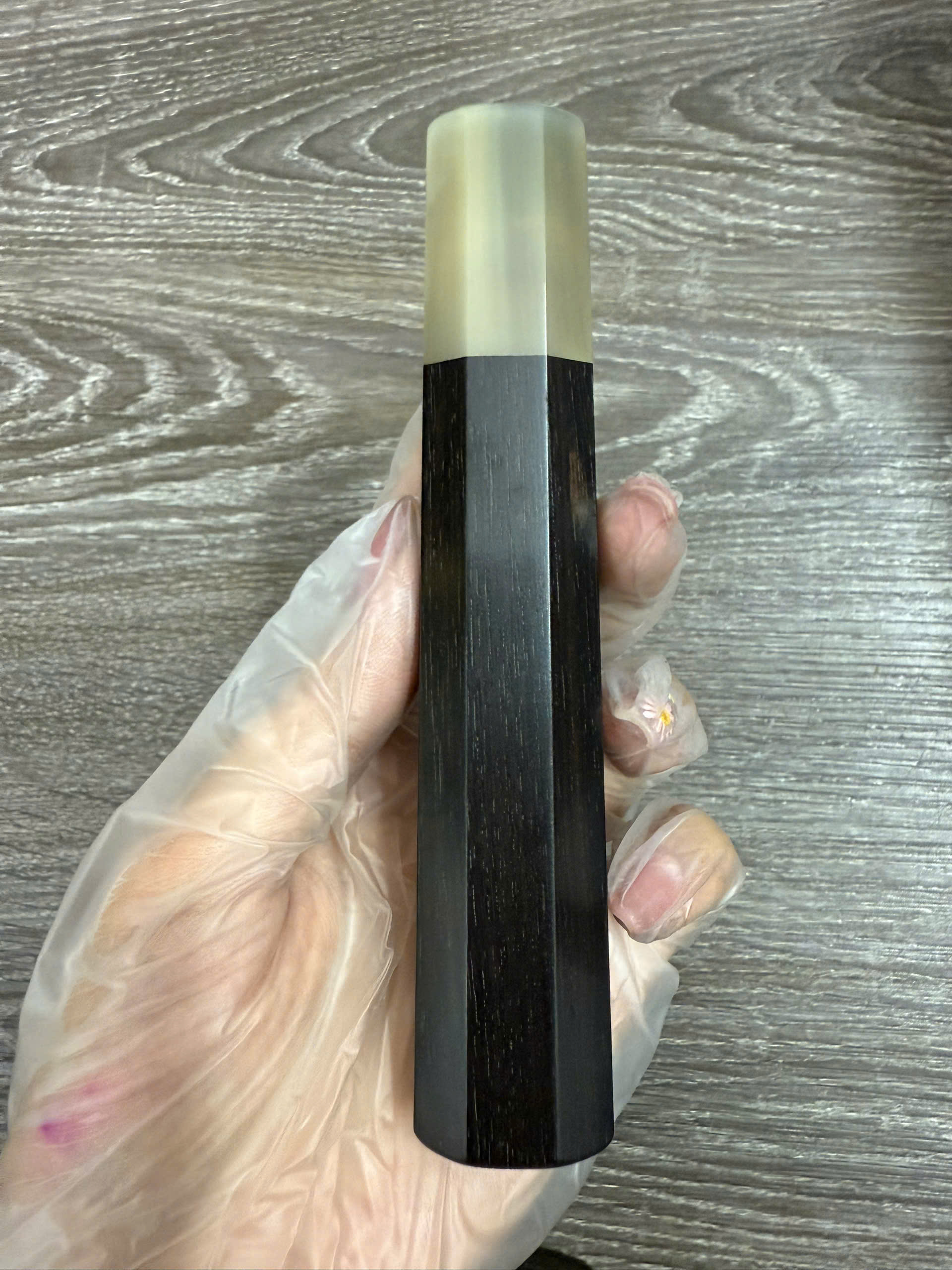
Against a very dark, visually quiet ebony blank, the ferrule can either continue the palette or add contrast. Black buffalo horn can keep the build subdued; white horn can draw a clearer line at the transition. Judge both against the specific blank and finished surfaces rather than assuming every ebony handle is solid black.
Either direction can work. A restrained ferrule keeps attention on the blade and shaping; a contrasting ferrule makes the front transition more visible. The choice is visual and does not by itself establish the finished handle’s weight or balance.
Origin and responsible sourcing
“Ebony” is a trade and common name for woods in the Diospyros genus; the name alone does not identify the species, supplier, batch or actual blank. Ask what species and source information is available for the handle you are considering, and treat unanswered details as unresolved rather than filling them in from the trade name.
African blackwood can look similarly dark in a finished handle, but it is not ebony. It is Dalbergia melanoxylon, while ebony is a trade and common name for woods in Diospyros. Colour, grain and sourcing questions can differ. The ebony vs African blackwood comparison explains the distinction.
Which knives and cooks suit ebony
Ebony suits a cook who wants a dark, restrained handle and is willing to judge the actual blank and complete build. It is not reserved for a particular knife category or length: a matched handle can work on a gyuto, santoku, nakiri, petty or slicer when its dimensions, construction, blade and tang produce the intended fit and balance.
To see a finished example of the look, the ebony handle, with its black buffalo horn option, shows the all-dark build, and the broader best wa handle woods guide places ebony next to the rest of the range so you can judge it in context.
Fit and measurement notes
Measurements and photos are optional before purchase. Keep a secure installed handle in place: close side and spine photographs of its junction can show accessible height, thickness, alignment and condition, but not hidden tang dimensions. If the tang is already exposed, record exactly three primary dimensions in millimetres: usable length from the shoulder or seating line to the tip, height near the shoulder, and face-to-face thickness at that station. Blade length, current handle length, maker or model, and wider knife photos are optional context.
Do not infer the finished handle’s weight or balance from “ebony,” knife category or blade length alone. Ask about the actual blank, handle dimensions and construction; ferrule, spacers or end cap, bore and tang depth, blade and tang all affect the installed result.
Caring for an ebony handle
There is no universal calendar for oiling an ebony wa handle. First identify its finish and follow the maker’s guidance for that finish. Keep the handle clean and dry, avoid soaking and direct heat, and use a care product only when the handle is stable and its finish is meant to receive it.
Oil is not a repair for movement, cracking or a wet blade-to-handle joint, and it cannot secure a loose tang. Do not diagnose the cause or add oil or adhesive from appearance alone; document the condition and contact the maker before attempting a repair. The full wa handle wood guide compares care considerations across woods and finishes.
Best fit for ebony
An ebony wa handle for a chef knife suits buyers who like a dark, restrained appearance. The name alone does not promise uniform black colour, a fixed handle weight or a rearward balance shift; assess the actual blank and complete build.
Pair the actual blank with a deliberate ferrule choice. Black horn can keep a dark palette subdued; white horn can create stronger contrast and make the front transition more visible.
The verdict on ebony
Choose ebony when you like the actual blank and the handle’s proposed dimensions and construction fit the blade, tang and balance goal. Ebony can look deeply dark and restrained, but species and blank appearance vary, and finished weight and balance come from the entire build rather than knife length alone. Use the configurator to compare options, or browse the current made-to-order handles for finished examples.