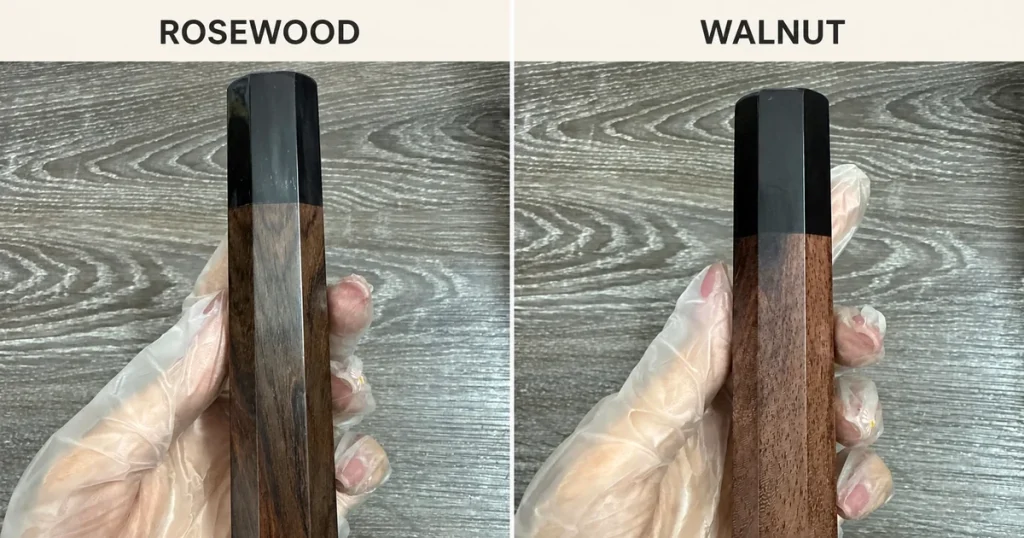
Rosewood is a good starting point if you like warm red-brown colour and flowing grain. Walnut suits a quieter brown look. Compare the product photographs below to see those two directions with black buffalo horn.
Natural wood and horn vary from piece to piece. If you prefer a brighter contrast, rosewood is also shown with white horn. Choose the look you like, then consider the complete handle’s dimensions, construction and fit; the wood name alone cannot tell you its finished weight or balance.
Rosewood vs walnut at a glance
Rosewood
Warm red-brown colour and flowing grain. Black horn keeps a dark front; white horn makes a lighter contrast.
Walnut
A quieter brown look, with colour and grain that vary by blank. Start with the actual photographs, then choose the horn contrast you prefer.
Fit and balance
Compare the complete handle’s dimensions and finished weight. The wood name alone cannot tell you how it will balance your knife.
“Rosewood” needs a batch answer
Rosewood is a trade and common name, not a complete identification. The Royal Botanic Gardens, Kew recognizes Dalbergia as a large genus with hundreds of accepted species, and “rosewood” is also applied in trade to woods outside that genus. Horn & Grain’s public catalog identity field declares Dalbergia spp. for standard Rosewood. That is a genus-level catalog declaration, not identification of the finished item to one species and not supplier or batch proof.
That evidence supports a careful statement: the current standard option is catalog-declared as Dalbergia spp., and its species within that genus should be confirmed from the supplier or batch when it matters. It does not support selecting an attractive Dalbergia species description online and assigning it to the handle. The separate Siamese Rosewood Deba handle, publicly declared as Dalbergia cochinchinensis, is a different catalog item and should not be used as proof of the standard rosewood’s species.
Species matters beyond storytelling. Color, pore structure, working behavior, density, and trade controls differ. CITES includes many Dalbergia materials in its Appendices with annotations and exceptions that can change how a product is documented across borders. Buyers and sellers should consult current official rules for the species, product form, and destination rather than treating “finished handle” or “rosewood” as a universal exemption.
Walnut is clearer, but the SKU still needs confirmation
Horn & Grain’s public catalog identity field declares its Walnut option as black walnut, Juglans nigra, a species accepted by Kew and native to eastern North America. The visible title of the current Walnut & Buffalo Horn product page uses the shorter “Walnut” label. The accurate product-level description is therefore “catalog-declared Juglans nigra,” while supplier or batch evidence for the individual handle should still be confirmed.
This distinction is not pedantry. It separates a useful sourcing question from a false guarantee. If the exact species is important to you, request it in writing for the actual piece. If the decision is primarily visual, a clear photograph and measured handle may be more valuable than the Latin name.
Color, grain, and ferrule pairing
The rosewood photographs show two clear visual directions. The black-horn example on the Rosewood & Buffalo Horn handle places a dark stop between warm wood and blade. The white-horn version creates a lighter transition. Those are examples, not color standards: both wood and natural horn vary, and screen white balance can exaggerate red, amber, or black.
Walnut with black horn is visually restrained. The warm brown body remains visible, but the ferrule anchors the front without competing with the blade. It is a sensible direction when the knife already has a patterned cladding, forge finish, patina, or strong blade geometry. For a different contrast, compare the horn choices in the configurator and confirm the actual horn and blank.
Compare candidate photographs under similar light. Look at all facets, not only the hero side. Ask whether the photographed product is the exact handle supplied and whether color correction was applied. If matching an existing saya, spacer, or blade finish, send a neutral-light photograph with a grey or white reference rather than describing the target as “warm” or “dark.”
Weight and balance: do not rank trade names
Walnut is often chosen to preserve a light or blade-forward feel, and many rosewoods are associated with greater density. But neither observation gives the weight of the finished handles on these product pages. The standard Rosewood declaration does not identify a species within Dalbergia, and handle length, cross-section, taper, bore depth, horn, spacers, and end caps all change mass.
When balance is central, request a matched comparison:
- finished weight of each candidate handle;
- length, ferrule-end height and width, and butt height and width;
- ferrule, spacer, and end-cap materials;
- tang-bore dimensions and intended insertion depth;
- the knife’s present weight and balance point.
A smaller rosewood handle may weigh less than an oversized walnut handle. A horn end cap can erase the difference you expected from the wood. Select from measurements first, then use grain and color as the tie-breaker. The wa handle size guide supplies starting ranges, not a guaranteed fit.
Care depends on the finish, not the marketing tier
Both handles should be washed by keeping the wood out of standing water, then dried promptly around the ferrule and blade junction. Avoid the dishwasher and sustained heat. USDA Forest Products Laboratory guidance explains that wood responds to moisture and that finishes only slow moisture exchange; no natural wood becomes maintenance-free because it is oily, dense, or expensive.
The current product pages do not identify a complete finishing schedule. Ask whether the handle is unfinished, oil-finished, waxed, or film-finished before applying a maintenance product. Oil is not a repair for a loose tang, widening seam, sour odor, swelling, or crack. Those symptoms call for inspection and possibly a refit.
Which should you buy?
Choose rosewood when the actual photographed blank has the warm figure you want, its identity and documentation meet your needs, and its measured dimensions and mass suit the knife. Choose walnut when visual restraint is the priority or when a measured walnut candidate better preserves the knife’s current forward feel. Do not decide yet if the seller cannot provide the actual-piece photo, fit information, or weight needed for your goal.
For a custom order, compare two real wood-and-horn directions and say what you would like to change about the fit or balance. Measurements and photos are optional before purchase. Keep a secure installed handle in place; clear photos of the blade-to-handle junction are useful starting evidence. If the tang is already exposed, its three primary measurements are usable length from the shoulder or seating line to the tip, height near the shoulder, and face-to-face thickness at the same station, all in millimetres. Maker or model, blade length, current handle length and wider knife photos are optional context.
Reviewed 7 August 2026. Method: current Horn & Grain public catalog identity fields, product pages, and configurator availability were checked against Kew records. Catalog declarations are reported separately from supplier or batch proof; no unpublished finished weight, dimension, species within the standard Dalbergia declaration, or continuous stock promise was inferred.
Primary references
- Royal Botanic Gardens, Kew: Dalbergia
- Royal Botanic Gardens, Kew: Juglans nigra
- CITES Checklist
- USDA Forest Products Laboratory: Wood–Moisture Relationships
- USDA Forest Products Laboratory: Finishing of Wood
Compare a measured rosewood or walnut direction in the custom configurator