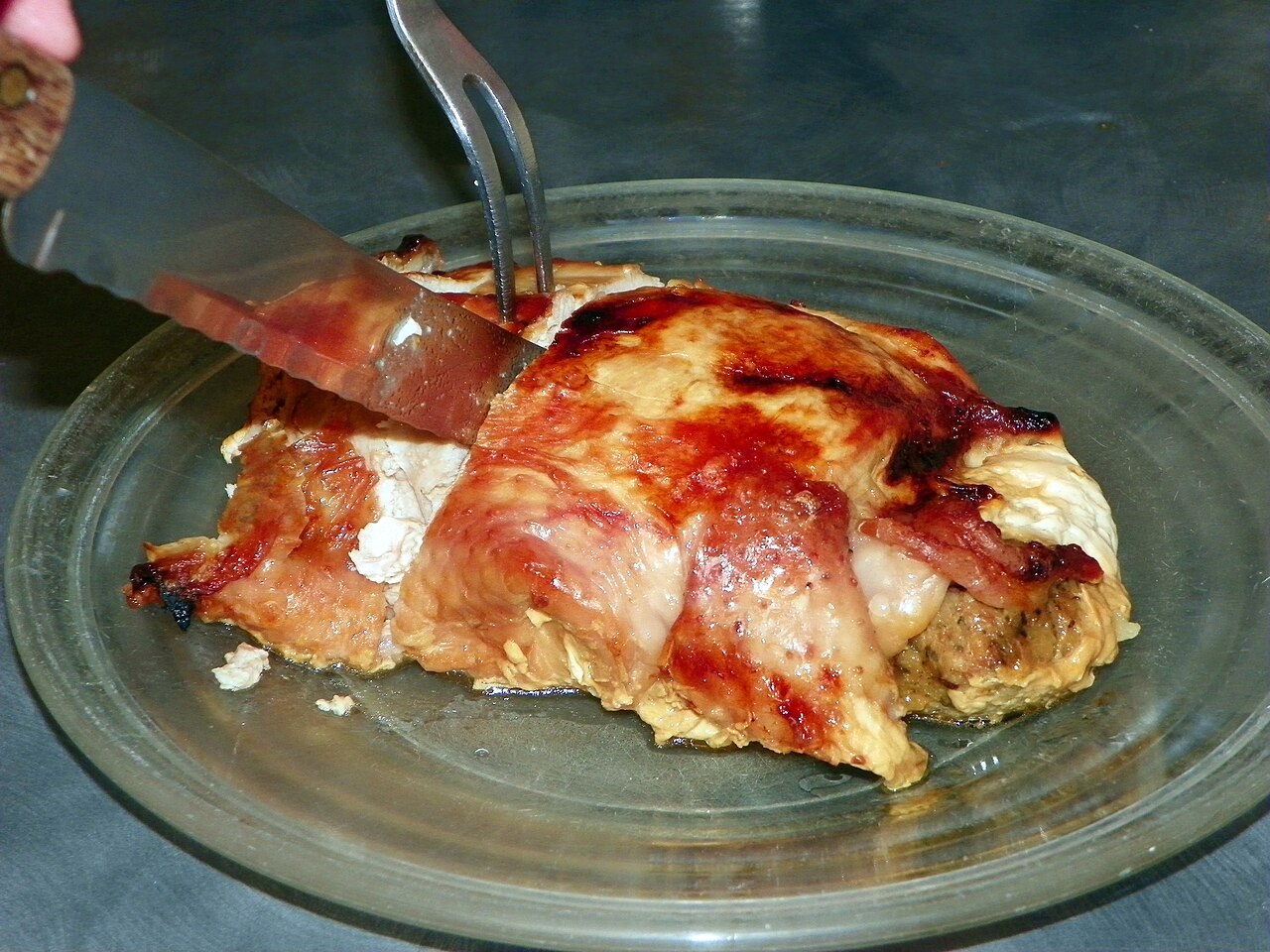
To carve a bone-in turkey breast, let it rest after roasting, set it skin-side up on a large board and cut down one side of the breastbone, keeping the blade against the bone. Follow the curve of the ribs to lift that half off in one piece, repeat on the other side, then lay each half flat and slice it across. Illinois Extension carves the breast in the same order: free the meat from the breastbone, move the whole section to a cutting board, then slice it. A boneless breast roast skips the bone work; you only slice.
Before you cut
Check doneness with a food thermometer in the thickest part of the breast. Illinois Extension and Nebraska Extension both give 165°F as the safe minimum internal temperature for turkey, following USDA guidance. Illinois Extension advises resting a roast turkey for 20 minutes after cooking so the juices spread evenly again for better slicing; Nebraska Extension adds that the rest makes the turkey easier to carve. If your recipe gives a different rest for a breast roast, follow it.
Set out a stable board with room for the slices, something to steady the meat (Illinois suggests a carving fork, or a folded napkin) and a sharp knife you can control. A groove or rim keeps juices off the counter; our carving board guide compares sizes and juice grooves.
Step by step
- Find the breastbone. With the breast skin-side up, locate the ridge of bone running down the middle between the two halves.
- Cut down one side of it. Steady the roast with the fork and cut along one side of the breastbone from the top end. Illinois Extension starts with a cut about 2 inches deep, gently separating the meat from the bone as it goes.
- Follow the ribs. Keep the blade angled toward the bone and use short, controlled strokes with the tip to ease the meat away from the rib cage until the half comes free. If the edge meets bone, change the angle instead of pushing harder.
- Repeat on the other side. You now have two boneless halves and the bare frame.
- Slice across. Lay a half flat on the board, skin up, and slice across it, across the grain as Illinois Extension describes, to the thickness you want. Draw the knife through in one long stroke where you can, rather than sawing back and forth.
Taking each half off whole gives you a flat, steady piece to slice. Our whole-turkey carving guide uses the same approach for the breast of a whole bird.
Boneless breasts and breast roasts
A boneless breast or rolled breast roast has no frame to remove. Rest it, take off any string or netting, set it on a flat side and slice straight across with long strokes. If it rolls, steady it with the fork; Mississippi State Extension’s knife basics recommend giving round foods a flat surface before cutting.
Keep leftovers safe
Illinois Extension says to refrigerate leftovers within 2 hours of cooking, divide large amounts into smaller portions in shallow containers so they chill faster, and use cooked turkey from the fridge within 3 to 4 days.
The knife for this job
Use a long, sharp slicing knife you are comfortable with. A Western carving knife is built for carving with a fork, at the table or on a platter, and copes better with work near bone; a sujihiki is thinner and suits long, single strokes on a board. Our sujihiki vs carving knife guide sets out that trade, and what a sujihiki is covers the Japanese slicer itself. For an occasional roast, a gyuto already in the drawer will do; gyuto vs sujihiki explains what the longer blade adds. None of these knives should cut through the breastbone. Hold the knife in a relaxed pinch grip (see how to hold a Japanese knife) so the long stroke stays straight.
If you are fitting a wa handle to the slicer, our wa handle size guide puts a 210–255mm gyuto or sujihiki in the Chef size and a 256–360mm sujihiki in Long.
Sources: Illinois Extension, Carving (rest, breast removal and slicing, joints not bone); Mississippi State Extension, Kitchen Knife Basics (flat surface, curled fingers); Illinois Extension, Using a Meat Thermometer (165°F, thermometer in the thickest part of a turkey breast); Illinois Extension, Storing Leftovers (2 hours, shallow containers, 3 to 4 days); Nebraska Extension, Safe Turkey fact sheet (165°F; 20-minute stand before carving, citing USDA FSIS).