A chuka bocho is the Japanese name for a Chinese-style kitchen knife, often sold as a Chinese cleaver. It has a tall, rectangular blade and is used as an all-purpose knife for slicing and chopping vegetables and meat. Japanese-made versions use hard steels that stay sharp longer but are less tough, so check what each model is built for before using it near bone.
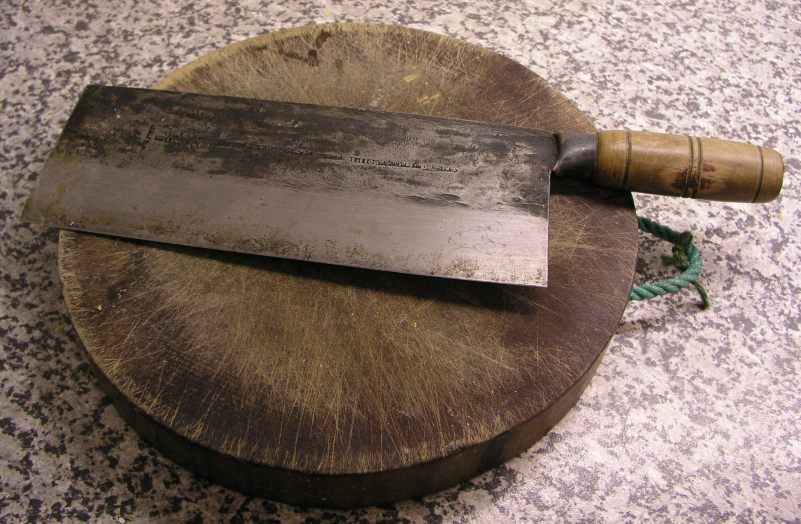
Chuka bocho at a glance
Every figure below is as the maker or seller lists it:
| Spec | What the sources list |
|---|---|
| Name | Chūka bōchō, literally “China kitchen knife” (Wikipedia) |
| In Japan since | First introduced to the Japanese market by Sugimoto cutlery in the 1930s (Korin) |
| One example | Misono 440 Chinese Cleaver: blade 220 × 110mm, 50/50 bevel, HRC 58–59 (Korin) |
| Bevel | Double bevel on that example |
| Profile | A tall, rectangular blade; models range from thin slicers to thick choppers (Knifewear) |
| Typical use | Proteins, produce and small soft bones (Korin); some chuka bocho can cut small bones (Knifewear) |
Sources: Wikipedia’s Japanese kitchen knife article for the name; Korin’s Chinese style cleaver page and Misono 440 Chinese Cleaver; Knifewear’s Chinese cleaver and chuka bocho comparison guide. Korin and Knifewear are retailers; their figures describe the knives they sell.
Thin slicer or bone chopper?
“Chinese cleaver” covers knives built for quite different work. Knifewear, which sells both Chinese-made cleavers and Japanese chuka bocho, explains that they come in a variety of sizes and thicknesses: some are excellent slicers that should not be used on bones, while others chop through bones easily but wedge when cutting dense vegetables.
Knifewear adds that Japanese chuka bocho are usually made from very hard steels. They stay sharp longer than many other knives, but the trade-off is that they are more brittle. Some can handle small bones; that depends on the model, so read the maker’s description before treating any tall rectangular blade as a bone cleaver. Korin describes its Chinese cleavers as suited to proteins, produce and small, soft bones.
If you need to split large bones, a knife made for that job is the safer choice. Why Japanese knives chip explains what hard impacts do to a fine edge.
Chuka bocho vs nakiri
Both have rectangular blades, but they do different amounts of the cooking. A nakiri is a compact, focused vegetable knife. A suitable chuka bocho is taller and longer and can take over more of the general prep a chef’s knife would do. Chuka bocho vs nakiri compares real dimensions and weights.
Who it suits
A chuka bocho suits a cook who likes a broad blade for chopping and slicing, has the board space for it and is comfortable with its height and weight. If you mainly cut vegetables on a small board, a nakiri or santoku may be easier to live with. If you want the knife for bones, choose a model sold for that purpose.
Handle size for this knife
A chuka bocho is not one of the knife types in our size recommender. Our wa handle size guide treats a knife type of “other” or “not sure” as an individual fit: the owner fits it by hand after checkout rather than auto-sizing it. You can still order the handle; measurements and photos are optional before buying, and the individual fitting replaces the automatic size recommendation. Start in the handle configurator.