For a compact knife devoted to vegetables, a nakiri is the simpler starting point. A Chinese vegetable cleaver makes sense when you want a broad blade for a wider range of everyday preparation and are comfortable with its size. Both can slice vegetables finely. The useful choice is the knife you can control through a whole meal’s preparation, not which rectangular outline looks more substantial.
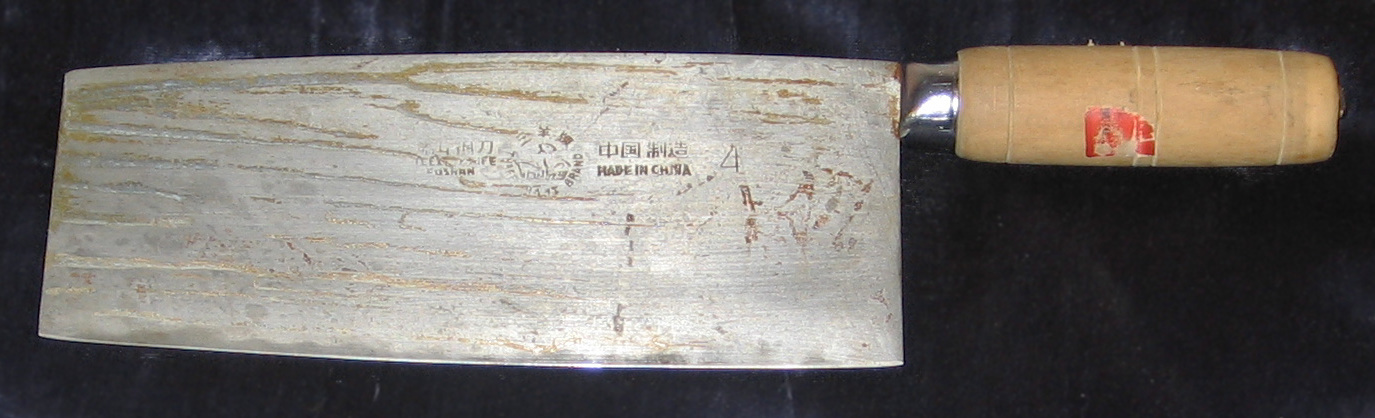
“Chuka bocho” is used for Chinese-style kitchen knives, but it does not specify one blade thickness or job. A thin vegetable cleaver and a heavy bone cleaver can look related while asking to be used quite differently.
Start with the work on your board
A nakiri is a vegetable specialist with a relatively straight cutting edge. TOJIRO’s knife guide describes the form as suited to peeling and thin slicing. Its flat profile is useful when you want a succession of complete cuts through an onion, a cucumber or a pile of greens.
A Chinese vegetable cleaver can be a general kitchen knife. Shun describes its Classic Vegetable Cleaver for produce and proteins, particularly mentioning larger vegetables such as cabbage. That is a useful example of an all-purpose vegetable-cleaver design; it is not a promise about every knife sold under the name.
The difference matters most if you already own a chef’s knife. A nakiri adds a focused vegetable tool. A suitable Chinese cleaver may take over more of the general preparation you currently do with that chef’s knife. Neither choice is automatically an upgrade: decide which job needs a different tool.
A broad blade changes how the knife occupies the kitchen
Blade length tells you how far the edge reaches. Blade height changes the space the face occupies, while total weight and handle shape affect how the whole knife sits in your hand. A short but tall knife can feel quite different from a longer, narrow one.
Before ordering, mark the proposed blade length on your board with a ruler. If a listing supplies height, mark that too. Leave space for the ingredient, your guiding hand and the food already cut. This simple outline cannot predict balance, but it can reveal a knife that will dominate a small board or be awkward to wash in your sink.
If you can handle a sample, use your normal grip and make slow, controlled cutting motions without food. Check whether you can raise and lower the blade comfortably and whether the handle or blade junction presses against your fingers. A knife that feels impressive for one lift still has to suit repeated preparation.
What real dimensions tell you
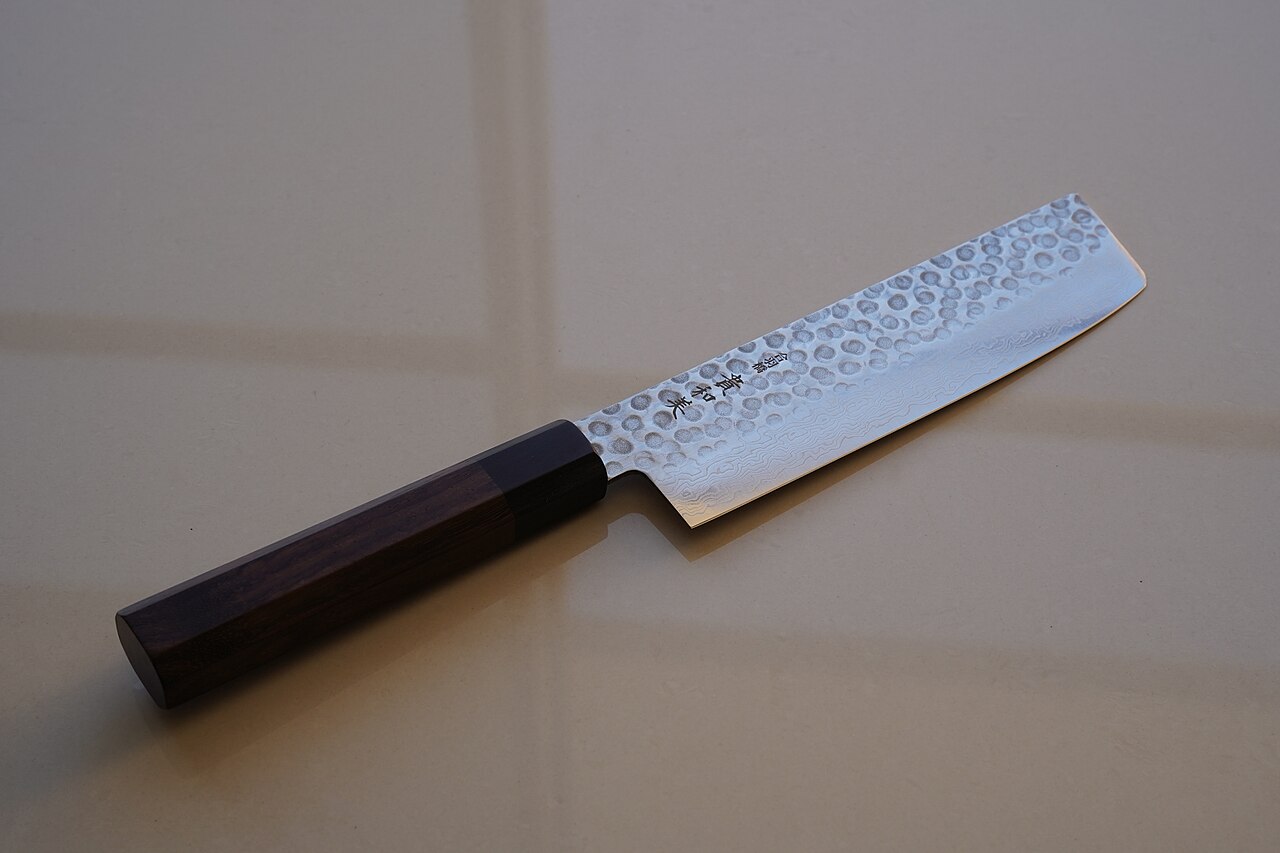
Two TOJIRO listings illustrate how different the packages can be. Its BASIC Nakiri F-315 has a 165 mm blade, 285 mm overall length and listed weight of 140 g. The PRO thin-blade Chinese Knife F-631 has a 225 mm blade, 340 mm overall length and listed weight of 510 g.
Those numbers explain why buying from a silhouette is risky. In this pair, the Chinese knife asks you to move considerably more weight and accommodate a longer edge. They do not establish the weight of an entire category, or tell you that a heavier knife needs less effort in your hand.
Compare complete specifications for the actual pair on your shortlist. Then compare storage: a broad blade may not fit an existing knife block, cover or drawer slot even if its overall length does.
The edge is for cutting, not proof of bone capability
A rectangular blade does not authorize chopping through bones. Shun expressly excludes joints and bones from the vegetable-cleaver model linked above. TOJIRO separately labels Chinese knives by blade type; the word “thin” is a reason to understand the model’s job, not to assume it behaves like a butcher’s cleaver.
For ordinary vegetable preparation, use a controlled cut that suits the edge profile. Do not force a flat edge through a large rocking arc simply because that is how you used a curved chef’s knife. If the knife binds, stop rather than twisting it sideways. For bone work, choose a tool expressly intended for that task.
The nakiri examples here are double bevel. An usuba is a separate, usually single-bevel vegetable-knife decision with different technique and sharpening demands. Our nakiri versus usuba guide explains that distinction.
Three useful ways to decide
| Your usual preparation | Start your comparison here |
|---|---|
| A chef’s knife already handles most jobs; you want a smaller dedicated vegetable knife | Nakiri |
| You want one broad blade for produce and boneless protein preparation | A vegetable cleaver explicitly intended for those tasks |
| The job includes joints or bones | A suitable bone-working tool; neither outline alone settles this |
For a small evening meal on a crowded board, a compact nakiri may be the more convenient addition. For larger vegetable batches, a broad vegetable cleaver may fit the way you already work. If you mainly need a pointed knife for mixed preparation, first revisit the santoku versus nakiri choice rather than forcing either rectangle into every job.
Choose the form by the food and movement, then refine the size and weight. The knife anatomy guide explains the listing terms you will meet along the way.