Use this overview to identify visible parts of a Japanese kitchen knife and understand what each helps you inspect. Knife shapes and terminology vary, so a feature or Japanese name may not apply to every model.
Quick reference: visible parts
| Part | Where it is | Why it helps |
|---|---|---|
| Tip / kissaki | Front end of the blade | Helps identify profile and detail-work shape. Compare the bunka and santoku tip profiles. |
| Spine / mine | Unsharpened top edge | Thickness and rounding affect pinch-grip feel. |
| Blade face | Broad side surface | Finish and grind vary; a pattern alone does not show cutting behavior. |
| Cutting edge | Sharpened lower line | The shown example is double-bevel; both sides have bevels. |
| Heel / ago | Rear of the edge near handle | Often used for board work; helps define usable blade length. |
| Choil | Transition near heel and handle | A view from this area helps inspect clearance and handle junction. |
| Machi | Step between blade and tang on some knives | Some makers use it as the blade-length reference point. |
| Ferrule and wa handle | Collar and grip behind the blade | Shape, material and fit affect the hand-to-blade transition. |
Nenohi’s knife-parts guide defines terms including kissaki, ago, mine, machi and nakago, and distinguishes front, back and cross-section features. Names vary among makers; use the knife’s own description when a term is ambiguous.
Blade length is not the same as overall knife length. Korin’s catalog illustrates traditional Japanese knife measurement from the machi to the tip. Check the maker’s stated convention when comparing specifications.
What is the blade made of, and why do Japanese knives feel thinner and harder?
Japanese kitchen knives can be made from carbon steel, stainless steel, or layered constructions that combine a harder cutting core with softer cladding. They may be forged, stamped, roll-forged, or made through other production methods; “Japanese knife” does not automatically mean “hand-forged.”
What you feel at the cutting board is influenced at least as much by geometry as by the steel name. A thin blade, a thin section behind the edge and an acute grind need less force to separate food. That is the low-resistance feeling people often notice when moving from a thicker European-style chef’s knife to a Japanese gyuto or santoku.
Hardness helps a thin edge resist rolling and can support good edge retention, but harder is not simply better. A harder, thinner edge can be less forgiving of twisting, hard impacts, frozen food or unsuitable cutting boards. The same geometry that helps a knife glide through an onion can make it less tolerant of abuse.
Carbon versus stainless is another trade-off, not a hierarchy. Carbon steels are reactive: they develop patina and can rust if left wet, so they reward prompt washing and drying. Modern stainless Japanese steels are more corrosion-resistant and easier to live with while still offering excellent cutting performance. Steel changes sharpening, edge behavior and maintenance; grind and thickness are what you often notice first in the cut.
If thin, moist slices cling after the cut, see why food sticks to a kitchen knife.
What is the tang, and why does it matter more than on a Western knife?
The tang is the continuation of the blade steel that runs into the handle. You usually cannot see it on a wa-handled knife, but it is the structural connection between blade and handle.
Many wa handles use a relatively narrow hidden or “stick” tang that tapers as it runs back into the handle. The handle is bored or burned to fit that tang, then seated snugly and, depending on the maker, may also be secured or sealed with adhesive. That differs from familiar full-tang Western construction, where handle scales sit on either side of a broad tang and are commonly pinned or riveted through it.
For the user, the important point is not that one tang is universally stronger. Both constructions can be entirely adequate for kitchen work. The difference is what the tang allows the rest of the knife to do.
A narrow hidden tang leaves less steel inside the handle, giving the maker more freedom over handle material, size and mass. It also makes many wa handles practical to remove and replace. A replacement still has to fit that specific tang; looking right from the outside is not enough.
This is why the handle is structural rather than merely decorative. It is part of the knife’s fit and balance system.
What does a ferrule actually do — decoration, or a job?
The ferrule is the collar at the front of many wa handles, where the wooden handle meets the blade. Buffalo horn is traditional, but ferrules can also be wood or synthetic material.
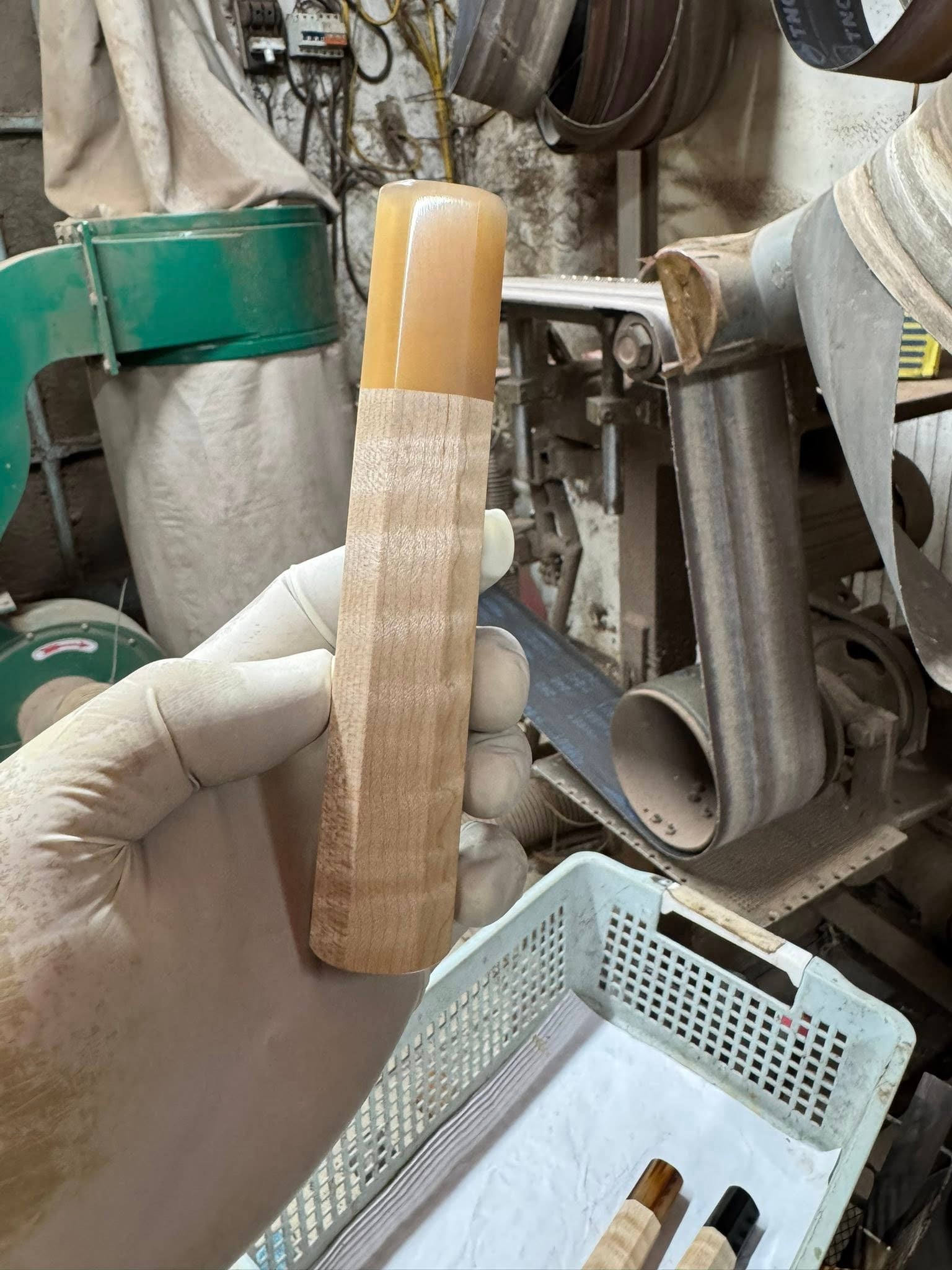
Its useful job is at the most stressed part of the handle: the opening around the tang. A well-fitted ferrule reinforces that front section and helps it resist splitting as the tang is seated. It also forms the transition your fingers encounter close to the blade, especially with a pinch grip.
So a ferrule can change feel in two quiet ways. Its shape and finish affect whether the front of the handle feels abrupt or smooth, and its material adds some mass near the front of the grip. Neither effect should be exaggerated; the blade and handle body usually matter more to overall balance.
The ferrule is both visual and functional. Color is obvious, but reinforcement and the hand-to-blade transition are the reasons it belongs in an anatomy guide.
Wa handle vs yo handle: what changes for the user?
“Wa” refers to Japanese-style handle construction; “yo” to Western-style construction. A wa handle is typically a one-piece handle fitted over a hidden tang, while a yo handle commonly uses scales around a broader tang, often with pins or rivets.
Both words are ordinary Japanese: 和 (wa) means Japanese or Japanese-style — the same wa as in washoku, Japanese food — while 洋 (yō) means Western, as in yōshoku. The pair simply marks one handle as the Japanese-style one, the other as the Western. You will also see “wa” explained as “harmony”; that is a real meaning of the character, but not the one at work here.
What changes for you is mainly grip shape, weight distribution and serviceability. Wa handles are commonly octagonal, oval or D-shaped, while yo handles are usually contoured more like familiar Western chef’s knives. But do not reduce the choice to “wa is light, yo is heavy.” Actual weight depends on the knife, tang, dimensions and materials.
If you are deciding between the two, the detailed wa handle vs Western handle guide covers the comparison. Here the important point is simpler: handle construction changes where mass sits and how easily the handle can later be replaced.
At Horn & Grain we work with four handle shapes — octagonal, oval, D-shape and round — and four size tiers, each named for the knives it most often serves: Compact (petty, small utility), Mid-size (santoku, bunka, nakiri), Chef (gyuto, kiritsuke) and Long (sujihiki, yanagiba), recommended from your knife type and blade length. Those tiers illustrate the principle: a handle is fitted to a knife. “Wa handle” is a construction family, not a universal-size part.
Where does the balance point sit, and what moves it?
There is no correct balance point for every Japanese knife. Two knives of the same length can feel different because their blades, tangs and handles distribute mass differently.
If a knife feels blade-heavy, more mass is pulling forward of your grip. If it feels handle-heavy, more sits behind the grip. Neither is automatically wrong. A forward-biased knife can feel purposeful in slicing and chopping; a more neutral knife can feel quick to redirect. Preference also changes with grip and cutting style.
Balance moves when mass distribution changes. A thicker or taller blade, or more steel toward the tip, can move it forward. A longer tang puts more steel inside the handle. A larger or denser handle, heavier ferrule, or added material at the butt can move it back toward the hand.
This is why changing a wa handle can noticeably change a knife without touching the blade. Wood species alone does not determine the result: dimensions, ferrule, tang insertion and end-cap material all contribute.
A useful diagnosis is to separate “cutting feel” from “balance feel.” If the knife wedges in food, look first at blade geometry. If it cuts well but the nose seems to pull your hand forward, look at the balance system — especially blade mass and handle mass. If edge orientation feels vague, handle shape may be the bigger issue.
If the edge enters a carrot or potato but resistance builds deeper in the cut, see why a sharp knife wedges in carrots and potatoes. If a cut consistently drifts to one side, check the setup and grind before suspecting blade damage.
Once you make those distinctions, “this knife feels wrong” becomes a much more useful observation.
Which parts are replaceable or repairable, and which are not?
A Japanese knife is not a kit that should be pulled apart for routine cleaning, but many wa-handled knives are built from serviceable parts rather than as one permanently sealed object.
The edge is the obvious serviceable part. Normal dullness is corrected by sharpening. Small chips can often be sharpened out or professionally reprofiled, depending on their depth and the blade. Surface rust or patina can often be addressed before it becomes structural damage. More serious thinning, straightening or refinishing is specialist work.
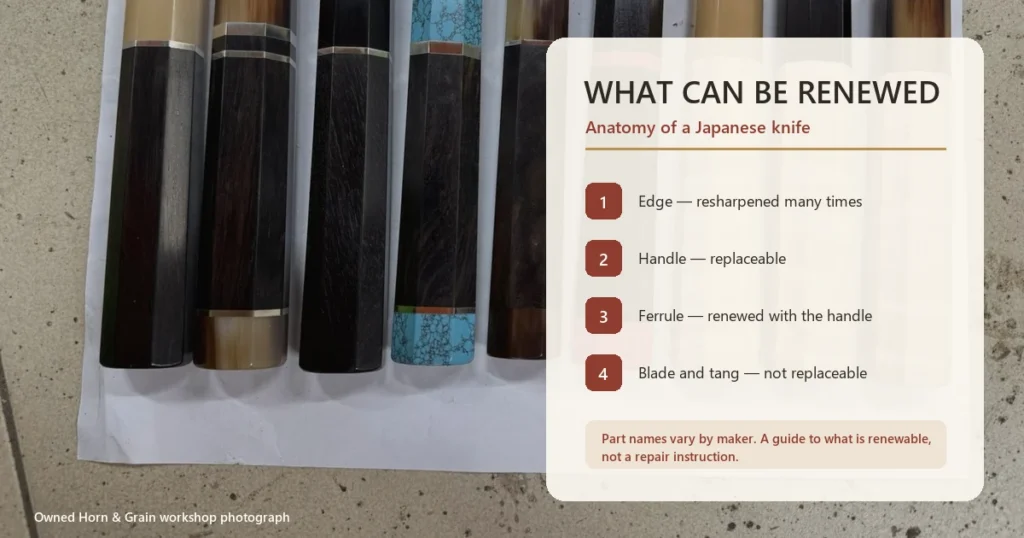
The wa handle is one of the clearest replaceable components. If the wood is damaged, the fit loosens, or the owner wants a different shape or balance, the old handle can often be removed and another fitted to the hidden tang. The ferrule is usually part of that handle assembly rather than a separate user-service item.
Replaceability does not mean universality. Tang dimensions and taper vary by maker, as do blade size and desired balance. In practical terms, handles are fitted to a knife’s tang, which is what a configurator is for.
The tang itself is structural steel. With the handle removed, superficial corrosion may be cleanable, but a deeply corroded, cracked or deformed tang is not something a new handle fixes. Likewise, a badly damaged blade is not “replaceable” in the same sense as a wa handle; then you are dealing with repair feasibility, not modularity.
For the part you can preserve most easily, routine handle care matters more than rescue work. The wa handle care guide covers that in detail.
The useful idea to keep is that blade and handle are not “functional part” and “decorative part.” They do different jobs in the same system. The blade determines how the knife enters and moves through food. The tang joins that blade to your hand. The ferrule reinforces and finishes the transition. The handle sets grip, orientation and part of the balance.
That is also why a well-made wa-handled knife can have a life beyond its first handle. The cutting tool can be sharpened and maintained, and when the fit or handle eventually needs to change, it can be re-handled instead of automatically replaced.