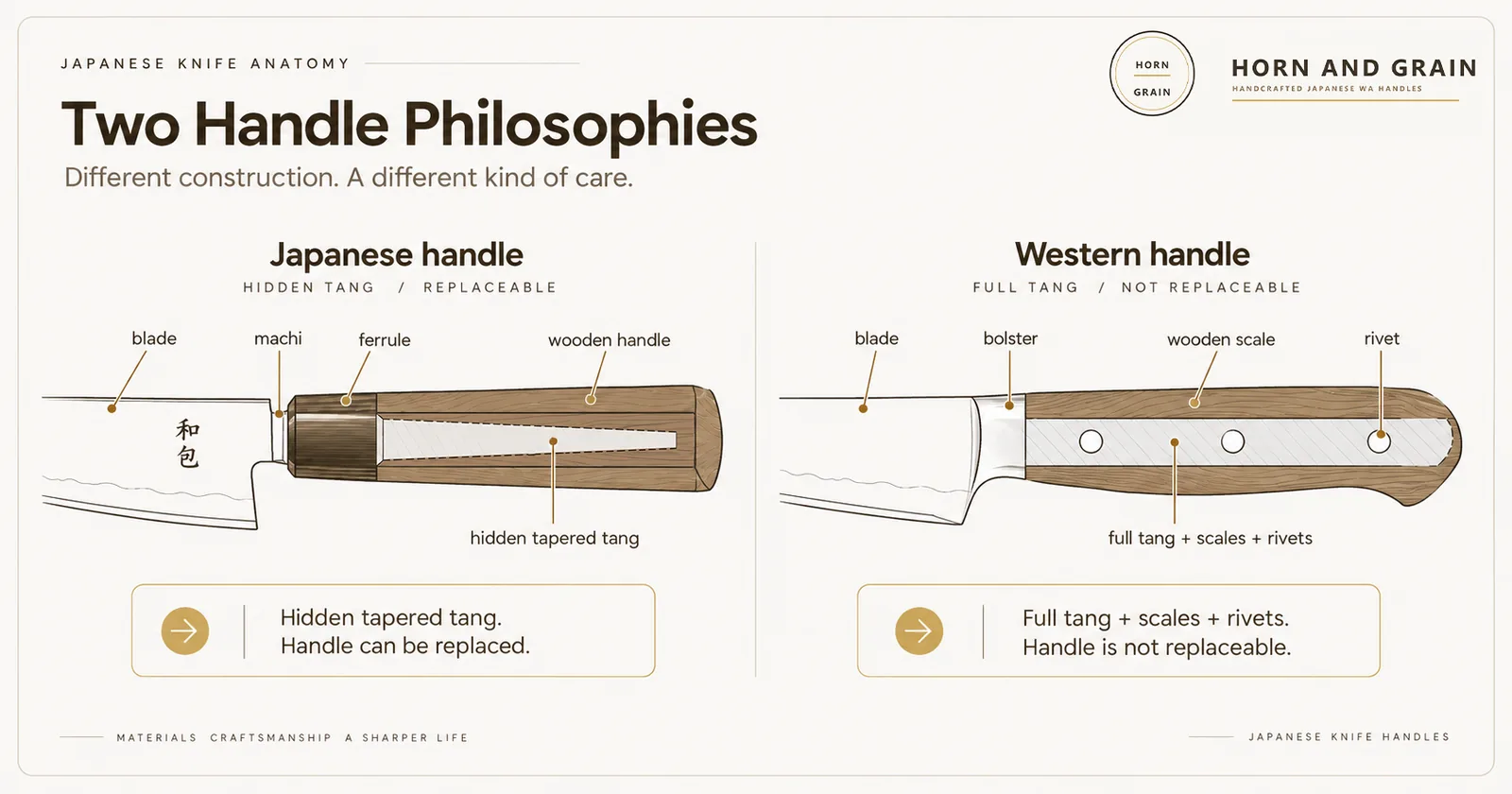
Short answer: choose between a wa handle and a Western (yo) handle by starting with the knife’s tang and the repair you are actually planning. A typical wa handle surrounds a hidden or partial tang and is often replaceable. A typical Western handle uses two scales around a broader tang, often with pins or rivets. Those are common patterns, not universal rules. Handle shape, material, dimensions, attachment method, and blade mass determine the final grip and balance.
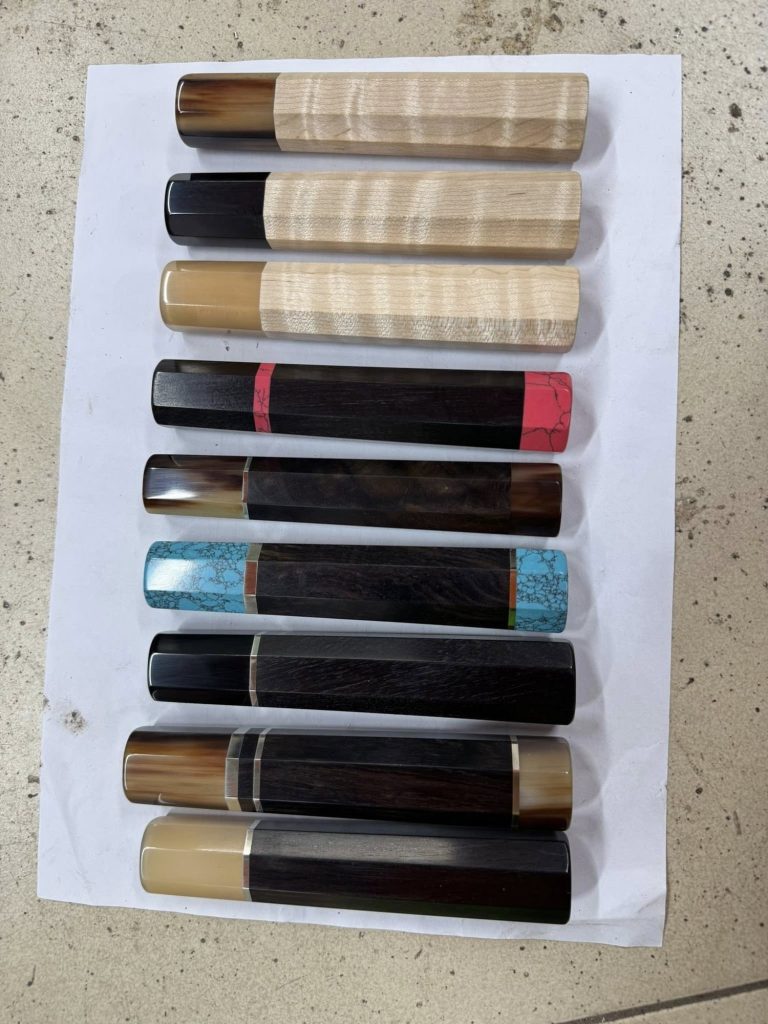
Horn & Grain makes wa handles. Its configurator does not offer Western scales or promise full-tang-to-wa conversions. If your knife already has a compatible hidden tang, the configurator is a sensible next step. If it has exposed metal around the entire handle, send photographs and measurements to a qualified rehandler before ordering anything.
Wa vs Western handles at a glance
Wa handle
- Common construction: one-piece or segmented handle around a hidden or partial tang.
- Common shapes: octagonal, oval, D-shaped, round, and maker-specific hybrids.
- Balance tendency: often less metal and mass behind the blade, although dense woods and end caps can change that.
- Replacement: often designed to be removed and refitted; the actual adhesive and fit method still matter.
- Horn & Grain path: compatible custom and ready-to-shop wa handles.
Western / yo handle
- Common construction: scales attached on either side of a broader tang; pins, rivets, adhesive, or a molded construction may be used.
- Common shapes: contoured scales or molded forms; geometry varies widely by maker.
- Balance tendency: often more tang and handle mass, although skeletonized tangs and light materials can change that.
- Replacement: scale replacement is possible, but generally requires a shop process.
- Horn & Grain path: no Western-scale option is shown in the current configurator.
Compatibility and balance
- Identify the tang construction before ordering a replacement.
- Compare actual finished dimensions and weight rather than relying on a style tendency.
- Do not assume that a full-tang knife can accept a standard wa handle.
First question: what tang is inside the handle?
A handle style cannot be ordered safely from blade length alone. Look at the construction you can actually see. If a strip of blade steel is visible around the top, bottom, and butt of the handle, the knife probably has a broad or full tang between scales. If the handle surrounds the steel and only the blade enters at the front, it may have a hidden or partial tang. “Probably” matters: bolsters, caps, liners, and molded handles can hide the true geometry.
Do not grind down a full tang simply because a wa handle looks appealing. Removing tang steel is permanent, can alter balance, may affect heat-treated areas, and can reduce the value or integrity of the knife. That conversion belongs with a knifemaker who has inspected the blade. Horn & Grain’s current custom flow asks for knife and tang information, but it is a wa-handle ordering tool—not authorization to modify every knife.
For an existing wa-handled knife, removal is still not automatically easy. Traditional friction or burn fits, hot-melt adhesive, epoxy, and repairs by previous owners behave differently. Sakai Ichimonji’s workshop guide shows old-handle removal and exposed-tang cleanup as separate steps before fitting a replacement. The attachment method must be identified before heat or force is applied.
Balance is a measured result, not a style guarantee
Wa handles are often described as light and blade-forward, while Western handles are described as heavy and neutral or handle-forward. That is a useful tendency, not a promise. A dense wa body, large horn components, metal spacers, or a decorative end cap can add substantial rear mass. A Western handle can use light scales and a skeletonized tang. Two knives with the same handle label can therefore balance differently.
Use a simple before-and-after brief instead of asking for “better balance”:
- Record the current knife’s total weight and balance point.
- Measure blade length and current handle length, height, and width.
- Describe the grip you actually use and the task that feels awkward.
- For wa replacement, record tang width, height, exposed length, and photographs from the side and spine.
- Ask for the candidate handle’s finished weight and dimensions when balance is critical.
The Horn & Grain size guide gives starting ranges by knife type, but those ranges do not override tang compatibility, hand size, or a measured balance goal.
Grip and orientation
An octagonal wa handle provides flat reference surfaces, which can make edge orientation easy to feel. An oval handle removes sharper transitions and may suit someone who changes grip frequently. A D-shaped handle is asymmetric and should be selected with handedness and the actual blade in mind. Horn & Grain’s current configurator displays octagonal, oval, D-shape, and round options. When you select D-shape, the configurator requires a right- or left-handed orientation, and Horn & Grain confirms the finished profile before production.
Western handles range from nearly rectangular scales to deeply sculpted molded grips, so it is not honest to call all of them “more ergonomic.” A contour that fits one hand can create a pressure point in another. Nor does a pinch grip belong exclusively to wa handles or a handle grip exclusively to Western ones. The better test is whether the geometry gives secure orientation without forcing the wrist or concentrating pressure during the cook’s normal work.
If possible, compare handles on knives with similar blades. Testing a light santoku with a wa handle against a thick, bolstered Western chef’s knife does not isolate the handle; blade geometry and total mass dominate the experience.
Durability, hygiene, and care
Neither construction is automatically more hygienic. A clean, sealed junction is easier to maintain than a cracked or gapped one, whether the handle has one front opening or several scale and pin interfaces. Wash the knife by hand, avoid soaking and dishwashers, and dry around the blade-handle junction. If the handle moves, emits an odor, shows a widening gap, or has a cracked ferrule or scale, stop treating the problem as routine oiling.
Wood care depends on the actual finish. The USDA Forest Products Laboratory documents that wood responds to moisture and that finishes retard moisture exchange rather than eliminating it. A fixed “oil every month” rule is therefore less useful than knowing whether the handle is unfinished, oil-finished, waxed, or covered by a cured film. Follow the maker’s finish-specific instruction.
Wa handles often have a practical service advantage: specialist shops routinely remove worn handles, inspect the tang, and install replacements. That does not make the job risk-free. Tosho Knife Arts emphasizes dry fit and alignment during installation, while Knives and Stones warns that a burn-in method suitable for softer handle woods can split a hardwood handle. Material and attachment method must guide the procedure.
Can you switch from one style to the other?
Wa to wa: commonly feasible when the old handle can be removed safely and the exposed tang is sound. Use the replacement guide for removal and tang inspection, then the installation guide for dry fit, alignment, and attachment.
Western scales to new Western scales: a professional can often re-scale a suitable full-tang knife. Horn & Grain does not currently list this service or these components.
Western/full tang to wa: sometimes technically possible, but it may require permanent tang modification or a custom handle engineered around unusual geometry. Do not purchase a standard wa handle on the assumption that it will slide onto a full tang.
Wa/hidden tang to Western scales: not a normal scale replacement. A hidden tang does not provide the broad steel perimeter to which conventional Western scales attach. A custom maker would need to design an entirely different construction.
Which handle fits your decision?
Choose a wa handle when the tang is compatible, you value replaceability and clear shape orientation, and you can select a measured build that supports the desired balance. Keep or repair a Western handle when its construction already suits the knife and your grip, or when conversion would require unnecessary permanent metalwork. Ask a specialist before either choice if the knife is valuable, antique, cracked, heavily corroded at the junction, or structurally unclear.
Horn & Grain’s role is narrower and more useful than claiming one style wins: it can help plan a compatible wa handle from the submitted knife, tang, shape, and material information. It should not imply that every knife can accept one.
Reviewed 7 August 2026. Method: the current Horn & Grain configurator, size workflow, and service content were checked against installation and replacement demonstrations from specialist Japanese-knife workshops. Construction and balance statements are framed as tendencies unless the individual knife can be measured.
Workshop and technical references
- Sakai Ichimonji Mitsuhide: knife handle replacement
- Tosho Knife Arts: wa-handle installation workshop note
- Knives and Stones: installing a hardwood wa handle
- USDA Forest Products Laboratory: Wood–Moisture Relationships
- USDA Forest Products Laboratory: Finishing of Wood
Plan a compatible custom wa handle from your knife and tang information