A deba is a thick-spined, single-bevel Japanese knife made to break down whole fish: removing heads, working through collars, freeing fillets, and cutting small bones. Rather than relying on chopping force, it uses its own weight and a stiff edge in controlled cuts. Blades commonly run about 120–210 mm, varying by maker. Hon-deba, ko-deba, ai-deba, and mioroshi-deba trade thickness for reach in different ways. A deba is not a bone cleaver. It passes through small fish bones and joints with weight, not through thick bones with force. Once the fillets are free, check for pin bones with fish-bone tweezers before cooking.
That makes “versatile” a relative description. Within whole-fish preparation, a deba can cover several jobs that would otherwise call for different cutting motions. Outside that work, its thickness and asymmetry become constraints. The weight is a feature when heads, collars, and frames are routine; it becomes a burden when the cook mainly handles prepared fillets or delicate fish. The useful questions are what size fish normally comes home, how substantial its bones are, and whether the work is mostly breakdown or long filleting.
Deba vs a Western fillet knife
These knives solve fish work from opposite directions. A Western fillet knife is thin and flexible, allowing its blade to bend and ride close to the frame as the cook follows the bones. A deba is stiff and heavy; it separates the head and collar, deals with small bones, and then follows the frame with stability, weight, and its single bevel. The flexible knife asks the hand to guide a bending blade through long, close passes, while the deba asks for deliberate placement and controlled use of mass. Neither philosophy wins in the abstract. A flexible fillet knife may feel more natural for skinning and tracing fine curves, while a deba brings authority when a whole fish still has its head, collar, and firmer structure. They can overlap, but one is not a direct replacement for the other. For the Western knife choice, see boning vs fillet knife choice.
Deba vs honesuki for chicken
A deba can be used on poultry, especially where a cook already understands how to find joints and avoid forcing the edge, but that does not make chicken its central job. The honesuki is the Japanese poultry knife, designed around working close to a bird’s joints and frame. If chicken is the reason for choosing a knife, read what a honesuki is rather than treating the deba’s occasional crossover as proof that it is the more general tool.
Hon-deba, ko-deba, ai-deba, and mioroshi-deba
The hon-deba is the full-bodied reference point: substantial spine, depth, and weight for the main sequence of whole-fish breakdown. A Sakai maker’s guide describes its standard deba range as 100 mm to over 240 mm, usually stepping by 15 mm. Those are that maker’s figures, not a universal sizing law. More length can suit a larger fish, but it also brings more blade to steer and more mass to manage. The useful question is the scale of the fish that normally reaches the board.
Ko-deba takes the idea toward small fish. Its compact blade is easier to place around a small head and short frame, where a long, weighty hon-deba can feel disproportionate. It gives up reach and some of the authority that comes with a larger, thicker blade. That trade makes sense for small whole fish, but the word ko does not turn it into a general-purpose petty knife. The Sakai maker’s guide does not give ko-deba a separate length range.
Ai-deba reduces thickness and weight while retaining deba-like depth and useful reach. The same guide gives 180–225 mm as that maker’s range, again in 15 mm steps. It suits fish whose bones do not call for the full substance of a hon-deba, accepting less mass and stability in return for easier handling. It is still a deba, not a thin fillet knife.
Mioroshi-deba leans furthest toward slicing. It is longer and thinner than the other forms, combining some deba capability with the reach needed for long cuts through a fillet. The guide describes 30 mm size steps and a maximum of 300 mm, but does not state a complete range. Its extra reach and reduced thickness help with filleting, while making it less suited to tougher material. Across the four forms, the choice is not a ranking: it is a decision about fish size, bone structure, available board space, and how much of the job is separation rather than long slicing.
Why a deba is heavy and single bevel
The mass is working structure. With the edge placed carefully, the blade’s weight helps it pass through a collar, joint, or small fish bone without the high-impact swing associated with a cleaver. The thick spine keeps the blade stiff and resists unwanted twisting. Its single bevel helps the cutting face track along bone and leave a clean face on the flesh. That is the geometry point that matters for this knife; the broader lesson belongs to the single-bevel page.
Spine, bevel, machi, and tang describe different parts, and anatomy of a Japanese knife is useful if those names are unfamiliar. They matter together on a deba because stiffness, cutting bias, and the connection into the handle all influence how the knife feels under its own mass. For a gift, a deba is a riskier choice than a symmetrical knife: it is single-bevel and handed, so the cook’s dominant hand needs to be known before choosing.
What chips a deba
Thickness is not permission to strike anything. Thick bones, frozen fish, twisting the blade while it is caught in a joint, and using it as a cleaver can all overload the edge. The correction is simple: a deba is not a bone cleaver; it is a fish knife that uses controlled weight through small bones and properly located joints. Once damage exists, the general causes and the decision between a home repair and a professional regrind belong with why Japanese knives chip, not in a guide to choosing the knife.
What a blade this thick asks of its handle
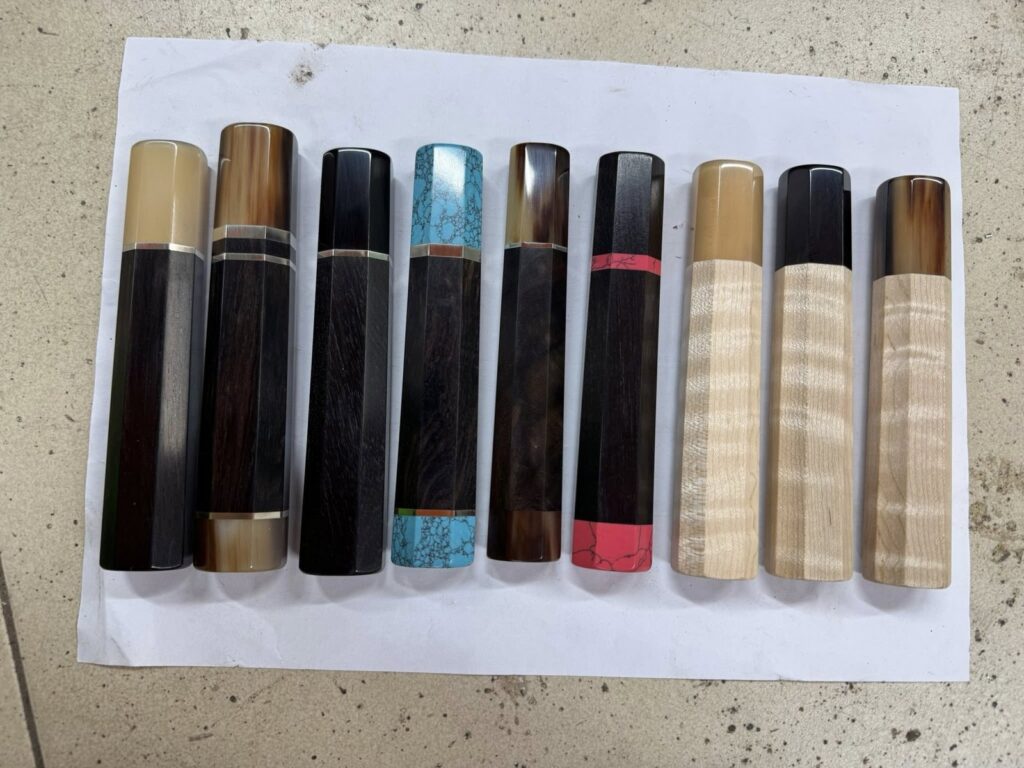
A thick, heavy blade wants a fuller handle with enough mass behind the hand that the whole knife does not feel like an unsupported blade pulling forward. This is qualitative, not a formula: hand size, grip, blade length, tang, and personal tolerance for forward balance all change the answer. Secure fit at the tang and machi matters too, because a precise, weight-led tool should not feel vague where blade and handle meet.
Handle fit is individual rather than something the word deba settles by itself. A Sakai maker’s guide notes that handle size changes as its deba blades and tangs get larger, but that relationship does not produce one universal pairing. The wa handle size guide provides the fit context for pairing a handle with a heavy blade without pretending that every deba calls for one fixed answer.
At Horn & Grain, we make handles rather than knives. The useful starting point remains the fish: choose the deba variant around what actually comes home, then give that particular blade a handle that belongs with it.