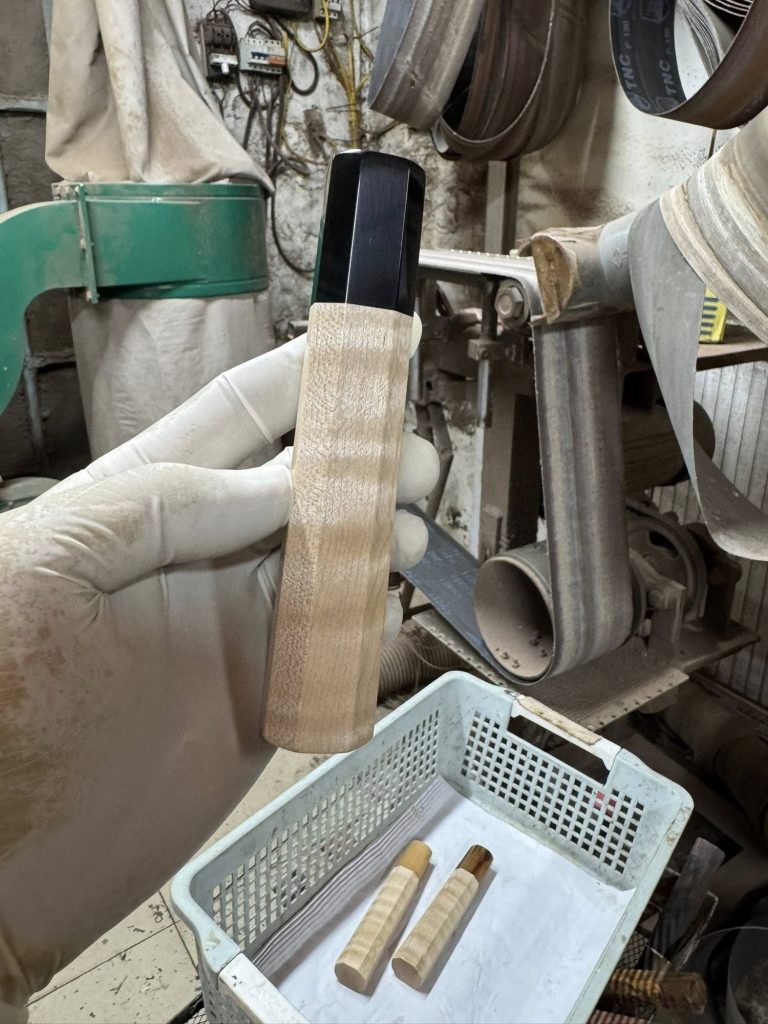
Traditional Japanese knife handles often use ho (hō / hōnoki, magnolia) because it is light, soft, straight-grained, low in resin and stable. Japanese encyclopaedias describe it as soft and little prone to warping; the botanical entry calls it “strong, light, and easy to work, sought by craftsmen”; Sakai City calls the haft “rot-resistant magnolia wood.” Its plainness is a design choice, not a corner cut. Ho is kind to steel, inexpensive to shape and replace, and expected to wear first. It is not the best wood, but the right wood for a handle designed to be refitted.
The tree behind the handle
Ho is Magnolia obovata, a deciduous magnolia. The botanical entry for the species describes it as native to Japan and the adjacent Kurile Islands, found from near sea level to 1,800 metres and reaching 15–30 metres in height.
A workshop wood, not a display wood
The recorded uses of ho make its place on a knife easier to understand. Encyclopedia Nipponica describes the timber as soft and little prone to warping, while the Britannica International Encyclopedia lists ho for woodblocks, sword sheaths and the teeth of wooden clogs. The published specification for Wajima lacquerware also names magnolia among its accepted base woods. It is one option in that specification, not the only wood beneath Wajima lacquer.
These objects ask different things of a material, but they share a workshop logic. Ho has a straight grain that takes a cutting tool cleanly. Its softness makes controlled shaping easier; its stability helps the finished shape remain useful; and its low resin content suits close work around steel. It can form a precise working surface without becoming more precious than the object it supports.
The roles also reveal what “good wood” means in context. A woodblock rewards a clean cut. A wooden-clog tooth is a wearing part. A lacquerware base does its work beneath another surface. A sword sheath must sit beside finished steel without needlessly marking it. In each case, visual drama matters less than predictable behaviour, and the possibility of repair or replacement is part of the object’s practical life.
The kitchen counterpart to the sheath has its own questions. The separate guide to what a saya is covers that object’s fit, pin and care without turning the handle’s material history into a sheath guide.
Ezuke: fit before permanence
Sakai City identifies handle fitting as ezuke and describes the final hafting of a wa handle—a wooden handle with a horn or wood ferrule fitted onto a hidden tang—this way: “the blade is inserted into a notch in the haft and fixed in place by striking the knife with a wooden mallet.” The brief description centres a fitted joint. In that joint, a slightly yielding wood can bear around a tapered tang. Close surface contact creates friction, allowing the handle to hold without requiring the joint to begin as a permanent adhesive bond.
That reversibility is not an incidental convenience. With a traditional friction fit, a handle that is worn or damaged can be knocked off and another fitted while the blade remains in service. The humble material accepts shaping and wear before the steel does. Softness, in this relationship, is not the absence of quality; it is what gives the handle its role as the replaceable part.
Friction fit is a tradition, not a claim that Japanese handles are never glued. Some makers also use adhesive to secure the tang or seal the opening, and an adhered assembly may not behave like a removable friction fit. The actual fitting sequence belongs in how to install a wa handle; the point here is that ho makes a close, serviceable fit possible.
Is “antibacterial ho wood” true?
No source used for this material history establishes that ho handle wood is antibacterial. Studies reporting antibacterial activity concern extracts from magnolia bark used in traditional medicine, not dry handle wood in ordinary kitchen use, so those findings cannot simply be transferred to a handle surface. The property Sakai City actually gives is “rot-resistant.” That is the supported description; rot resistance is not a synonym for antibacterial.
Why soft ho is paired with a ferrule
The common explanation for the ferrule is that the collar braces the opening around the tang and helps the wood resist splitting as the tapered tang is seated. This is local reinforcement: the main body can retain the yielding character that makes it easy to fit, while the opening receives support against the tang’s spreading force.
Buffalo horn is traditional in this role, though wood and synthetic ferrules also exist. With buffalo horn, the pairing is practical rather than contradictory. A soft wooden body and a firmer collar do different jobs within one handle; the collar supports the vulnerable opening rather than turning the whole piece into a hard, permanent shell.
Why the handle wears first
Denser hardwoods shift a handle’s weight, balance and appearance; choosing among them belongs in the wood guide.
Like other relatively soft, pale working woods, ho can darken and polish under the grip while taking dents and stains. When the wood is no longer sound enough to serve, the handle is knocked off and replaced. That ending completes the material logic rather than defeating it: ho yields its place without requiring the blade to be discarded.
Seen within Japanese kitchen craft, the traditional ho handle expresses a clear order of value: preserve the steel, fit the wood to it, and let the handle be the part that wears first. Its humility is not an apology. It is a design for repair.