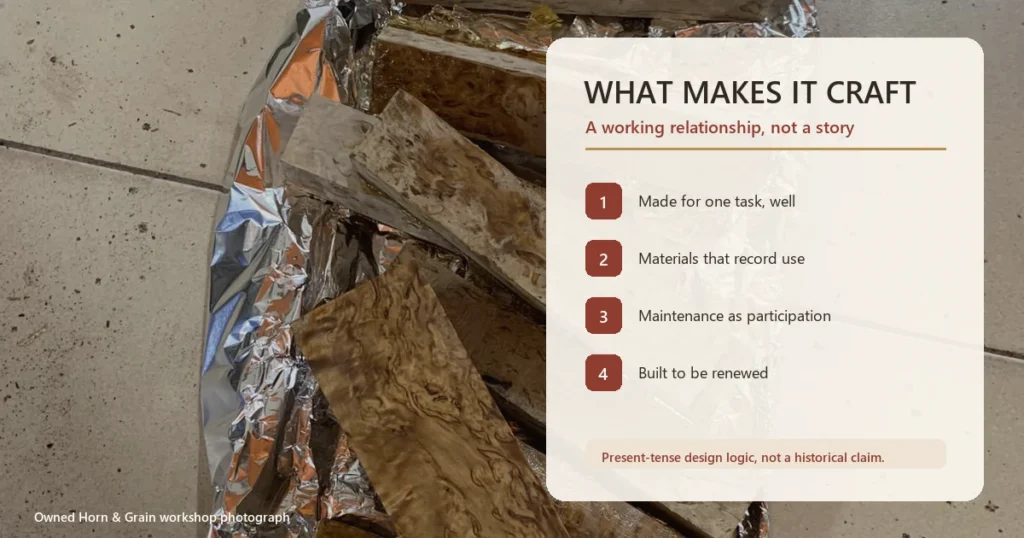
What makes Japanese kitchen tools feel like craft objects rather than mere utensils? A working relationship. They are designed around particular tasks and materials, made to be maintained rather than replaced, and expected to change through use. The owner’s care—sharpening, drying, oiling, and eventually re-handling—is part of the object’s life, not an inconvenience added afterward. Craft is therefore not only visible in the maker’s choices. It continues in the user’s hands, through small acts that keep the tool useful.
This relationship matters more than decoration, rarity, or a romantic story about where an object came from. A plain knife, grater, or cutting board can embody it. The evidence appears in how closely the object fits its work, how honestly its materials age, and how readily it can be renewed. For a focused comparison, see see how the kitchen tools guide separates grater tasks.
Specialization as a design philosophy
A common Western home-kitchen pattern is consolidation: one chef’s knife handles most cutting, a box grater offers several surfaces, and a durable board accepts whatever task arrives. It is an efficient arrangement.
Many Japanese kitchen tools express a different design instinct. Instead of asking one object to perform every job adequately, they narrow the job until the form can answer it precisely. A vegetable knife may carry a broad, relatively flat edge that meets the board cleanly through cabbage, herbs, and roots. Its shape is not versatility for its own sake; it is an accommodation to repeated contact between vegetables, steel, hand, and board.
A single-purpose grater makes the principle even clearer. It may occupy drawer space for one preparation, yet its teeth, stiffness, and working area can be tuned to the texture it is meant to produce. A cypress cutting board brings its own kind of specificity: it is comparatively soft beneath a keen edge, pleasant under the hand, and dependent on thoughtful washing and drying.
None of these objects is automatically superior because it is specialized. Specialization trades convenience for focus. It asks the user to understand what a tool does well, choose it deliberately, and let its limits remain visible. The object becomes legible: its shape explains its purpose.
Materials that record use
Craft materials are sometimes described as though their highest virtue were remaining untouched. Kitchen materials lead more active lives.
Carbon steel reacts with food, moisture, and air. With use it can develop a patina: a stable-looking record of meals prepared and surfaces exposed. That change does not excuse rust or neglect. It distinguishes controlled aging from damage and makes care visible in the steel.
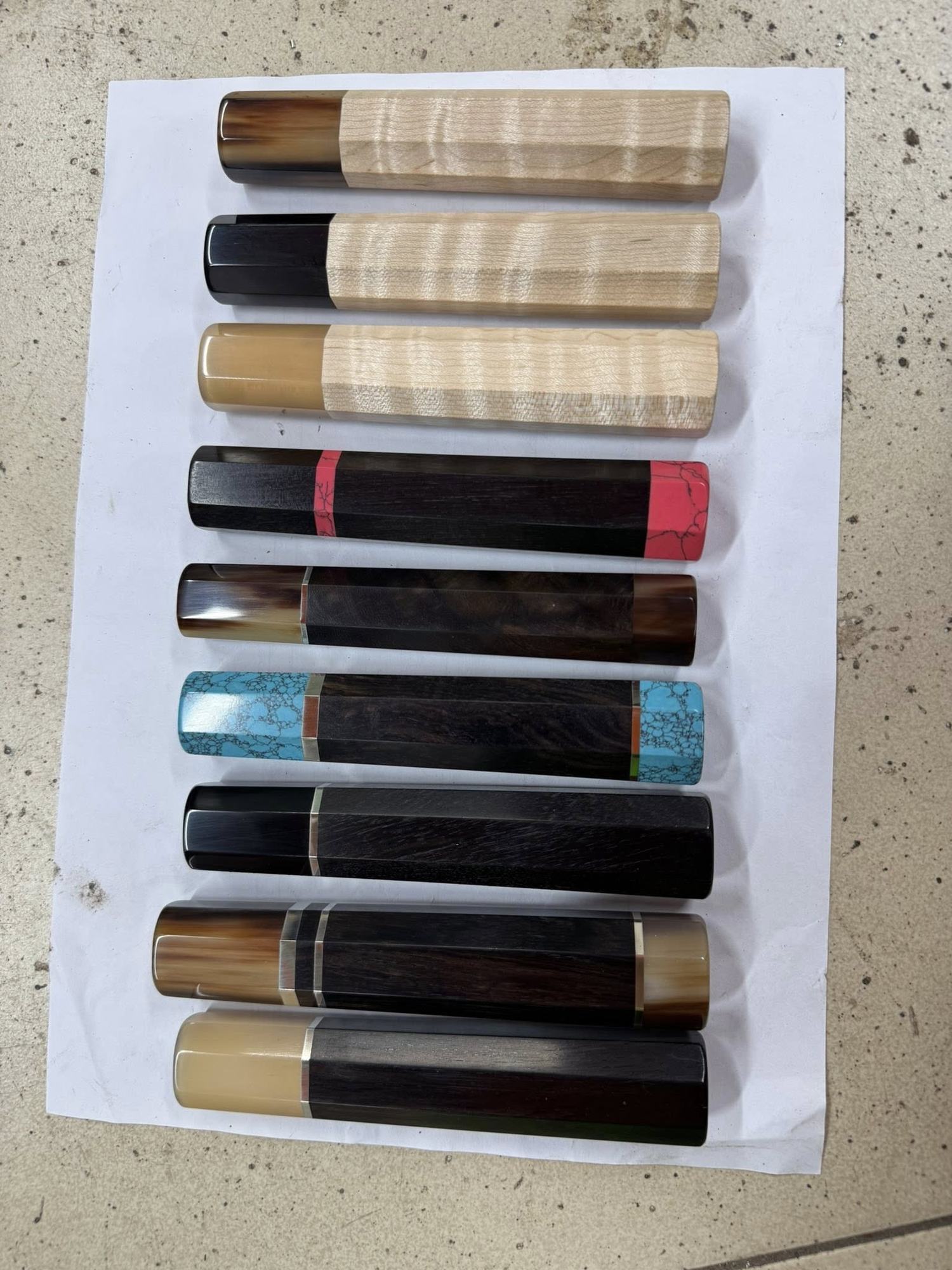
Wood also records contact. A handle may darken where fingers repeatedly hold it. Grain becomes more apparent as the surface settles, while small marks soften the perfection of a new object. Different species respond differently to moisture, oils, and wear; our wood guide looks more closely at those practical differences. Horn can become smoother and more lustrous where it is handled, polishing gradually rather than staying visually fixed.
These materials do not merely tolerate time. They disclose it.
That is not an argument against stainless steel, molded handles, or synthetic boards. Japanese kitchens contain all of them, and they can be exceptionally practical. Resistance to staining, dimensional stability, and easy sanitation solve real problems. Craft does not require fragile materials or a compulsory patina. The important question is whether the material suits the work—and whether its needs are understood rather than hidden.
Maintenance as participation
Maintenance is where the relationship becomes most vivid. A maker establishes geometry, joins materials, and prepares a working surface. The user keeps those decisions alive.
Sharpening on stones is a direct example. Each session removes a minute amount of steel and restores the meeting of two planes at the edge. Pressure, angle, stone condition, and finishing choices affect how the knife returns to the board. Poor sharpening can distort the maker’s geometry; attentive sharpening preserves it while adapting the edge to actual use.
Wooden tools ask for quieter routines. A board is washed without being left submerged, wiped, and set where air can reach its faces. A handle is dried instead of remaining wet beside the sink. When appropriate, a suitable oil is applied sparingly to slow excessive drying and help the surface remain stable. The wa handle care guide sets out that work in practical terms.
These actions are modest, but they change the meaning of ownership. The object is not delivered in a permanently finished state. It is finished again after each use: cleaned, dried, inspected, sharpened when needed, and returned ready for work.
This is not reverence for its own sake. A knife exists to cut, and a board exists to be marked. Care is valuable because it protects function. It also develops judgment. The user learns the sound of an edge on a stone, the feel of wood that has taken on too much moisture, and the difference between an honest patina and active corrosion. Knowledge accumulates alongside wear.
Serviceable by design
A serviceable object anticipates that its working surfaces will eventually change. It leaves a path back.
A knife edge is consumed slowly through cutting and sharpening, yet it can be formed again many times. A solid wooden board can collect grooves and stains, then be flattened or re-planed when its surface no longer serves well. Loose fittings can be assessed; worn parts can be repaired or renewed.
A wa-handled knife makes this logic especially visible because its handle is replaceable. The blade and handle have different rates of wear and different jobs, so they need not share the same lifespan. Understanding the anatomy of a Japanese knife helps make that separateness clear: blade, tang, handle, and fittings form a working assembly rather than an indivisible object.
Replaceability does not mean casual interchangeability. A new handle still has to fit the tang, align with the blade, seat securely, and suit the balance of the knife. Service requires knowledge. But the possibility of service changes the future of the object. Wear becomes a stage in its life, not an automatic reason for disposal.
This is the practical bond between maker and user. The maker leaves the object maintainable; the user accepts responsibility for noticing when maintenance is due.
The honest modern picture
Most Japanese kitchen tools today are factory-made, and many are excellent. Precision grinding, controlled heat treatment, stable synthetic materials, and repeatable production can produce tools that work beautifully. A handmade object can be poorly conceived, while a mass-produced one can be thoughtful, durable, and repairable.
“Craft” is therefore not a reliable synonym for handmade, old, scarce, expensive, or Japanese. It describes an approach as much as an origin story: close attention to purpose, materials selected with their full lifespan in mind, and a willingness to maintain what is worth keeping.
There is no need to police authenticity. A stainless santoku sharpened regularly can participate in this relationship. So can a carbon-steel vegetable knife, a machine-made grater, or a cypress board dried carefully after dinner. The meaningful distinction is not between pure tradition and compromised modernity. It is between objects treated as sealed consumables and tools understood as ongoing work.
Japanese kitchen craft becomes clearest at that point of continuation. The maker does not have the final word, and neither does the factory. The edge meets the stone, the wood meets the hand, and usefulness is renewed through attention.