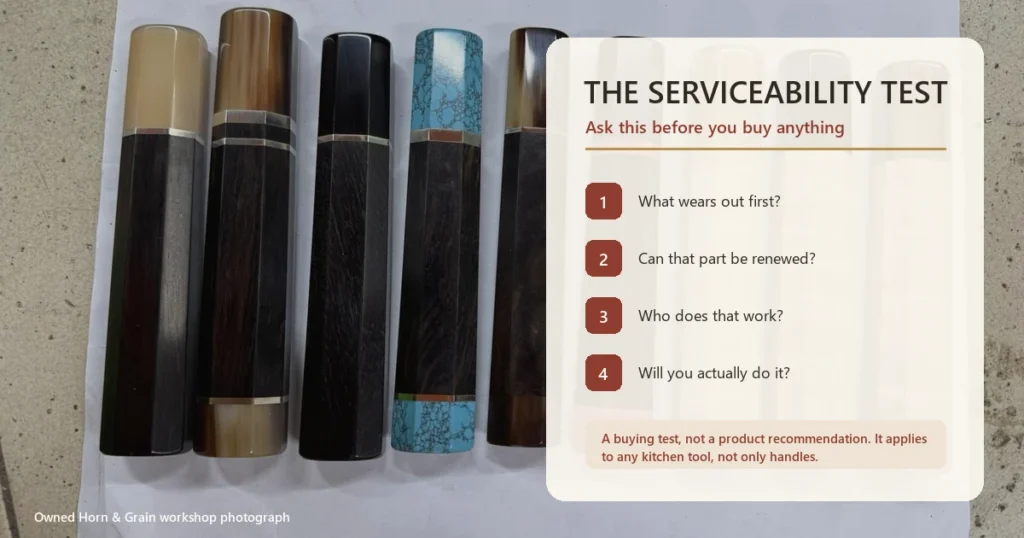
Which kitchen tools actually reward maintenance? The ones whose first-wearing part can be renewed without discarding the rest—and whose owner will realistically renew it. An edge that can be resharpened, a board that can be resurfaced, or a handle that can be replaced has a future beyond its first signs of wear. Toughness and price do not answer this question. Before buying, identify the wear part and ask whether it can be restored or replaced. A cheap tool with a replaceable wear part can outlast an expensive tool sealed against repair.
This principle runs through Japanese kitchen craft, but it applies just as well to an ordinary board, storage rack, or pair of shears. The useful distinction is not between premium and basic, but between objects that can absorb wear and objects whose first serious fault becomes their last.
Find a guide by the job
Choose the task in front of you, then start with a guide written to answer it. If you are troubleshooting a kitchen knife, use the Knife Problem Finder to choose a practical first check.
Sharpen and maintain
- Your first whetstone setup
- Choose a whetstone grit
- Flatten a whetstone
- Choose a sharpener for Japanese knives
- Sharpen a serrated bread knife
- Check a dull or chipped ceramic knife
- Prepare a knife for mail-in sharpening
- Diamond plates vs waterstones
- Use a nagura stone
Choose and care for a cutting board
- Choose a cutting-board size
- Choose a board for Japanese knives
- Bamboo vs wood cutting boards
- Hasegawa vs Asahi cutting boards
- Clean a wooden cutting board
- Oil a wooden cutting board
- Clean and dry a wooden spoon
- Check a warped wooden board
- Stainless-steel cutting boards and knives
Prepare, cook, and serve
Prepare ingredients
- Choose a Benriner mandoline width
- Set up and use a mandoline with its food holder
- Choose a Japanese grater by ingredient
- Choose a Japanese peeler by task
- Choose a rolling-pin shape by dough and grip
- Remove pin bones with fish tweezers
- Learn Japanese vegetable cuts
- Choose and use a rice-washing bowl
- Choose and use a suribachi
Cook and simmer
- Use a bamboo steamer
- Use an otoshibuta drop lid
- Choose a yattoko pot
- Choose a takoyaki pan
- Choose a tempura pot
- Mesh skimmer vs ladle
- Choose a colander or strainer by task
Serve and care
- Hangiri vs ohitsu
- Understand a rice-cooker measuring cup
- Choose a scale or cups for baking
- Choose and use a shamoji rice paddle
- Use a miso strainer
- Choose a whisk by shape and task
- Choose a fish spatula or turner
- Use a sushi mat
- Japanese kitchen towels: fukin and sarashi
- Choose a tawashi brush
The Serviceability Test
Standing in a shop, pick up the object and ask: what will deteriorate first?
On a knife, it will usually be the cutting edge. On a board, it may be the working surface or the board’s flatness. On shears, it may be the blades, pivot, or spring. On a storage block, it may be an insert that traps grit or wears against the edge. Once you identify that part, look for a credible route back.
Can the edge be reached and sharpened? Can the board be flattened without exposing a hollow core? Can a damaged fitting be removed, or has the object been moulded into one inseparable unit? If renewal needs a specialist, does that service actually exist?
Construction answers this better than packaging does: accessible fasteners, visible joints, ordinary materials, enough substance to survive refinishing, and a maker who explains cleaning, adjustment and part replacement. A long warranty may replace a failed object, but replacement is not serviceability.
Then apply the less flattering half of the test: will you do the maintenance? A tool that needs weekly attention is not a lifetime purchase for someone who avoids recurring chores. That makes neither the tool nor the owner defective; it makes the maintenance plan unrealistic. The best candidate is not the object with the longest care manual, but the one whose predictable wear can be corrected by an action you are willing to take.
Boards: Maintain the Surface, Protect the Edge
For a board, the serviceability test begins with its working face. Knife marks are normal wear. The important question is whether that marked surface can be renewed while the board remains flat and useful.
Some wooden boards are intended to be re-oiled when the surface becomes dry. Oil does not erase cuts or correct a warp; it is one part of managing a material that responds to moisture. Deeper wear may call for sanding or professional resurfacing. Before buying, ask whether the board is solid enough for that treatment and whether its construction permits flattening. A thin surface over an unknown core offers fewer second chances.
Keeping a board flat is also maintenance. Avoid leaving one face wet while the other dries, prolonged soaking, or storage that traps moisture against one side. Let air reach both broad faces during drying. Follow the maker’s care instructions; not every board is designed to be oiled or sanded.
Material matters to the knife as well as the board. Glass and stone boards are hard on edges. They may resist visible cutting marks, but the edge takes the contact instead. A surface that looks unchanged after years of use is not necessarily the surface that preserves the tool used on it.
Wood, plastic, and composite boards do not need to be turned into a universal ranking. Ask what happens when each one is deeply scored or no longer flat. Can it be resurfaced? Is there enough material to do so? If not, is replacement an acceptable part of owning it? For useful language about grain, movement, and the differences between timber species, see the wood guide.
A maintainable board is not one that stays pristine. It is one whose ordinary scars do not end its useful life—and whose care routine fits the way you actually wash, dry, and store it.
Edges: Look Beyond Initial Sharpness
A new knife can impress for a short time. The serviceability test asks what happens after that first edge is gone.
Maintainable steel responds predictably to an appropriate sharpening method. Its cutting geometry can be re-established as repeated sharpening changes the bevel and removes material. That matters more over time than how dramatic the factory edge feels on the first day.
Use the anatomy of a Japanese knife to identify the parts involved, then inspect the actual construction. Is there enough access to sharpen the whole edge? Can a competent sharpener thin the blade when necessary, or do coatings, deep serrations, awkward bolsters, or complicated transitions obstruct the work? Is the grind understandable enough to reproduce?
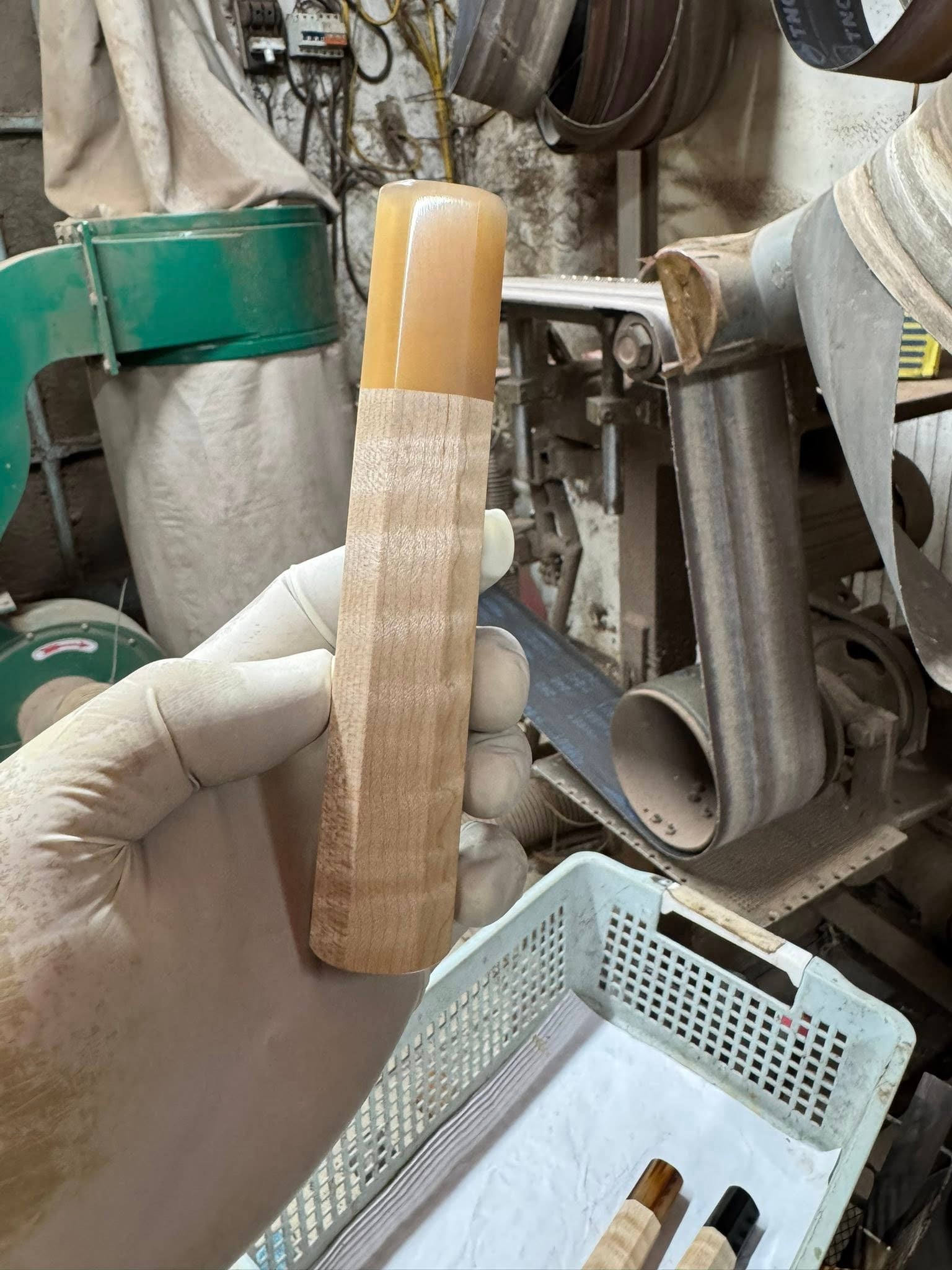
Fittings deserve the same attention. Handles, scales, ferrules, pins, and other junctions can loosen, crack, or wear while the blade remains sound. Parts that can be separated give a repairer options; moulded construction often gives fewer.
None of this makes every repair economical. Severe corrosion, deep cracks, or repeated poor sharpening can leave too little sound material. Serviceability is not immortality — it is the presence of reasonable interventions before replacement becomes the only option.
Care Equipment: Buy a Routine, Not an Aspiration
Sharpening is a skill that people often buy gear instead of learning. Owning stones does not create a stable bevel, and collecting finer abrasives does not correct inconsistent pressure or angle.
For someone who wants to learn, a modest setup used regularly is more useful than an elaborate one left in a cupboard. Stones themselves need care: their surfaces wear, load with metal, and may need flattening. Strops can refine an edge and remove a light burr, but they cannot indefinitely replace sharpening when the bevel has become rounded or damaged. For a purchase-inventory worksheet, see a practical knife-set inventory worksheet.
Using a professional sharpening service is a legitimate maintenance plan. It may be the most honest answer for someone who cooks often but has no interest in practising on stones. The serviceability test still applies: find out whether the tool can be sharpened conventionally and whether a suitable sharpener is accessible before the edge becomes unusable.
Storage protects an edge more reliably than most gear does. A blade guard, well-fitted sheath, suitable rack, or clean slot keeps an edge from striking other utensils — holding the knife securely without forcing the edge to scrape against a hard or dirty surface. Drying the knife first, and keeping abrasive debris away from the edge, requires little equipment.
Handles also benefit from simple, material-appropriate care rather than constant treatment. The wa handle care guide explains how to clean, dry, inspect, and respond to changes without turning routine ownership into a restoration project.
Buying and Gifting Without Pretending to Know the Future
When choosing for yourself, start with failure rather than features. Name the first likely wear point, the renewal method, who will perform it, and where the object will be while waiting for that work. If those answers are vague, the promise of longevity is vague too.
Consider the whole routine. A large board may be resurfaceable but impractical if it cannot be washed or dried comfortably in your kitchen. A knife may accept a new edge beautifully but still be the wrong shape for the food you prepare.
Gifts make those mismatches easier to create. Hand size, grip, available counter space, storage, tolerance for weight, and willingness to maintain an object are personal. Ask the recipient, let them choose, or give something that does not depend on concealed preferences. Arranging maintenance for a tool they already value can be more thoughtful than adding another object.
“Buy it for life” overpromises because it is survivorship bias dressed as advice. The old board or knife still in use is visible; the discarded examples built in similar styles are not. Age alone does not prove good design, and high price does not guarantee repairability.
Things survive because they were serviceable and somebody serviced them. That is the durable lesson to carry into any kitchen aisle: what wears out first, and can it be renewed without replacing the whole thing?