A yattoko pot is a handleless cooking pot lifted with a separate pan gripper. Its attraction is compact storage and less handle clutter around the hob. It makes sense at home if those advantages solve a real space problem and you are comfortable managing the separate gripper every time you need to move the pot.
For a single everyday saucepan, a permanently attached handle may be more convenient. Yattoko cookware trades that ready grip for a more compact pot; it does not remove the handling work.
What makes it different from a yukihira saucepan?
Nakao describes its yattoko range as cookware without a handle, used with a pan gripper. That is the defining feature. A hammered appearance alone does not make a pot yattoko, and not every compact Japanese saucepan is the same system.
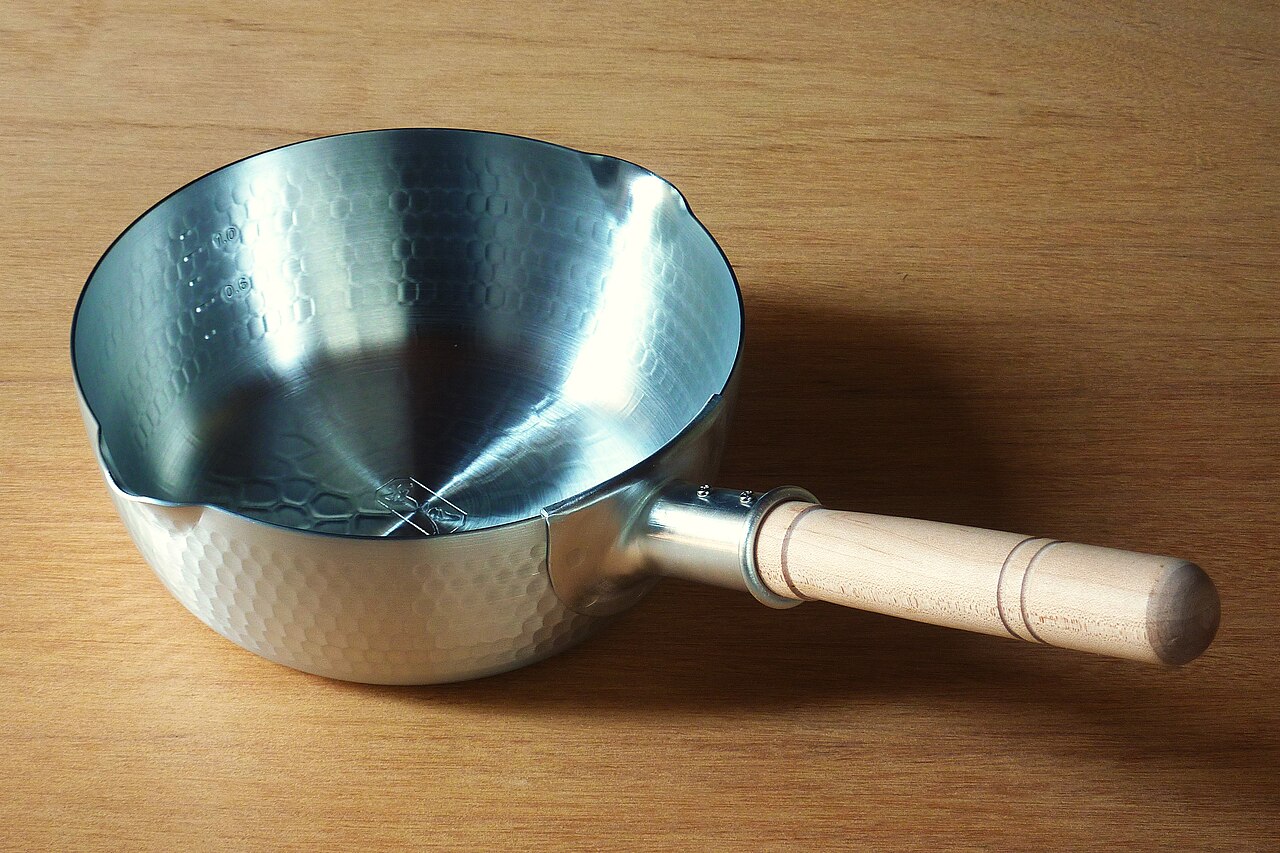
A conventional yukihira has its own handle ready for lifting, pouring and controlling the pan. A traditional handleless yattoko requires you to take up the appropriate gripper and engage it with the rim. If you are mainly deciding between saucepan materials and sizes, the yukihira guide covers that separate choice.
Nakao also sells a yattoko variant with an upright wooden handle. Product names therefore need to be read with the photographs and description. Confirm whether the item in your basket is the handleless version you intended to buy.
Where the space saving helps
Without projecting handles, compatible pots can occupy a more compact storage footprint. This can be useful when you use several small pans for separate components of a meal. The advantage is easier to appreciate in a crowded cupboard than in a single product photograph.
Measure the pots and the storage opening before ordering a set. Nesting depends on their actual dimensions and shapes; do not assume that any two pans of different nominal diameters will fit together neatly. Store them clean and dry, and follow any protection instructions for their surfaces.
On the hob, removing the permanent handle changes the layout but does not let you ignore burner spacing. Each base still needs the right support and heat source, and you still need room to engage the gripper without colliding with another hot vessel.
The gripper is part of the purchase
Check whether the pot and gripper are sold separately. Nakao’s L-type pan gripper listing links it to the N-40 and D-11 pots and describes gripping from the side. Buy an explicitly compatible tool rather than assume ordinary kitchen tongs are equivalent. For a focused comparison, see choose everyday tongs by their tips and reach.
Before cooking, learn the engagement with a cool, empty pot on a stable surface. Confirm that you can attach, control and release it as its instructions describe. This is an opportunity to understand the mechanism before the vessel contains hot food, not a test of maximum carrying capacity.
Give the gripper a predictable place beside the work area, clear of heat and contamination. If it is missing, wet, damaged or does not grip securely, leave the pot safely supported and resolve that first. The entire system depends on having the right lifting tool available.
For this L-type gripper, Nakao says to insert the jaws fully and keep squeezing while it holds the vessel. Wipe off any oil before use, and do not use it to toss the pan. That continuous grip matters: a removable-handle pan with a locking mechanism may operate differently.
Induction depends on the exact pot
The word yattoko tells you about the handle arrangement, not whether the base works on induction. Nakao’s N-40 aluminium range is gas-only. Its King Denji D-11 stainless range is listed for induction and gas.
That distinction is enough to prevent a costly wrong purchase. For induction, also check the hob’s minimum and maximum supported base sizes against the selected pot. A compatible material and an appropriate base dimension both matter.
Treat catalogue capacity as a specification, not a direction to fill to the rim. Allow the working space required by the recipe and the pot’s instructions. A compact storage choice should still give the food enough room while cooking.
Choose the first size around one real task
Start with the amount you regularly cook in a saucepan you already own. Compare that pan’s usable capacity, internal diameter and depth with the proposed yattoko. This is more informative than buying every available size because the nested set looks tidy.
For example, Nakao lists its 18 cm N-40 at 180 mm internal diameter, 75 mm depth and approximately 1.6 litres. Its 18 cm D-11 is 180 mm internal diameter, 80 mm depth and 1.8 litres. These are two specific listings, showing why the same nominal diameter need not mean identical capacity.
If you like the first pot and the handling routine, you can judge whether another size would actually replace a pan you use. That also gives you a chance to assess the storage benefit without committing to a full set immediately.
Who should keep the ordinary handle?
Choose a conventional saucepan when quick, familiar handling matters more than nesting, or when keeping track of a separate gripper would frustrate the way you cook. There is no need to adopt a professional-kitchen arrangement simply because it looks efficient in someone else’s space.
Choose yattoko when compact storage, several small cooking vessels and the separate-gripper routine fit together in your kitchen. Confirm the heat source, buy the compatible gripper and learn the handling before the first hot meal. Those decisions turn an unusual-looking pot into a useful part of the kitchen tool collection.