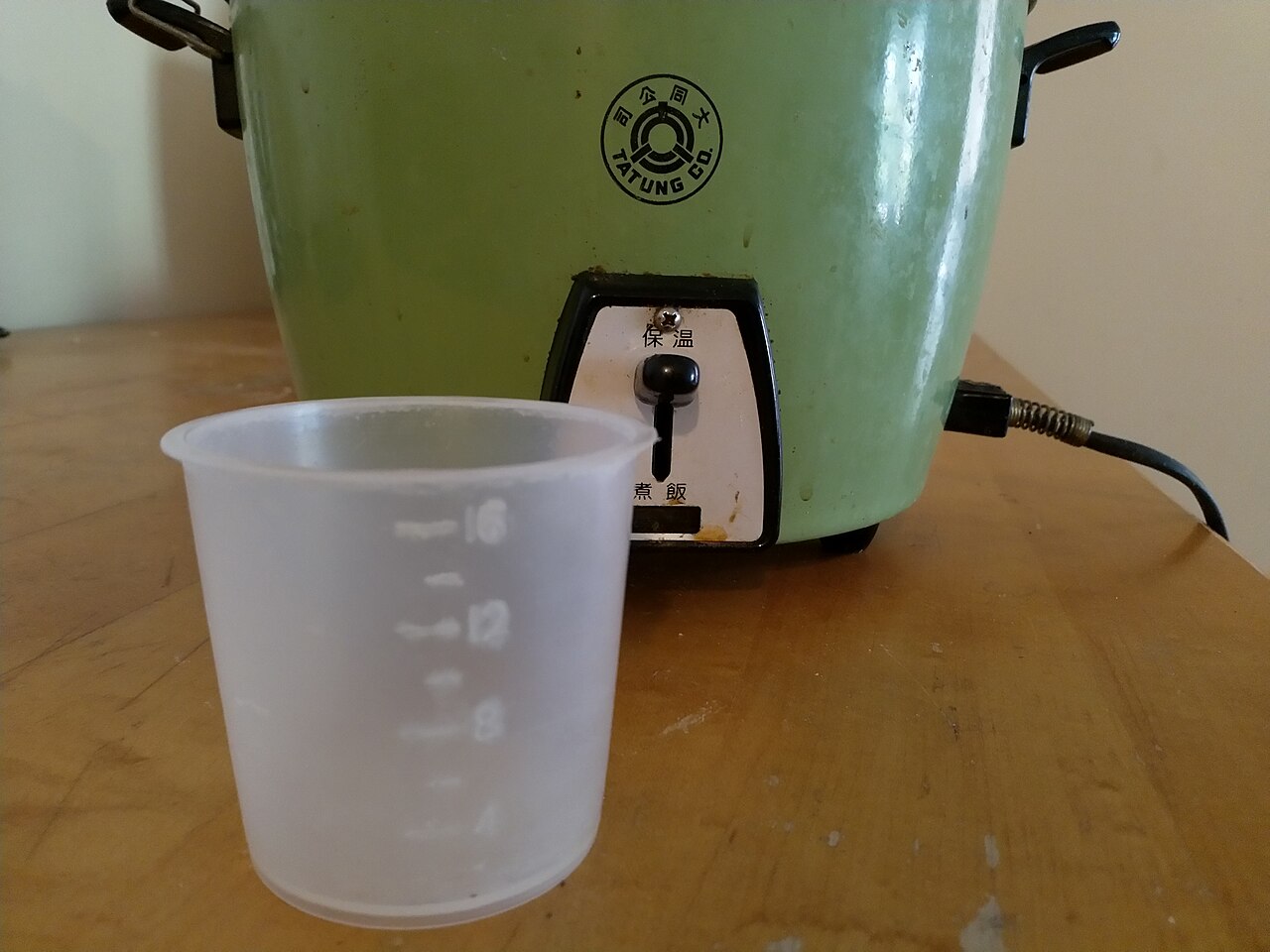
If your rice cooker uses a 180 mL measuring cup and that cup is missing, measure 180 mL of dry rice for each rice-cooker cup. Put the rice in the inner pot, rinse as directed, then add water to the line for that number of cups and that type of rice. The numbered line describes the combined contents of the pot; it is not a direction to measure the same number of cups of water separately. This cup belongs to the cooker; for ordinary baking, use the recipe’s gram weights or its own cup method in this scale-and-cups guide.
Check the cooker manual before substituting a cup. Zojirushi, for example, states that its NS-TSC capacity uses an approximately 180 mL cup of raw short-grain white rice. An ordinary kitchen cup, a mug and a cup of cooked rice are different measurements.
Why an ordinary cup changes the result
A measuring system has two linked parts: the amount of dry rice and the amount of water appropriate for it. The supplied cup establishes the first; the inner-pot line establishes the second. Changing the rice measure while keeping the same line breaks that pairing.
Zojirushi describes its cup as roughly three-quarters of a US measuring cup in its rice-cooker FAQ. That is a useful comparison, not a reason to treat any household cup as exact. Kitchen measuring cups have different marked capacities, and a drinking mug has no dependable cooking volume.
If you fill a larger cup twice and then choose the pot’s “2” line, you have put more rice into the pot than the line assumes. Calling both measures “two cups” hides the mismatch. This is why the first troubleshooting step is to identify the actual measure, before changing a successful recipe or buying different rice.
Replace the missing cup in a controlled way
Find the model number and read its manual or replacement-parts listing. Some machines supply more than one cup for different rice preparations. Match the cup to the instructions you are following, rather than choosing a replacement solely because it is described as a rice cup.
For a model confirmed to use 180 mL, a marked measuring vessel can measure that volume of dry rice. Fill it to the 180 mL mark without packing the grains down. If the marks are too coarse to read that volume reliably, order the correct replacement cup. Zojirushi’s FAQ directs owners to its parts service with the model number.
Once you have that measure, the arithmetic is straightforward:
| Rice-cooker cups | Dry rice volume at 180 mL per cup |
|---|---|
| 1 | 180 mL |
| 2 | 360 mL |
| 3 | 540 mL |
These are calculated dry-rice volumes, not water quantities or cooked servings. They also do not authorize a batch below your cooker’s minimum or above its limit. Measuring one cup at a time and counting each addition is often easier than reading a large jug at an awkward intermediate line.
Do not replace 180 mL of rice with 180 g of rice. Millilitres describe volume and grams describe mass; changing the unit changes the instruction. Use a rice weight only when the cooker maker or recipe supplies one for that purpose.
Read the right line with the rice already in the pot
For short- or medium-grain white rice, Zojirushi’s white-rice directions demonstrate the sequence: level the dry measure, put rice in the pan, rinse, and add water to the matching WHITE line. Three supplied cups pair with line 3 on that scale. Level the rice so it is submerged evenly, and use the corresponding cooking menu.
Set the pot on a level surface when reading the water. Check the label beside the scale, not only the numeral. A pot may carry several scales for different preparations; “2” beside porridge is not interchangeable with “2” beside white rice.
After rinsing, empty the rinse water before adding cooking water. You then bring the contents up to the required line, rather than adding a separately guessed quantity on top. Our rice-washing bowl guide covers the washing and draining tools without changing this measuring system.
Before starting, wipe the outside of the inner pot as your manual directs and select the correct menu. Water line and menu belong to the same set of instructions.
When the recipe gives a ratio instead
Some grains or preparations use measured water instead of a marked scale. Follow a recipe for your cooker model and grain. Zojirushi’s NS-LAC05 grain guide distinguishes grains with dedicated lines from preparations needing other measurements, and tells readers to use the same measure for grain and water when measuring both.
In a ratio recipe, consistent units preserve the ratio. In a numbered-line method, the dry rice must match the cup on which that line is based. These are two workable systems, but combining half of each produces an uncertain result.
Do not apply a generic rice-to-water ratio over the top of a model’s line instructions. Likewise, do not assume a brown-rice or mixed-rice recipe uses the white-rice maximum. Check the specified capacity for that menu.
Capacity is dry rice; servings are the result
A cooker’s advertised cup capacity normally needs a definition beside it. In Zojirushi’s comparison guide, it refers to uncooked rice measured with the supplied cup, and other grains can have smaller maximum batches. It does not mean that a five-cup cooker only produces five kitchen cups of cooked rice.
For meal planning, use the cooked yield stated by a suitable recipe or note the amount your usual dry batch produces. That is separate from choosing the water line. A bowl of cooked rice cannot tell you which dry-cup line to use for the next batch without that link.
If a correctly measured batch is still too soft or firm, check the grain, menu and rice condition before making a small recipe-supported adjustment. Zojirushi’s troubleshooting guidance identifies several possible causes, not just the cup. Start by making the measurement repeatable; then you can tell what an adjustment actually changed. The Japanese kitchen tools guide covers the rest of the rice-preparation toolkit.