Choose a tamagoyaki pan for the egg batch you normally make, then confirm that the exact pan works on your stove. A compact pan suits a small recurring batch; a larger cooking surface needs enough mixture to form the layers you intend to roll. Compare usable interior dimensions separately from the total length including the handle, and choose a weight and care routine you will be comfortable with every morning.
The best starting point is the meal: a small roll for a lunch box, a larger family portion, or occasional practice. Buying extra cooking area “just in case” is not automatically helpful if most of your batches are small.
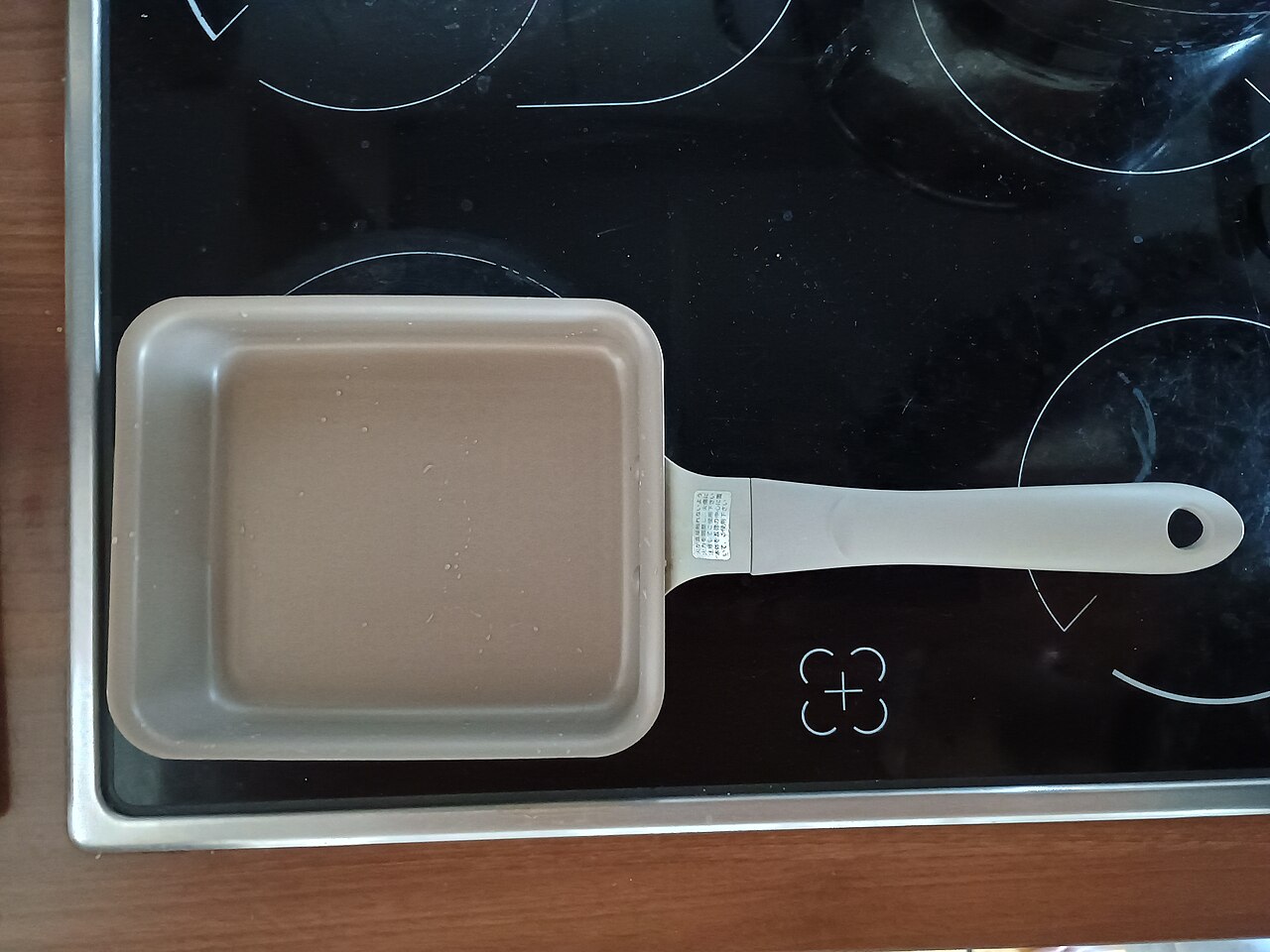
Why the pan has straight sides
Tamagoyaki is built by cooking seasoned egg in thin layers and repeatedly rolling them together. Kikkoman’s explanation of the dish distinguishes that process from pouring in the whole mixture and cooking it as one thick omelette.
The dedicated pan gives the cook a regular shape in which to form those layers. Kikkoman’s pan guide describes this as the purpose of the rectangular design. Square pans also exist; the two shapes are associated with different regional traditions, rather than one being the sole authentic version.
For choosing a pan, focus on the shape you will actually work across. Width affects the roll you form; length gives space for the layer and the rolling movement. A photograph may make two pans look similar even when their working areas differ substantially.
Match an egg guide to its own product range
An egg-count recommendation can be a useful starting point when it belongs to the exact pan being sold. In SUWADA’s Yoshikawa range guide, the published examples are:
| Size in that range | Suggested batch | Total listed dimensions |
|---|---|---|
| Small | 2–3 eggs | 106 × 340 × 25 mm |
| Medium | 4–5 eggs | 130 × 370 × 30 mm |
| Large | 7 or more eggs | 180 × 380 × 30 mm |
The long middle dimension includes the handle; it is not the length of the egg-cooking surface. Use this table for that seller’s range only. Another manufacturer’s “Small” is not necessarily its equivalent.
If you make two eggs on an ordinary weekday, start with a model whose guidance covers that batch. If you normally make four or five, compare the next appropriate size. A larger pan may suit a larger recurring portion, but its label alone cannot tell you how your particular recipe will fill it.
The reason is straightforward: the same volume spread over a larger area makes a thinner layer. The quantity of seasoning and the amount of egg poured in each round also belong to the recipe. Use a range’s egg guide to narrow the choice, then look at the cooking area rather than treating egg count as an exact universal formula.
Read interior dimensions and weight together
For an example of clearly stated cooking dimensions, Yoshikawa’s COOK-PAL REN page lists its rolled-egg pans with interiors of 146 × 106 × 25 mm for S, 180 × 130 × 30 mm for M, and 180 × 180 × 30 mm for L. The corresponding approximate weights are 400, 575 and 850 g.
Those are interior measurements from that maker’s page, not extra columns to attach to the seller’s egg chart above without confirming the exact model. They show the information worth seeking on any listing: actual working space and the weight of the complete pan.
Consider both on the stove and at the sink. If you plan to lift and tilt the pan while cooking, its empty weight is only the start; food is added afterward. If a long handle will crowd another burner or your storage drawer, total dimensions matter too. A good fit is comfortable throughout the routine, not just large enough for the eggs.
On induction, check the exact pan and the hob
Material is only part of induction suitability. Iwachu’s model 24017 is a cast-iron tamagoyaki pan marked for induction use, with an 18 × 15 × 2.8 cm interior and an approximate weight of 1.3 kg.
Other ranges differ. River Light’s manual excludes its tamago-yaki pans from IH use, citing their small contact area. SUWADA lists the three pans in its current range as induction-compatible. These statements concern different products, so one does not invalidate the other.
Before ordering for an induction cooker, match the full pan model to its compatibility information and check the hob’s cookware requirements. The inside width, outside rim and base touching the hob are not interchangeable measurements. On gas, also consider how the pan will sit on the supports and where the handle will extend.
Choose the surface care you are willing to do
A pan is easier to keep in use when its maintenance suits your habits. Ask whether the surface is coated or treated, how it is prepared before cooking, which utensils are allowed, and how it should be washed and dried.
Yoshikawa describes COOK-PAL REN as treated steel with a natural-wood handle and says its treatment does not need to be burned off before use. River Light gives a specific oil-preparation routine for its own steel range. Those instructions illustrate why “steel pan” is not a complete first-use guide.
Read the actual routine before choosing. A coating, a treated surface and a traditional pan needing a different oiling process may all fit someone, but they should not be bought with the expectation that their care will be identical. Nor should a cast-iron listing be treated as permission to use the seasoning instructions from an unrelated product.
Separate a size mismatch from a technique problem
If a small quantity of egg spreads into a very thin sheet across a large pan, revisit the batch-to-area match. If the egg sticks, inspect the surface preparation, oiling and heat guidance before deciding that the size is wrong. If the pan is hard to maneuver, pay attention to its weight and handle arrangement rather than merely buying a shorter rectangle.
For the first cooks, follow one suitable recipe so the mixture and sequence remain consistent while you learn the pan. Changing batch size, temperature and surface preparation at once makes the result harder to interpret.
A suitable tamagoyaki pan answers four everyday questions: enough room for your usual batch, compatible with your stove, comfortable to handle, and realistic to maintain. Our kitchen tools guide develops that last question for the rest of the kitchen.