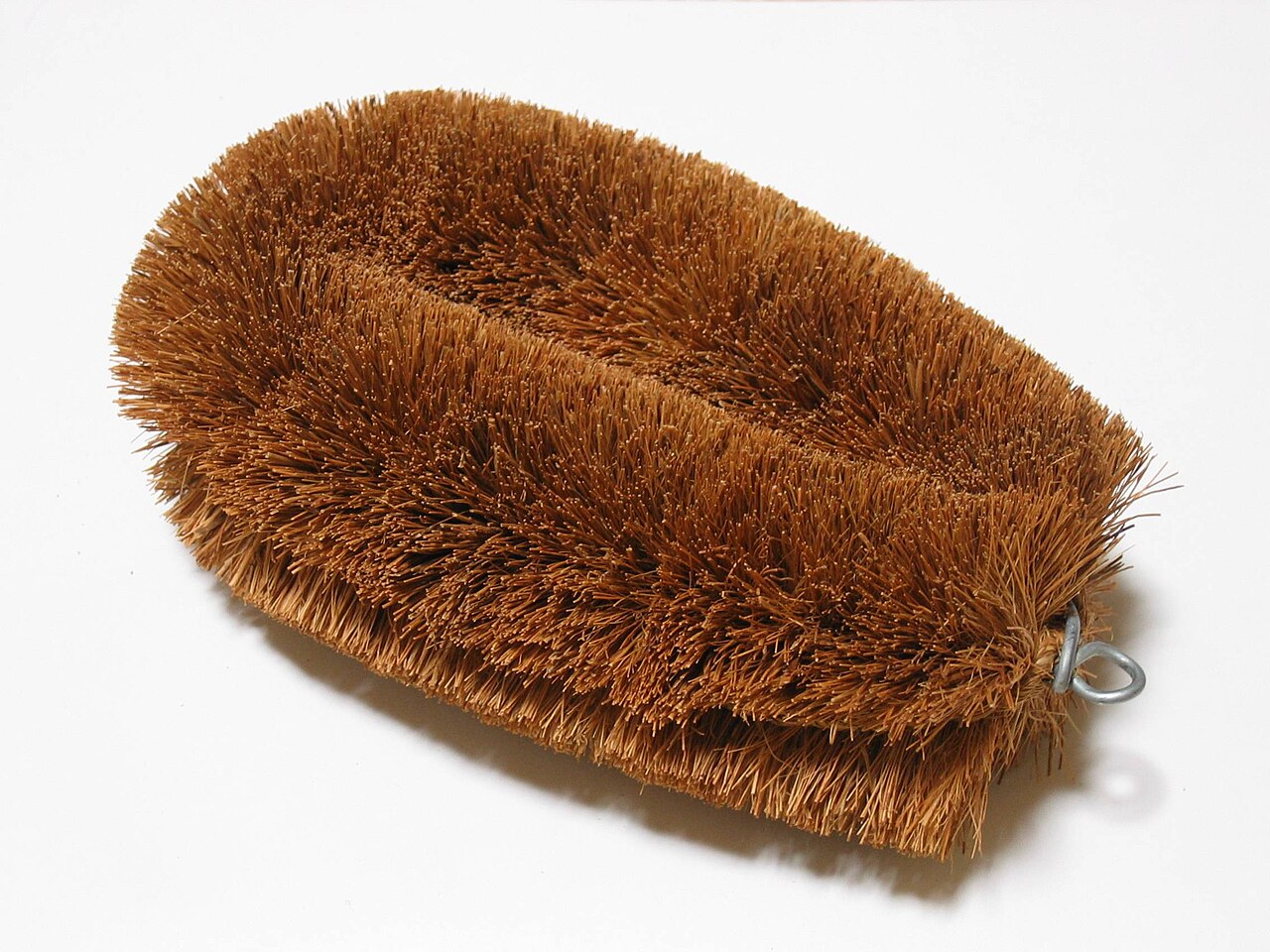
For stubborn soil on sturdy root vegetables or a robust colander, a firm coconut-fiber tawashi is a useful starting point. For gentler brushing around wood and small recesses, consider flexible shuro. Sisal sits at the soft end of the range. Choose for the surface you need to clean, then for the dirt on it; the hardest brush is not automatically the most useful.
Those distinctions follow Kamenoko’s published fiber categories. They describe a way to choose within a named maker’s range, not a universal promise that every natural-fiber brush can wash every pan.
The reason to use a brush instead of a sponge
A brush becomes useful where the surface has places for food to lodge. Kamenoko’s brush and sponge FAQ contrasts a sponge’s broad contact with the individual contact points of tawashi fibers. It identifies mesh colanders, grooved mortars and knife marks in wooden boards as useful brush tasks.
Imagine washing a smooth dinner plate and a mesh strainer. Across the plate, a sponge can cover the broad surface directly. With the strainer, the question is whether the cleaning tool reaches the spaces around the mesh. Buying a firmer sponge does not necessarily answer that shape problem; a brush offers a different kind of contact.
This is why a tawashi can complement an existing washing routine without replacing every sponge. Start with the item that remains awkward to clean. If most washing consists of smooth plates and your current tool works well, there may be no need for another brush beside the sink.
The fibers do different jobs
Kamenoko’s fiber guide separates firm palm, medium shuro or “hemp palm,” and soft sisal. The company explains that its palm fiber comes from coconut husks. Shuro is a different palm fiber, rather than a finer grade of the same coconut material.
| Fiber in Kamenoko’s guide | Character | A useful starting task |
|---|---|---|
| Palm / coconut | Firm, scraping contact | Soil or thin skin on sturdy roots |
| Shuro / hemp palm | Flexible, resilient brushing | Wood and narrow recesses |
| Sisal | Soft; softens when wet | Gentle washing of approved surfaces |
The choice is between kinds of contact. If you want to remove a thin skin while washing a root vegetable, a scraping action may be welcome. If you want that skin to remain, gentler brushing is the more relevant aim. Decide what should remain on the food before deciding how hard to scrub it.
The same reasoning applies to cookware. Removing attached food is one goal; preserving the surface beneath it is another. Choose a brush that can do both for the particular item, rather than measuring success only by how forceful the brush feels in the hand.
A vegetable brush and a board brush need not be the same purchase
For vegetables, begin with the intended result: removing loose soil, brushing around an irregular surface, or also removing a thin skin. Kamenoko uses carrots to illustrate the difference between firm palm and gentler shuro. That is more informative than choosing by color or assuming all brown brushes behave alike.
For a wooden board, consider flexibility and access to the working surface. A brush can help with residue in knife marks, but it does not repair the marks or replace the board’s washing and drying routine. If the actual concern is blackening or persistent staining, buying a harder brush does not establish the cause. The hinoki cutting-board care guide covers the board itself.
For a colander or grooved mortar, shape deserves as much attention as fiber. Compare the brush’s working face with the object: can it reach the curved interior or the recess that prompted the purchase? A large brush that suits a board may feel awkward inside a small mortar. That is a fit issue, not proof that the fiber is wrong.
Delicate surfaces need a narrower answer
“Natural” describes where a fiber comes from. It does not establish that the finished brush will leave a coating, polished surface or piece of glass unchanged. Kamenoko specifically warns that its firm palm fibers are unsuitable for delicate materials.
Sisal’s softer position in the range makes it a candidate for gentler jobs, but “softer” remains a comparison, not permission for every surface. For nonstick cookware, enamel or glass, match the exact brush’s stated uses with the item’s care instructions. If the cookware calls for a soft sponge, that is already a complete choice; a tawashi is optional.
Avoid making a first brush responsible for every object at the sink. A single recurring job is enough to justify it. If the kitchen later needs both firmer and gentler contact, the second brush should have a recognizable task, rather than becoming an indistinguishable spare.
Give the brush a place to dry
Kamenoko’s care instructions advise rinsing a new brush under running water to remove loose fiber particles. After use, drain it and store it where air can circulate. For food caught between fibers, the maker suggests rubbing two brushes together to loosen the particles. It also notes that soft sisal fibers can take a set, so their shape needs consideration during storage.
The practical sequence is to clear the brush as part of washing up, remove excess water and put it in a drying position. A convenient storage place must satisfy that last job too. If the proposed spot is a closed container or a dish that stays wet, choose another position before buying the brush.
Do not mistake a rinse for disinfection or a natural-fiber label for a hygiene claim. These are ordinary cleaning and drying directions. They do not establish a universal sanitizing method, replacement interval or permission to boil, bleach or machine-wash every brush.
Start with the job your current tool misses
Before adding a tawashi, name the problem in one sentence: soil on roots, residue in a strainer, or food caught in a board’s knife marks. Then choose the fiber, size and shape around that problem, with a drying place ready.
If your current sponge already cleans the item comfortably and within its care instructions, keep it. A brush earns its place through a specific useful difference. The wider kitchen tools guide applies the same approach to tools whose upkeep you want to make part of everyday cooking.