For a Japanese knife, choose a sharpening method by its actual edge geometry and the amount of practice you want to do. A whetstone makes sense if you want to learn direct control of the edge. A manual or electric sharpener can suit someone who wants a guided routine, provided the exact device supports the knife. A professional service is a complete option for someone who would rather hand over the work.
There is no single sharpener category that is automatically right for every Japanese blade. An everyday double-bevel knife, a traditional single-bevel knife and a serrated knife ask different things of the abrasive touching them.
Identify the edge before comparing tools
The bevel is the angled surface leading into the cutting edge. A double-bevel knife has an edge worked from both sides. A traditional single-bevel knife has a different relationship between its broad front bevel and back face. It is not simply an ordinary two-sided knife with half the sharpening omitted.
TOJIRO’s maintenance guidance gives distinct directions for double- and single-bevel blades. That distinction matters more to this decision than a Japanese place name on the box. The Japanese knife anatomy guide explains the wider relationship between blade construction and function.
Find the knife’s model and maker guidance before treating a device’s “Asian” setting as a match. Also decide whether your aim is to preserve the existing edge geometry or deliberately change it. A tool that creates a documented angle may do exactly what it promises while still changing something you wanted to keep.
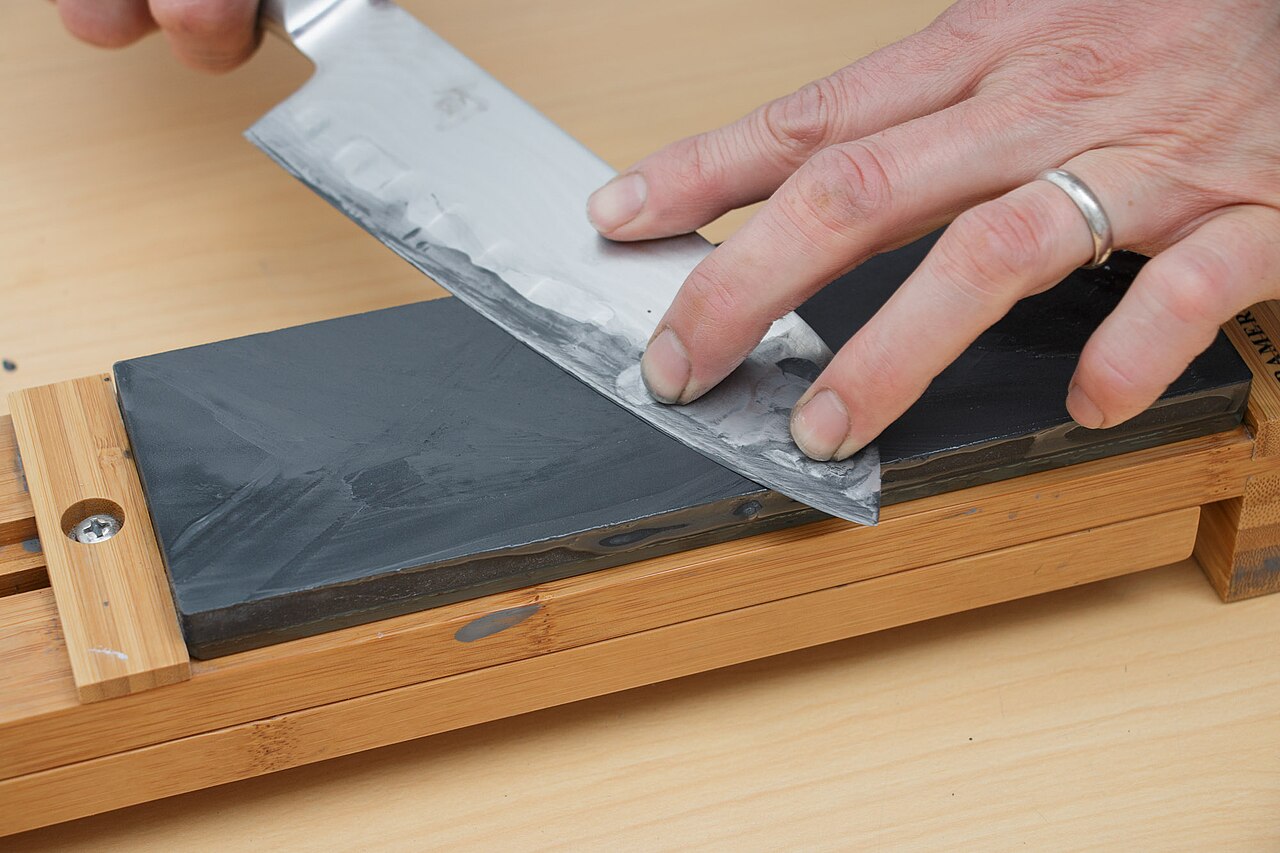
A whetstone gives control, and asks you to supply it
With a freehand stone, the abrasive surface does not impose one fixed path on every knife. You position the blade. That flexibility is the reason to choose it when you want to learn how the existing edge is shaped and maintained.
It also makes the user responsible for consistency. Buying a stone does not establish a working angle or tell you when the edge is complete. You need willingness to practise, inspect the result and repeat the process. Someone who enjoys learning that skill may find the routine satisfying; someone who sees only another unfinished chore should take that reaction seriously.
For example, a cook with one ordinary double-bevel knife and an interest in learning has a clear reason to begin with a stone. A cook with several unfamiliar specialist blades has more to identify before starting. The same tool can accommodate different work, but the knowledge needed is not identical.
The first whetstone setup covers equipment and preparation once you choose this route. The sharpening-angle guide covers the technique and edge checks. You do not need to buy an elaborate progression merely to decide whether learning appeals to you.
Manual sharpeners trade flexibility for a defined routine
A guided manual device provides some of the positioning that you would otherwise control yourself. That can make the routine easier to understand, but the device’s design also sets limits. Read those limits at model level: “pull-through” and “rolling” describe broad approaches, not a common compatibility standard.
TOJIRO’s F-641 Double Rolling Sharpener contains #320 and #1000 ceramic wheels, with replaceable stones. The maker excludes serrated and single-bevel knives. Those exclusions give an immediate answer for those blades, even though the same manufacturer makes Japanese knives.
KAI’s Q-Sharpener listing describes a pull-through tool for stainless-steel knives and excludes serrated edges. It does not establish single-bevel compatibility. A broad material description is not enough to fill that gap.
If you want a manual tool, make a short list only after finding one that explicitly covers your knife’s edge type. Then compare the routine, support arrangement and replacement abrasive provision. A familiar brand or an extra sharpening stage cannot substitute for that basic fit.
Electric does not mean the same result from every machine
An electric sharpener supplies powered abrasive action as well as a guided procedure. The relevant questions remain specific: which blade types are covered, what edge does the machine create, and which procedure applies to your knife?
Chef’sChoice is a useful example of why blanket rules fail. Its Model 15 manual, linked from the manufacturer’s manuals index, gives separate procedures for contemporary Asian blades and traditional single-bevel Japanese blades. That is evidence about this model’s documented method, not permission to put a single-bevel knife through any electric appliance.
The maker also says the 15XV converts traditional 20-degree edges to its 15-degree Trizor design. Conversion and routine maintenance are different decisions. If preserving your current geometry is important, establish that the knife maker accepts the intended result before using a device that changes it.
These examples do not prove that every electric sharpener damages Japanese knives, or that a documented machine will give every user the same outcome. They show what useful buying information looks like: an exact model, a defined blade type and a stated edge result.
Professional sharpening is a maintenance method
Use a service when you want the knife maintained but do not want to learn or keep sharpening equipment. It is especially useful to seek an assessment when the problem extends beyond ordinary dullness, or when you are unsure how a specialist edge should be preserved.
Give the sharpener the exact knife model and describe the issue plainly. Ask whether they handle that edge type, whether they intend to preserve or alter its geometry, and what work the quoted service includes. A routine edge refresh, chip repair and broader blade work should not be assumed to be the same job.
For a knife used every day, turnaround and having another usable knife meanwhile are practical considerations. Those may matter more to your routine than the sharpening tool used behind the counter. The kitchen tools guide places professional service within the broader choice of keeping tools maintainable.
Make the choice around the routine you will keep
| Your priority | Route to investigate | What must be established |
|---|---|---|
| Learn and control the edge | Whetstone | Technique suited to this blade |
| Follow a guided manual routine | Compatible manual tool | Exact edge-type approval |
| Use powered convenience | Compatible electric model | Procedure and resulting geometry |
| Delegate the sharpening | Professional service | Experience with this edge and agreed scope |
If you want to learn, choose a modest stone setup and practise the relevant method. If you want convenience, choose a device only when its instructions answer the compatibility question. If you want a maintained knife without another skill or appliance, arrange a service. Each is a workable plan when it fits both the blade and the person using it.