Start with four shape families: rounds and their fractions, narrow strips and flat rectangles, wedges, and angled chunks. These cover many everyday Japanese recipe instructions. The Japanese name tells you the form; the recipe tells you the size and thickness needed for the dish. For cabbage shreds, slices and wedges, see our step-by-step cabbage cutting guide.
You can practise them with a familiar, sharp gyuto, santoku or nakiri on a stable board. A specialist usuba is not required. The aim is repeatable pieces that suit the food you are cooking, not speed or decorative perfection.
Read the shape before choosing the size
Several names describe what a cut resembles. Hangetsu means half-moon; icho refers to a ginkgo leaf; tanzaku evokes a narrow strip of paper. Kikkoman’s culinary reference connects these shapes with the texture and presentation of Japanese dishes. Kikkoman’s cutting-style introduction. For clean leek rings or half-moons, see our leek cleaning and cutting guide.
A half-moon can still be a thin salad slice or a thicker piece for cooking. Memorising one thickness for every name misses the recipe’s intention. Look for the cut’s dimensions, a preparation photograph or a description such as thinly sliced or bite-size.
| Shape family | Common names | Starting ingredient |
|---|---|---|
| Circles and fractions | Wagiri, hangetsugiri, ichogiri | Cucumber, carrot, daikon |
| Strips and rectangles | Sengiri, tanzakugiri | Carrot, daikon, cabbage |
| Wedges and angled chunks | Kushigiri, rangiri | Onion, carrot, eggplant |
Choose manageable pieces before cutting. A long vegetable does not have to remain full length while you work on it, and a round root may need a flat resting face for the next operation.
Wagiri, hangetsugiri and ichogiri: one cylinder, three shapes
Wagiri produces rounds. Cut across a cylindrical vegetable, keeping the spacing appropriate to the recipe. Cucumber gives a small circle; a broad daikon gives a much larger one. The name remains the same, but the bite does not. Kikkoman’s rounds reference.
For hangetsugiri, halve the vegetable lengthwise first. Put the flat side down, then cut across it. Each piece has one straight side and one curved side: a half-moon. This is a useful way to make a wider vegetable more manageable without changing the recipe’s requested slice thickness. Half-circle slices.
For ichogiri, divide the cylinder lengthwise into quarters before slicing across. The resulting pieces are quarter-rounds with a curved outer edge. A thick daikon that would make an awkward full round can become smaller, readily portioned pieces this way. Quarter slices.
The distinction is the lengthwise division made before the cross-cuts. Do not confuse a quarter-round slice with a thick triangular chunk: its thickness is still controlled by the spacing of those final cuts.
Sengiri: make even sheets before making fine strips
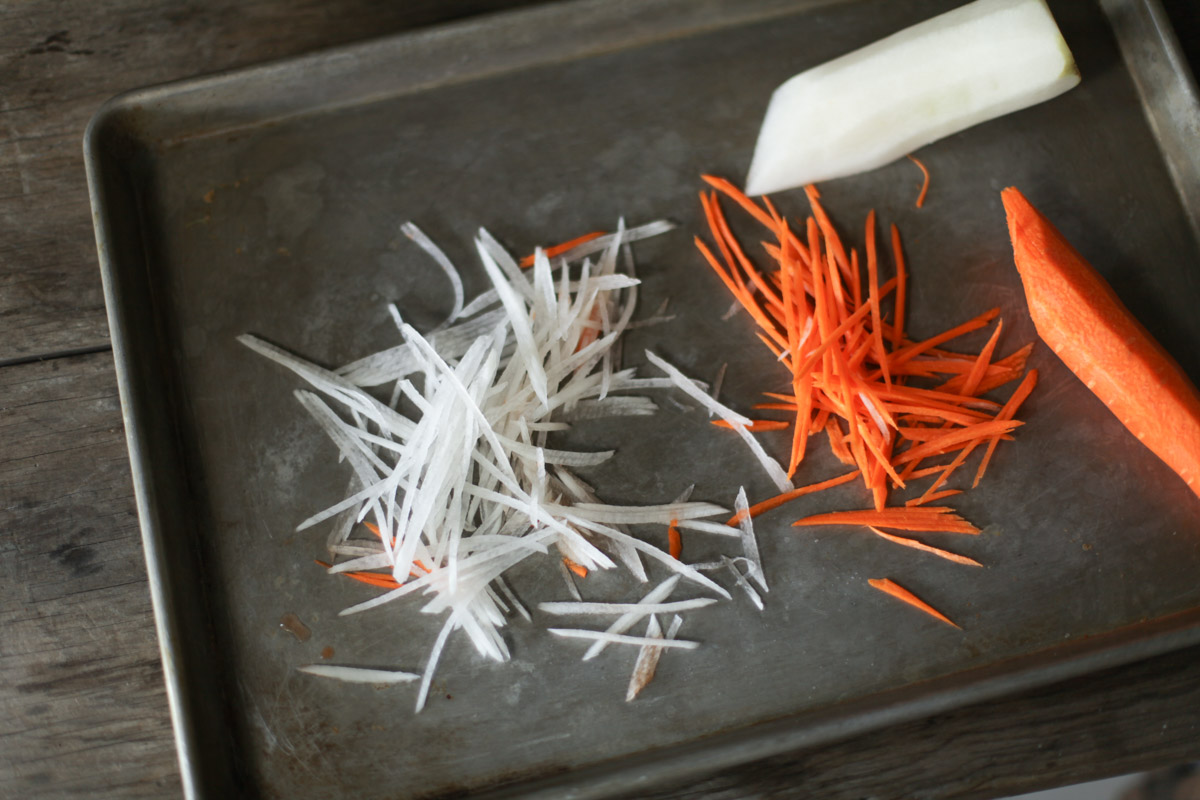
Fine strips depend on two dimensions. The thickness of the first slices controls one side of each strip; the spacing of the second cuts controls the other. If the first slices vary wildly, careful final cuts cannot make the whole pile even.
For carrot or daikon, cut a manageable length and create a stable resting face. Cut thin planks, place a small, controllable stack or overlapping group on the board, then slice them into narrow strips. Kikkoman demonstrates this plank-and-strip sequence and uses 1–2 mm planks in its carrot and daikon examples. Treat that as an example for fine julienne, not a compulsory dimension for every recipe. Fine-strip preparation.
Cabbage starts differently because the ingredient already consists of sheets. Remove the firm core as needed, gather a manageable amount of leaf and slice across it finely. A large unstable bundle is harder to control than a smaller one, even if cutting the whole cabbage at once looks quicker.
If the strips taper, slow down and look at the planks and stack before blaming the knife. Establishing a stable base and keeping a consistent cut direction usually gives you a more useful thing to practise than simply trying to move faster.
Tanzakugiri: keep the rectangle flat
Tanzaku pieces are thin rectangles. They have a broad face, unlike the narrow, roughly stick-shaped result of fine julienne.
For carrot or daikon, make a short section, divide it lengthwise into broad slabs, then turn and slice those slabs to create thin rectangular pieces. The broad dimension remains visible in the finished cut. Kikkoman illustrates this with approximately 4–5 cm lengths, 1 cm slabs and 2 mm final slices. Those dimensions clarify the shape; adjust to the actual recipe. Thin rectangular cuts.
There is no need to trim away every curved surface merely to make all pieces look manufactured. In everyday cooking, preserve useful food and aim for reasonably consistent thickness. If a recipe specifically calls for a neat rectangular garnish, that is a more exact presentation task than making vegetables for a family meal.
Rangiri: turn the vegetable, keep the pieces comparable
Rangiri is often translated as random cutting, but the randomness is in the changing faces rather than an invitation to make unrelated sizes.
Make an angled cut across a manageable carrot or cucumber, lift the blade clear, rotate the vegetable and make the next angled cut. Continue turning between cuts to produce irregular, multi-faced chunks. For a thick carrot, halve it lengthwise first. Kikkoman’s method aims for easy-to-eat pieces of comparable size and places the next cut around the centre of the previous cut face. Rangiri examples.
A tapered carrot needs judgment as its diameter changes. Repeating an identical distance between cuts from the thick end to the narrow tip produces progressively smaller pieces. Adjust the spacing to maintain a similar overall piece size, using the previous pieces as your reference.
Do the turning while the blade is out of the food. Rotating the ingredient is part of setting up the next cut; twisting a knife already trapped in a dense piece is a different action.
Kushigiri: cut towards the centre for wedges
For onion wedges, peel and halve the onion lengthwise, remove the stem portion as required, and divide each half into wedges by directing the cuts towards its centre. The result follows the onion’s curved form rather than producing parallel crosswise slices. Kikkoman uses these wedges in curry and stew examples. Onion wedge preparation.
The visual distinction is useful when reading a recipe: an onion half cut repeatedly across its width gives curved slices; an onion half divided radially gives wedges. They are not interchangeable simply because both begin with half an onion.
Let the recipe determine how many wedges and whether they should remain in larger groups or separate into layers. “Wedge” describes the cutting direction and shape, not one universal serving size.
Practise one useful cut through a whole ingredient
Choose a dish you already cook and improve the relevant cut. Use the first few pieces as a visual reference, keep the amount under the knife manageable, and pause when the shape starts drifting. You can learn more from one consistently cut carrot than from attempting every named technique in the same session.
If pieces remain attached underneath, check whether the edge completes its travel to the board. If the blade binds in a dense ingredient, reduce the piece to a suitable working size with an appropriate tool rather than forcing a delicate edge. The gyuto and santoku comparison and santoku versus nakiri guide explain how profiles affect board work.
Katsuramuki, the continuous-sheet peeling associated with an usuba, is a separate advanced skill. The nakiri and usuba guide explains that tool distinction. Everyday rounds, strips, wedges and rangiri give you plenty of useful work to master first. If you use a nakiri, see the guide to its board movement and limits.