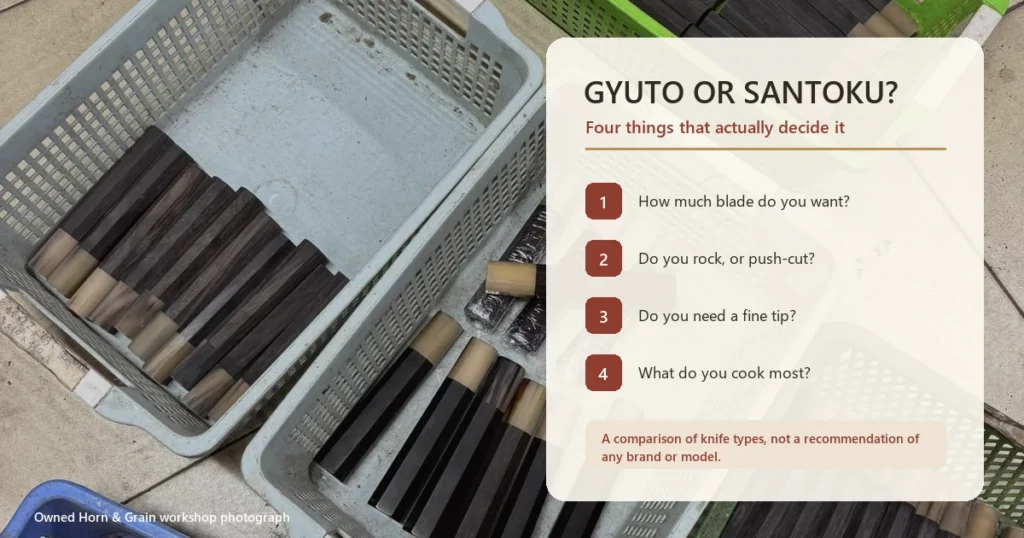
Gyuto or santoku—which should you actually reach for? The honest answer is that they overlap far more than knife marketing admits. Both can handle most everyday kitchen work. The meaningful differences are length and blade profile: a gyuto favors rocking cuts and precise tip work, while a santoku feels more natural in straight up-and-down chopping. Choose according to your cutting style, board space, and usual ingredients. There is no wrong pick for a first serious Japanese knife. For an onion-specific sequence from root-halving to dice, see our step-by-step onion guide.
Neither shape automatically makes food preparation faster, more skillful, or more “authentic.” The better knife is simply the one whose size and movement feel comfortable enough that you reach for it without hesitation.
What each one actually is
A gyuto is the Japanese take on the familiar chef’s knife. It usually has a longer blade, commonly around 210–240 mm, with a pointed tip and a cutting edge that curves gently upward toward the front. That combination gives it a broad working area while keeping the tip useful for detailed cuts.
A santoku is shorter, typically around 165–180 mm. Its blade is comparatively flat and often taller for its length, with a rounded or downward-sloping tip rather than the long point of a gyuto. It still has enough blade for vegetables, boneless meat, fish, and most other daily preparation.
Those descriptions can make the two sound more different than they are. Put either one on a normal home cutting board and it can slice onions, portion chicken, chop herbs, and prepare dinner. The distinction becomes clearer through movement: how much blade travels across the board, how the edge meets it, and how confidently the knife fits into the available space.
The differences you’ll actually feel
A gyuto’s curved edge allows the knife to rock. The front of the blade can stay near the board while the handle rises and falls, creating the rolling motion many cooks use for herbs, garlic, and repeated chopping. Its pointed tip also helps when trimming meat, opening joints, making small incisions, or starting a careful slice.
That does not mean a gyuto must be rocked. It also works well for push cuts, where the blade moves forward and down through the ingredient. The extra length can pass through a large cabbage, squash, eggplant, or cut of meat in one clean stroke rather than requiring several short cuts.
A santoku encourages a straighter motion. Its flatter edge meets more of the board at once, so it feels natural to lift the blade and bring it down or slightly forward. For diced onions, sliced carrots, chopped greens, and quick weekday preparation, that direct movement can feel controlled and efficient.
Because it is shorter, a santoku is easier to keep within a small board. There is less tip extending beyond the ingredient and less blade to steer. It may feel immediately manageable to someone moving up from a small utility knife.
Blade height matters too. A relatively tall santoku can create comfortable knuckle clearance—the space between the chopping hand and the board—and its broad side is convenient for guiding food into a pile. A gyuto can also provide good clearance, but the exact feeling depends on the individual blade shape.
Length changes control in both directions. A shorter knife can feel nimble, calm, and predictable. A longer one can feel smoother because it completes large cuts without sawing or repositioning. Neither sensation is universal. Control comes from matching the blade to the board, the ingredient, and the motion already used comfortably.
Which one suits the way you cook?
A santoku makes a strong case in a small kitchen. If the usual board fits between the sink and stove, a 165–180 mm blade leaves useful room around the food. It is well suited to meals built from onions, carrots, mushrooms, herbs, tofu, boneless proteins, and other ingredients that rarely demand a long slicing stroke.
It can also be a reassuring first Japanese knife. The compact length is easy to judge, the flatter edge rewards simple chopping, and the taller blade can keep the hand comfortably above the board. Someone who naturally lifts the knife between cuts, rather than rocking it on the tip, may find a santoku familiar from the first meal.
Choose a gyuto when there is enough board space to use its length. It handles whole vegetables with fewer interruptions: halving a cabbage, cutting long greens, slicing a large eggplant, or working through several onions without the blade feeling crowded. The extra reach is also useful when portioning boneless meat or drawing the knife through a large piece of fish.
A gyuto is particularly convincing as a one-knife-for-most-things option. Its curved edge supports rocking, its tip handles detail, and its length covers both small preparation and larger ingredients. Cooks who already use a Western chef’s knife comfortably will probably recognize its balance of reach and versatility.
The deciding question is not which design is more advanced. Consider what happens on an ordinary evening. Is most preparation compact and vegetable-heavy, using short downward cuts on a modest board? A santoku is likely to feel at home. Does cooking regularly involve whole produce, meat trimming, long slices, or a rocking motion? A gyuto offers more room to work.
If possible, mark the typical blade lengths on the cutting board with a ruler. That simple comparison often says more than photographs: it reveals whether a 240 mm gyuto would feel useful, whether it would dominate the space, or whether a shorter santoku would leave the right amount of breathing room.
Do you eventually want both?
Many cooks eventually keep both because the two shapes divide work naturally. A santoku is convenient for quick, compact preparation; a gyuto comes out when extra reach, a pointed tip, or a longer slicing stroke will help. That is a practical division, not a required progression.
There is no need to buy both at the start. Either can cover the central role in a home kitchen while cutting habits become clearer. After months of cooking, any genuine limitation will be easier to recognize than it is while comparing descriptions.
Neither knife replaces every other shape. A small paring knife remains better for work held in the hand, while a serrated bread knife handles crusty loaves without crushing them. A useful knife selection can stay small.
Whichever you choose, it can live longer than its handle
Both shapes are commonly available with replaceable wa handles. In the anatomy of a Japanese knife, the blade, tang, and handle form a connected system, but the handle does not have to determine the blade’s lifespan.
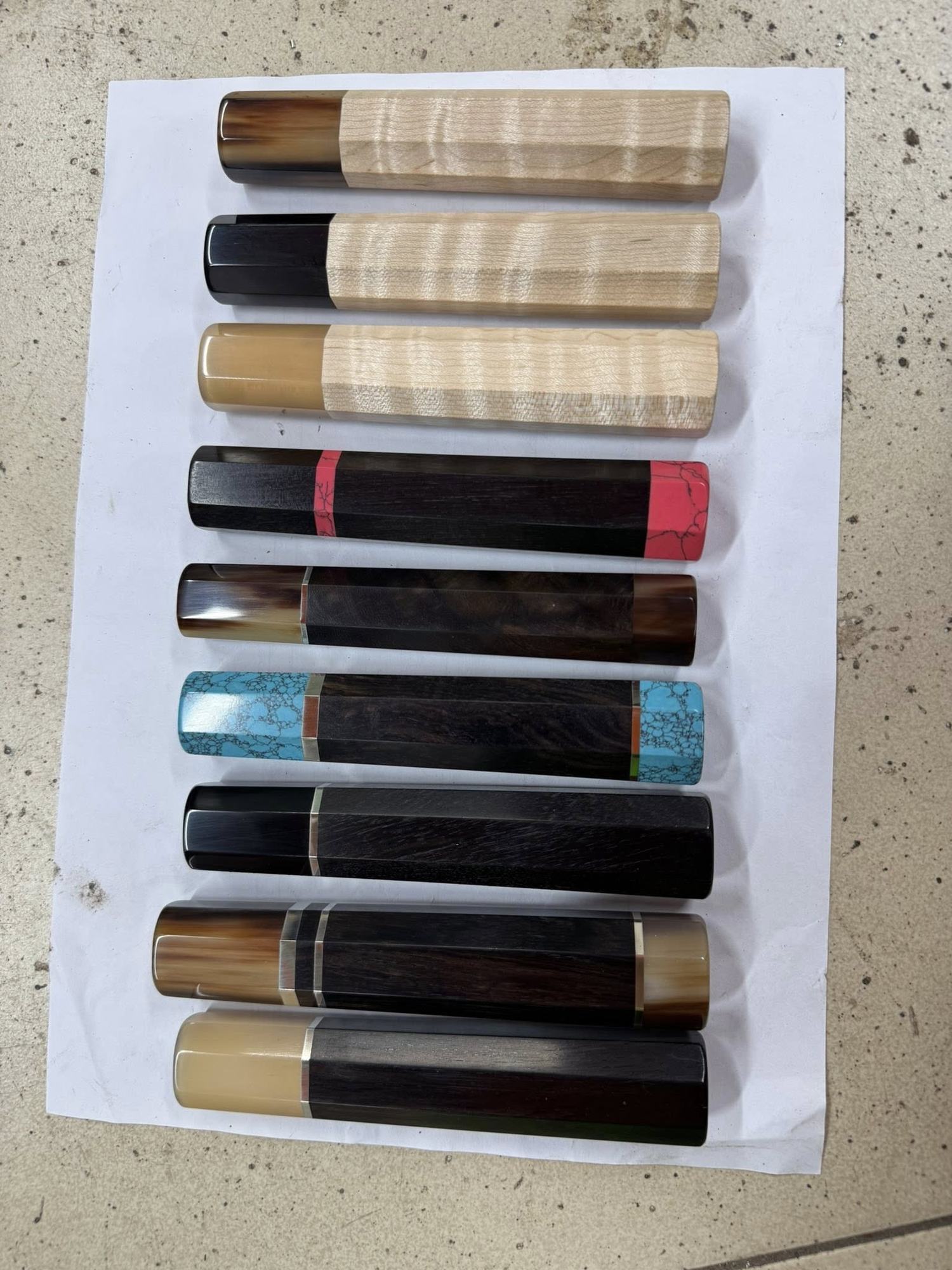
If a sound blade eventually needs a new handle, it can often be re-handled rather than retired; our size guide explains the measurements needed, and we make replacement wa handles to order.