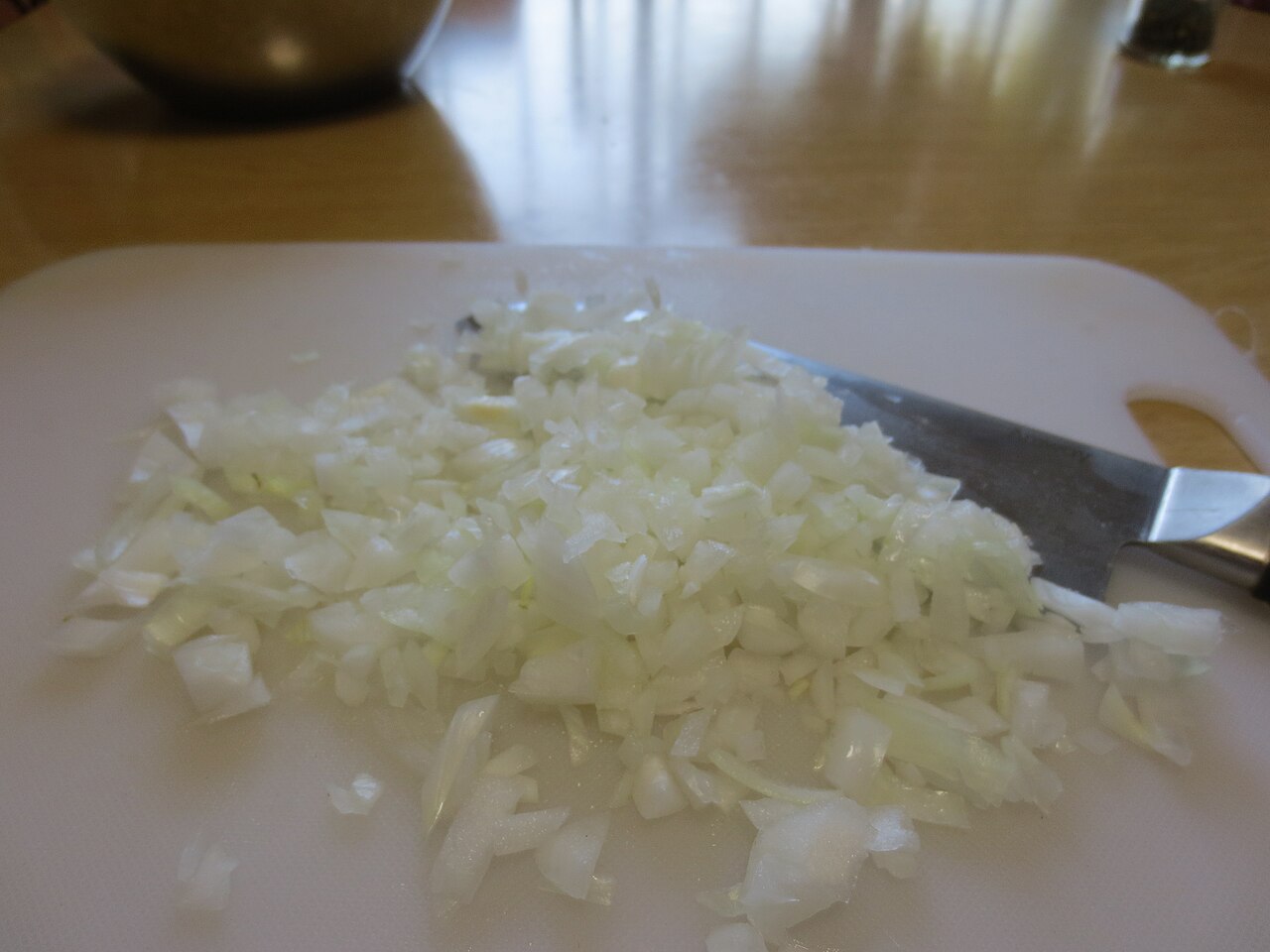
To dice an onion, cut it in half through the root, peel it, and place one half flat-side down. Make parallel cuts along the onion’s length toward the root, stopping short so the layers stay connected. Turn the half 90 degrees on its flat face, then slice across the first cuts to release the dice. Keep the root end clear of the blade path and discard it after the final cuts.
Set up safely
Use a sharp chef’s knife and a dry board that stays in place. Peel away the papery skin, then trim only the non-root end. Cut straight down through the root to split the onion in half. Set one half cut-side down before making smaller cuts. Purdue Extension’s onion method describes lengthwise cuts that stop before the root, followed by crosscuts to make dice; Virginia Cooperative Extension demonstrates a different method that also includes horizontal cuts.
Make the first cuts
Place the half with the root away from your body and the flat face on the board. Curl the fingertips of your guiding hand back over the onion, keeping the thumb behind them. Hold the knife securely and make parallel cuts along the onion’s length toward the root. Stop each cut before it reaches the root so the layers remain joined. Space the cuts according to the dice size you need; narrow spacing makes smaller pieces and wider spacing makes larger ones.
Keep the knife point and guiding hand clear of each other. You do not need to press a flat palm on top of the onion or make deep horizontal cuts. The root-held method gives the onion a stable shape while you make the first set of lines. If the layers loosen or the onion rocks, pause, set the knife down, and reposition the half flat-side down.
Slice across to make dice
Turn the onion half 90 degrees while keeping it flat-side down; move your guiding hand clear before repositioning. Make the next cuts across the first set. Use a controlled downward-and-forward motion that fits your knife and board. As the cut reaches the connected root section, keep your fingertips curled and move the guiding hand back only after the blade clears. Continue until the remaining root piece is too small to hold securely, then stop and discard it or save it for stock.
Dice means pieces with a reasonably consistent shape, but exact dimensions depend on the dish. Utah State University Extension lists common small, medium and large dice sizes; use a stated recipe size when one is given. A soup may tolerate a rougher chop, while a quick-cooking sauté may benefit from smaller, more even pieces. Gather the onion with a scraper or the spine side of the knife, never by sweeping fingers across the edge.
Common snags
If the onion slides, pause and reset the board and the half on its flat face. If cuts are uneven, make fewer cuts with comfortable spacing and finish large pieces separately. Do not try to catch a falling onion or knife, and do not speed up to match a video. Mississippi State Extension’s knife basics recommends a flat surface and curled fingers for round foods.
Move the diced onion to a clean bowl before starting another ingredient. For other named vegetable shapes such as rounds, strips and wedges, see our Japanese vegetable-cutting guide. If you are choosing a knife for everyday prep, our gyuto-versus-santoku comparison explains how blade profiles suit different cutting motions.