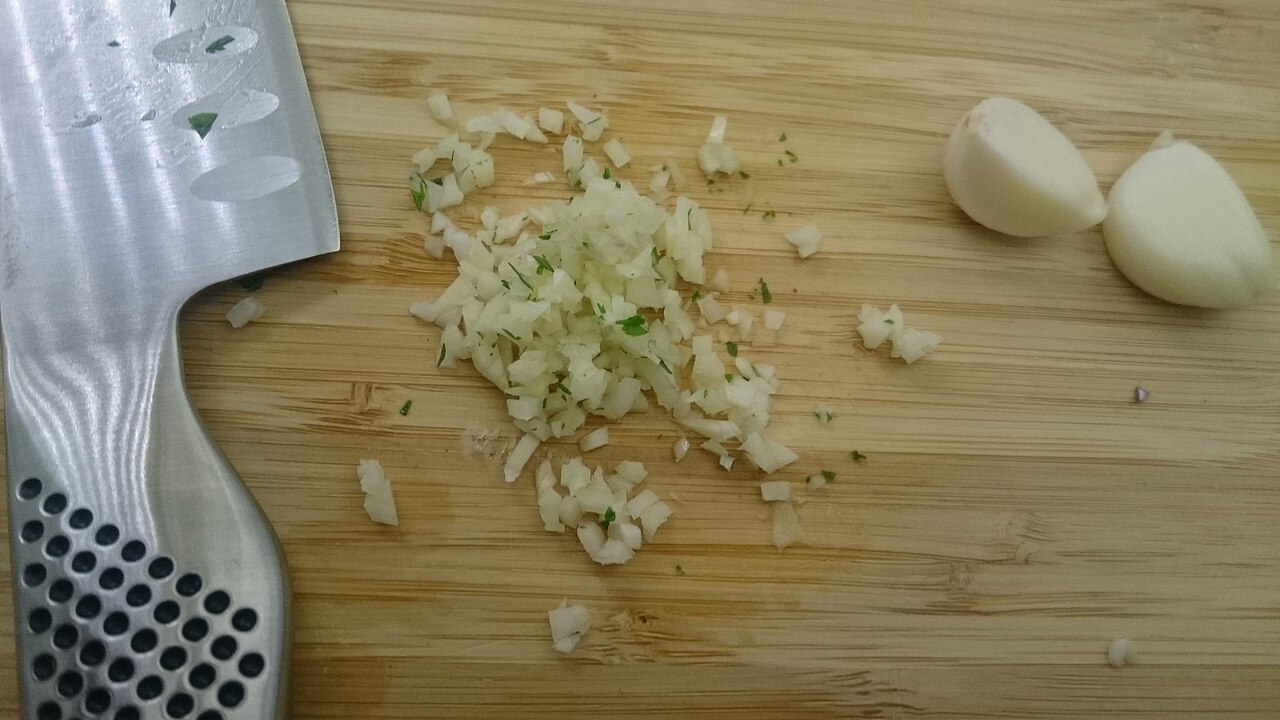
To mince garlic, cut a peeled clove into thin slices, narrow strips, then small crosswise pieces. Keep the clove flat on the board, use a controlled knife motion, and stop when the pieces are evenly small enough for your recipe. Minced garlic stays in separate pieces; grating makes a finer, wetter result.
Set up a stable clove
Separate one clove and remove its papery skin. Keep the peeled clove whole until you are ready to cut a flat face.
Use a board that does not slide. Trim only a dry end if needed, then cut the clove lengthwise so it has a broad, flat face. Set that face on the board. The flat side steadies the garlic while you cut. Curl the fingertips of your guiding hand and keep them behind the edge; work at a pace that lets you place each cut deliberately.
Slice, strip and crosscut
- Make thin slices. Hold the clove steady with curled fingertips and cut from one end to the other. Thin slices make a finer mince; thicker slices leave larger pieces.
- Cut the slices into strips. Bring the slices together on the board, keeping your fingertips tucked back. Cut lengthwise into narrow strips. If the pieces shift, pause and reposition them with the knife edge safely away from your hand.
- Crosscut the strips. Turn the strips across the blade path and cut into small pieces. Gather larger pieces with a scraper or the spine of the knife, then chop across them again if you want a finer mince. Keep your free hand clear while gathering.
Stop when the pieces are small and reasonably even for the dish. There is no single required size: a quick pan sauce may suit a finer mince, while a dressing or filling may tolerate larger pieces. You do not need to rock the blade quickly; a short, controlled up-and-down cut works too.
Mince, slice or grate?
Choose the preparation by the texture the recipe needs. Slices stay larger and distinct. A mince spreads small pieces through a dish. Grating breaks garlic down more finely and releases more moisture. Utah State University Extension describes minced garlic as strong, sliced garlic as milder, and grated garlic as an intense option for marinades or dips. These are general cooking distinctions; follow the recipe when it specifies a form.
If you want fine grated garlic for a dip or marinade, a small condiment grater may suit that job. Our guide to Japanese graters for ginger, daikon and wasabi explains when a fine grater makes sense. Purdue Extension also lists mincing, grating, pressing and slicing as separate ways to prepare garlic.
Fix the common snags
- The clove rolls: Stop and cut a flat face before continuing. Do not try to hold a rounded clove upright while slicing.
- The pieces are too large: Gather them with a scraper or the knife spine and crosscut again. Keep fingers away from the edge as you move the garlic.
- The garlic sticks to the blade: Set the knife down. Use a spatula or scraper to clear the blade, keeping your fingers off the edge.
- You wanted a paste-like result: Grate or press the garlic instead of chopping it smaller and smaller. Choose the method your recipe calls for.
Sources
- Kikkoman: Garlic preparation — cut-side-down setup, wooden-spatula crushing option and a detailed mince method.
- Purdue Extension FoodLink: Garlic — preparation and distinct options to mince, grate, press or slice.
- Utah State University Extension: Garlic — distinctions among minced, sliced and grated garlic.