Choose an olive wood cutting board by matching its listed working area and care routine to how you plan to use it. The category includes narrow serving boards and wider prep boards, so compare the dimensions of each model rather than relying on the wood name or a product photo.
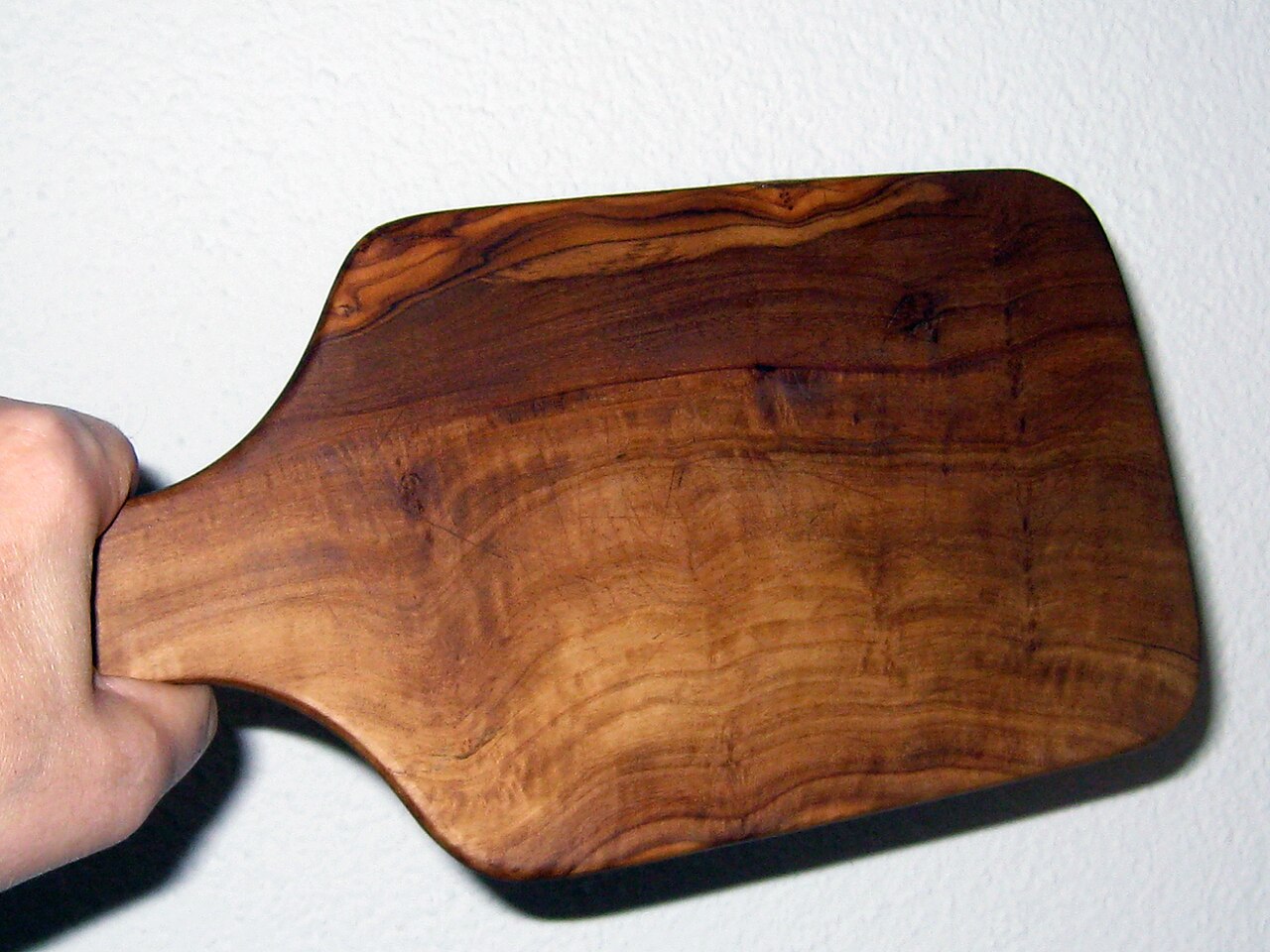
Photo by Stadtei, Schneidbrett aus Olivenholz.JPG, CC BY-SA 3.0, via Wikimedia Commons. Unmodified.
Compare actual olive-board sizes
These maker listings show different proportions and intended uses. Measurements are the makers’ listed dimensions; check the selected size and current listing before buying.
| Listing | Size | Use and care stated by maker |
|---|---|---|
| WÜSTHOF Dune, small | 8 × 13.8 × 0.9 in | Prep and serving; wash with warm soapy water, towel dry immediately, allow airflow, store dry. The maker specifies food-grade mineral oil. |
| WÜSTHOF Dune, medium | 10.8 × 17.7 × 0.9 in | Prep and serving; same care listed for the Dune board. |
| West Elm olive-wood board, medium | 15 × 7 × 1 in | Hand wash only. |
| West Elm olive-wood board, large | 21.5 × 7 × 1 in | Hand wash only. |
Length alone can mislead: the West Elm models are long but only 7 inches wide, while the WÜSTHOF sizes are wider. Think about the food you prepare. A small board may suit slicing a lemon or serving cheese; a wider surface gives more room to hold ingredients and collect scraps. A serving board’s shape may also make it less convenient for repeated chopping.
Check the fit before ordering
Measure the clear counter space and the opening of the sink where you will wash the board. Check cabinet or rack clearance and whether you can lift the board comfortably. A paper outline in the listed length and width is an easy way to test the footprint. Leave space for a bowl or plate beside it if you usually transfer cut food as you work. Our cutting-board size guide walks through measuring the counter, sink and storage area.
Look for listed thickness, handle shape, feet and any groove. A groove can help contain liquid but occupies part of the working face. Handles and decorative contours can add outside length without adding cutting area. Product photos show one board’s appearance; rely on the selected model’s dimensions and specifications for fit.
Follow the model’s care directions
The two makers give different care instructions. WÜSTHOF specifies immediate towel drying, airflow and food-grade mineral oil for its Dune board. West Elm says its listed board is hand wash only. Follow the instructions attached to the exact item you choose, especially for washing and oiling. Do not assume one brand’s finish or care routine applies to another olive-wood board.
If the board is for a Japanese kitchen knife, check the knife maker’s board guidance too. Our guide to cutting boards for Japanese knives explains why a suitable surface matters and what to inspect.
Choose the board whose working area suits your prep, whose outside dimensions fit your kitchen, and whose care routine you can follow consistently.