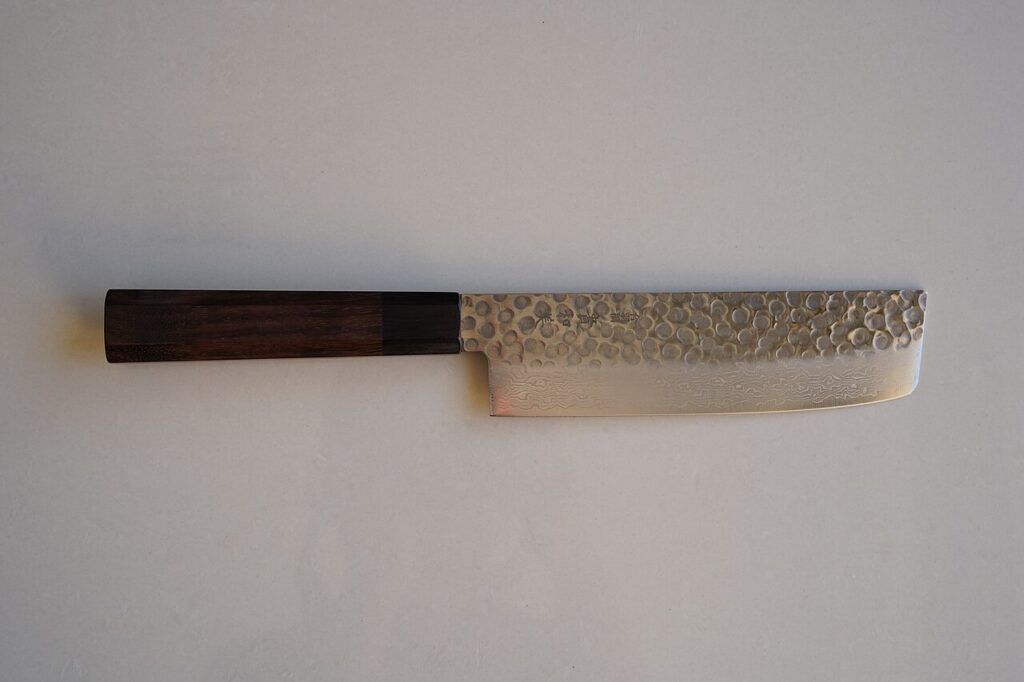
Most home cooks are better served by a nakiri for everyday vegetable preparation. An usuba is a single-bevel specialist for precise peeling such as katsuramuki, with different handling and sharpening demands. Choose by the work you want to do, not by treating one knife as an upgrade to the other.
Choose by task and bevel
Choose by the work you want to repeat, then check the exact knife’s bevel and size. TOJIRO’s knife guide describes a nakiri as a vegetable knife with a straight edge for peeling and thin slicing; it describes an usuba as single-bevel and especially suited to peeling vegetables, particularly daikon.
| Decision | Nakiri | Usuba |
|---|---|---|
| Everyday vegetable preparation | A straightforward dedicated vegetable option. The TOJIRO BASIC F-315 is one double-bevel example. | Also a vegetable knife, but the single-bevel edge changes handling and sharpening; it is not an automatic upgrade for routine chopping. |
| Specific peeling work | TOJIRO lists peeling and thin slicing among nakiri uses. | TOJIRO says the usuba is best suited to peeling vegetables, especially daikon. Its F-1128 example is single-bevel and right-handed only. |
| Handedness and commitment | The cited F-315 is double-bevel; verify the bevel on the exact model you are considering. | Check the exact handed version before buying and be prepared to learn its single-bevel steering and maintenance. F-1128 details describe that model only. |
If you want a dedicated knife for ordinary vegetable prep, start with the nakiri. Choose an usuba when its particular peeling work and single-bevel practice are part of the point. Neither is a quality level above the other; the useful distinction is task, edge arrangement, handedness and the exact model. For the bevel difference, see single-bevel and double-bevel knives.
What is the nakiri’s case?
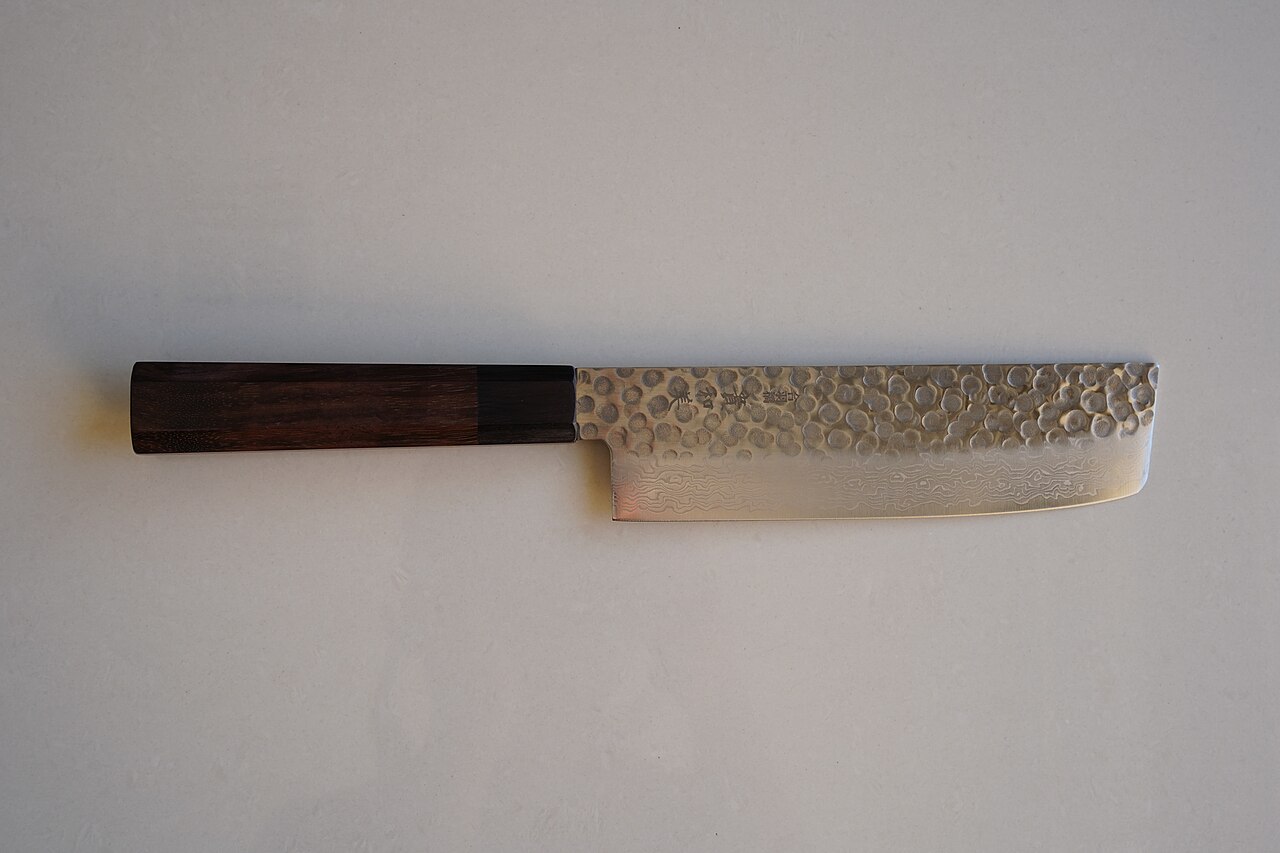
The nakiri is exceptionally well matched to the vegetable work done in most home kitchens. Its flat edge can make broad, consistent contact with the board, while its tall blade gives useful knuckle clearance and a convenient surface for moving chopped ingredients. Through cabbage, aubergine, potatoes, squash and other tall produce, a well-made nakiri tracks straight and feels easy to place.
It also works in either hand. There is no need to seek out a left- or right-handed version, and switching hands within a household does not change the basic experience. Its double-bevel edge is forgiving of ordinary technique: the cook still needs sensible control and a stable board, but the knife does not demand a specialised cutting discipline before it becomes useful.
Nakiri are typically around 165–180 mm long. That is enough edge for most vegetables without giving the knife the footprint of a longer general-purpose blade. They are usually thin enough for clean vegetable work, reducing the wedging and splitting that can make dense produce feel more like something being forced apart than sliced.
Sharpening is comparatively straightforward, too. Anyone already comfortable maintaining an ordinary double-bevel Japanese knife will find the basic task familiar. That matters because a vegetable knife earns its place through frequent use, and a knife that can be maintained confidently is more likely to stay sharp and remain in rotation.
None of this makes the nakiri a compromise. It is not an usuba with the difficult parts removed. It is the knife the home task actually calls for: direct, efficient and specialised without requiring the kitchen to reorganise itself around the blade.
What is the usuba’s case?
The usuba exists for a narrower and more demanding body of work. Its signature association is katsuramuki, the rotary-peel cut in which a cylindrical vegetable is turned against the blade to produce a long, continuous, exceptionally thin sheet. It also belongs in paper-thin decorative work and in the exacting vegetable preparation standards of professional washoku, traditional Japanese cuisine.
At that level, the characteristic behaviours of a single-bevel blade are not eccentricities to tolerate. They are working tools. The knife supports cuts, surfaces and forms that matter when vegetable preparation is itself a disciplined craft and the finished result is judged with professional scrutiny.
That specialisation brings obligations. Usuba are made in right- and left-handed versions, so handedness is part of the purchase decision rather than an incidental preference. Sharpening is also part of owning one—not merely the need to keep it sharp, which applies to every knife, but the need to learn and preserve the blade’s intended form. A buyer who plans to hand the knife to a general sharpening service without checking its experience with single-bevel Japanese blades is leaving an important part of ownership unresolved.
A couple of traditional tip shapes are available. That choice can matter to a practitioner with a clear preference, but it need not become a detour into regional lore for someone still deciding whether an usuba belongs in the kitchen at all.
An usuba is typically a bigger investment than a nakiri, and the financial difference is only part of the cost. Time, attention and sharpening practice belong in the comparison. In return, it offers capabilities that are real—but highly specific. If those capabilities match the work, the knife makes sense. If they do not, its professional pedigree will not make ordinary vegetable preparation automatically better.
Where is the honest crossover?
A professional cook doing traditional Japanese vegetable preparation has an obvious reason to choose an usuba. So does a committed practitioner who is actively learning techniques such as katsuramuki and wants the appropriate instrument rather than an approximation.
There is also a third legitimate buyer: the enthusiast who wants the sharpening practice and exacting technique as part of the pleasure. A hobby does not need a commercial kitchen to justify serious tools. If learning the knife’s habits, maintaining it carefully and gradually improving specialised cuts sounds satisfying, an usuba can be a deeply rewarding choice. Wanting the practice is a real reason, and curiosity pursued with patience is not pretence.
The purchase that tends to disappoint is the usuba bought as a status nakiri—the expensive, professional-looking version that is expected to do the same job with more authority. Its demands then feel like defects, while its strengths go unused. That is how a beautiful and capable tool can quietly become a drawer knife. The mismatch is not a failure of the cook or the blade; it is simply the result of buying for an imagined hierarchy instead of the work and experience actually wanted.
Choose the usuba because its particular practice is appealing. Choose the nakiri because clean, comfortable vegetable preparation is the goal. Neither decision needs an apology.
Which flat knife—or neither?
A cook still weighing a dedicated vegetable knife against a second generalist is one decision upstream; santoku vs nakiri addresses that choice. Once a nakiri or usuba is the clear fit, understanding the anatomy of a Japanese knife provides useful context for the blade, tang and machi. Whichever knife is chosen will usually wear a wa handle, which is where we come in: Horn & Grain makes those handles to order.