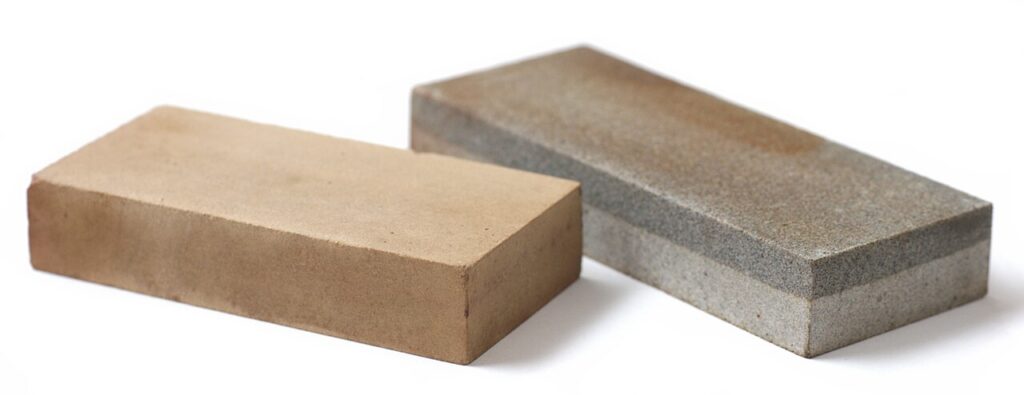
Most home kitchens need fewer whetstone grits than the catalogue suggests. A medium stone around 1000 grit is the working heart of sharpening: it restores a dull edge and, for most cooks, is sufficient on its own. Coarse stones are for repair. Higher grits serve particular jobs and preferences. They are options, not stages everyone must collect. Skill on one stone beats a shelf of them, and a clean 1000-grit edge beats a badly finished 8000-grit edge. We have no stone to sell you; this is simply a guide to choosing less and using it well.
What do grit numbers mean?
Grit is a rough description of how aggressively a stone cuts and how refined an edge it can leave. Lower numbers indicate coarser stones. They remove steel faster, making them useful when the edge needs substantial correction. Higher numbers indicate finer stones, which remove steel more slowly and smooth the edge left by the previous grit.
That does not make a higher number automatically better. A coarse stone can do a repair that a fine stone would perform painfully slowly. A medium stone can produce a sharp, practical kitchen edge without any further polishing. A fine stone can refine an already sound edge, but it cannot compensate for an edge that was never formed properly.
Because rating systems, abrasives and stone construction vary between makers, grit numbers are best treated as broad bands rather than exact, interchangeable measurements.
Think of grit as a choice of job rather than a quality score: coarse reshapes, medium sharpens, and fine refines.
Why is a stone around 1000 grit the one that matters?
A medium stone around 1000 grit removes enough steel to restore ordinary dullness without behaving like a repair tool. It can form a fresh edge, bring the two sides together cleanly and leave a useful amount of microscopic texture, often called “bite.” That bite helps an everyday knife engage tomato skin, herbs, onions and other familiar kitchen ingredients.
For a normally used, double-bevel kitchen knife that becomes dull rather than damaged, this is genuinely all the stone most people need. It handles routine sharpening, develops the control required for consistent results and makes it easy to notice whether pressure and positioning are steady. Regular use of one medium stone is more valuable than occasionally moving through a complicated progression that has not yet become repeatable.
A finisher does not unlock sharpness that was absent at 1000 grit. If portions of the edge were missed, the two sides did not meet, or the final passes were uncontrolled, a finer stone will mostly preserve those problems with a shinier surface. Refinement begins only after the medium stone has produced a complete edge.
Which stone first? Choose one medium stone around 1000 grit. “Splash-and-go” stones are wetted at the surface before use; soaking stones are placed in water as their maker directs. These are neutral categories describing preparation, not a ranking of edge quality. Follow the care instructions for the particular stone.
Learning the behaviour of that one stone—how it feels when cutting, how the sound changes and how the water carries away residue—builds judgment that transfers to every later grit.
When does a coarse stone earn its place?
A coarse stone, roughly 220–500 grit, earns its place when repairing small chips associated with why Japanese knives chip or resetting a genuinely neglected edge that would take an unreasonable amount of work on a medium stone.
It works quickly because it removes material aggressively. That speed is useful when reshaping is actually required, but it also makes care and control more important. A coarse stone is not a necessary first stage every time a knife feels dull, and routine use removes more steel than an ordinary sharpening session needs.
For most home kitchens, the coarse stone is an occasional tool rather than the foundation of the setup. Once the damage or heavily worn section has been corrected, the medium stone takes over. Its job is to remove the coarse scratch pattern, establish a cleaner edge and leave the knife ready for use. The coarse stone does the repair; it does not usually provide the finished edge.
What do higher grits add?
Stones around 2000 grit and above refine the edge produced on a medium stone. As the scratch pattern becomes finer, the edge can feel smoother and more polished. At the same time, some of the pronounced bite associated with a medium finish may be reduced. The balance between smoothness and bite is partly practical and partly a matter of taste.
Higher grits can make sense for knives used for controlled push cuts through delicate ingredients, where a smooth passage through the food matters more than an assertive, toothy feel. They also have a genuine role in finishing traditional single-bevel knives, whose broad sharpened face and specialised cutting work can reward careful refinement.
For an all-purpose double-bevel knife used across a mixed home-kitchen workload, stopping near 1000 grit remains entirely reasonable. A finer finish may feel pleasant, but it is not a requirement for a capable edge. Steel, food, cutting style and sharpening skill all affect whether extra refinement is noticeable or useful.
Polishing for its own sake is also a valid hobby. Some people enjoy the appearance, tactile feedback and concentration involved in taking an edge further. That enjoyment does not need a productivity argument. It simply should not be confused with a compulsory route to sharpness.
Which sharpening progressions make sense?
A progression should solve a visible problem, not satisfy an imagined requirement to touch every number. Three simple paths cover most situations:
- Dull but undamaged: medium around 1000 grit, then stop.
- Chipped or seriously neglected: coarse stone, then medium around 1000 grit.
- Consistent at 1000 and curious about refinement: medium around 1000 grit, then one chosen finishing stone.
The important gate is skill. Move to the next stone only when the previous stone’s work is consistent from heel to tip and can be repeated without guesswork. The next grit should refine an established edge, not search for one that is still missing.
That usually means becoming comfortable with steady positioning, even work along the full edge and removal of the fragile lip of metal—often called a burr—created during sharpening. For the complete double-bevel process, follow the beginner whetstone sharpening steps; the sharpening angle guide explains how to match and hold the bevel.
If a 1000-grit result is uneven, another stone adds another variable. If it is clean and dependable, a finisher becomes an informed experiment: compare the result in familiar kitchen work, decide whether the smoother feel suits the knife, and keep it only if it adds something worth the extra step.
A sharpening session can soak the whole knife, so we dry the handle too; the wa handle care guide covers the rest.