To give a knife without the traditional bad luck, tape a small coin to the box or card and let the recipient hand it back. The exchange makes the knife a purchase rather than a gift, so, within the custom, the friendship stays uncut. Hand it over guarded or sheathed, never bare. Explain the coin in the card so it is not mistaken for change. And if you do not know their knives, give the choice rather than the guess.
This page is about presenting a knife once it has been chosen; it is not a guide to what to give someone who owns Japanese knives. The aim here is simply to make the handover safe, clear and considerate.
What the folklore record actually says
The coin custom is recorded in Iona Opie and Moira Tatem’s A Dictionary of Superstitions (Oxford University Press, 1989), a reference work drawing together British and European folklore. In its material on knives, the feared consequence is expressed through the object’s action: a knife given freely may “cut” love or friendship. When the recipient hands the giver a coin, money has changed hands and the knife counts as a sale instead.
That is the useful core of the custom. The reference supports the association and the token sale, not the embellished backstory often attached to them. Nor does a recorded belief mean that every recipient observes it. The coin is a small courtesy: it lets someone who values the custom accept the knife comfortably, without asking anyone else to declare a belief in bad luck.
Japan: taboo and auspicious at once
Nippon.com’s Gift-Giving Etiquette in Japan says that knives are “frowned upon as gifts for a wedding or a house move” because they can suggest cutting ties. The same guide carries the opposite reading too: a blade can “cut a path forward.” It also notes that “ideas are shifting,” so a wanted knife is not automatically an unwelcome gift.
Those meanings can sit side by side. An object associated with separation on one occasion can suggest resolve and a fresh start on another. The considerate approach is therefore personal, not absolute. For a Japanese recipient, or a family that keeps Japanese gift customs, find out how they view the occasion. A wedding or house move deserves particular care; a quiet question or choosing together is better than assuming either approval or offence.
Five yen: a friendly pun, not a rule
A five-yen coin adds a light piece of Japanese wordplay. Its name, go-en, sounds like goen, a word associated with good fortune or connection. A Japan Today report on the five-yen shrine-offering claim notes the pun, but also quotes Izumo Taisha’s explanation that there is no prescribed amount and that amount-based associations are wordplay for entertainment. The pun can make the exchange warmer, but it is not doctrine. A five-yen piece is an example, not a requirement; another small coin can perform the same token purchase.
China: “one cut, two pieces”
In Chinese gift etiquette, a blade can call to mind 一刀两断 (yī dāo liǎng duàn): literally, “one cut, two pieces,” and idiomatically a clean break or severing of a relationship. A popular DigMandarin guide to Chinese gift taboos notes the phrase when explaining why a knife may be an unlucky gift and describes the workaround: the recipient gives a small amount back, changing the knife from a gift into a symbolic purchase.
A popular cultural guide is not evidence that every Chinese recipient follows one rule. Practice varies by family. If the recipient or their family observes the taboo, make the coin exchange explicit. If their view is unknown, ask discreetly rather than treating cultural background as a prediction.
Make the handover clear and safe
Presentation starts with the ordinary physical courtesy. Keep the edge covered by a guard or a saya, a fitted wooden sheath. The knife must never be handed over bare, hidden loose in wrapping, or arranged so that opening the package exposes an edge unexpectedly. Keep whatever suitable cover accompanies the knife in place throughout the exchange. The cover is about safety and care, not superstition.
Tape the coin where it will be seen as soon as the box or card is opened. Do not leave it loose at the bottom of the packaging. Then give it a sentence in the card, perhaps:
> A knife can be said to cut a friendship. Please hand this coin back so the knife becomes a purchase and the friendship stays uncut.
At the handover, point out the note and allow the recipient to return the coin. Accept it; that completes the small transaction. The moment can be warm and quick rather than solemn. If the recipient has never heard of the custom, the written explanation keeps the coin from looking like forgotten change and makes the intention easy to understand.
Match the gesture to the occasion
For a wedding or house move involving a Japanese recipient or family, the Nippon.com guidance is a reason to pause before relying on the coin alone. Ask someone close to the recipient, or ask the recipient directly. Their preference matters more than a general cultural summary. For other occasions, the coin exchange makes the handover workable: it acknowledges the idea of cutting ties while recasting the knife as a purchase. If a family has its own version of the practice, follow that version without turning the exchange into a lesson.
When to give the decision instead
A gift can be thoughtful without being a completed surprise. If the recipient’s preferences are not known, the better course is a promise note and choosing together. A simple line such as “A knife is planned, and the choice is yours” gives the recipient a real say without pretending to know what they would want. Once the choice is made, the coin can still be part of the eventual handover.
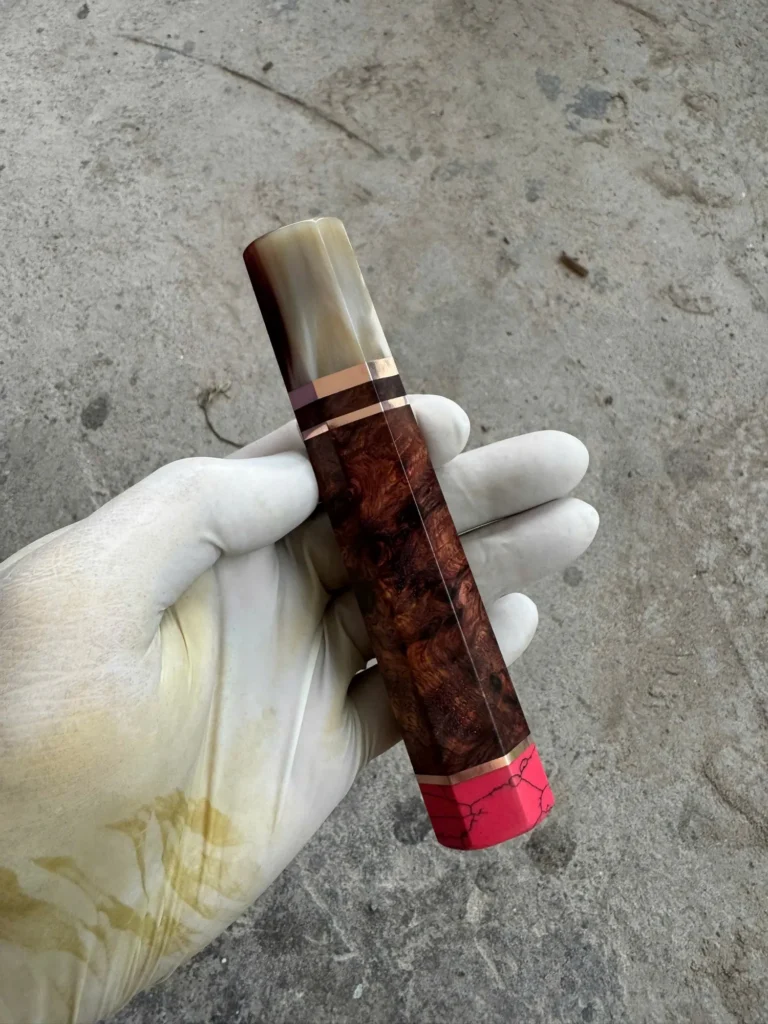
For a cook whose favourite knife already exists, giving a made-to-order wa handle is one such decision to make together. For the broader question of gifts around a working kitchen, the kitchen tools guide keeps that separate from this handover custom.
The coin is not a test of belief and the surprise is not the measure of generosity. A covered edge, a visible coin, a plain explanation and room for the recipient’s own preference are enough to give a knife without making the friendship carry the risk.