Choose a French rolling pin if you want to steer dough directly with your palms; choose a handled pin if you prefer a fixed grip and a barrel that rolls between handles. A straight, handle-free dowel is a third option for broad, uniform passes. Match the form to the shape of dough you make and the grip you find comfortable.
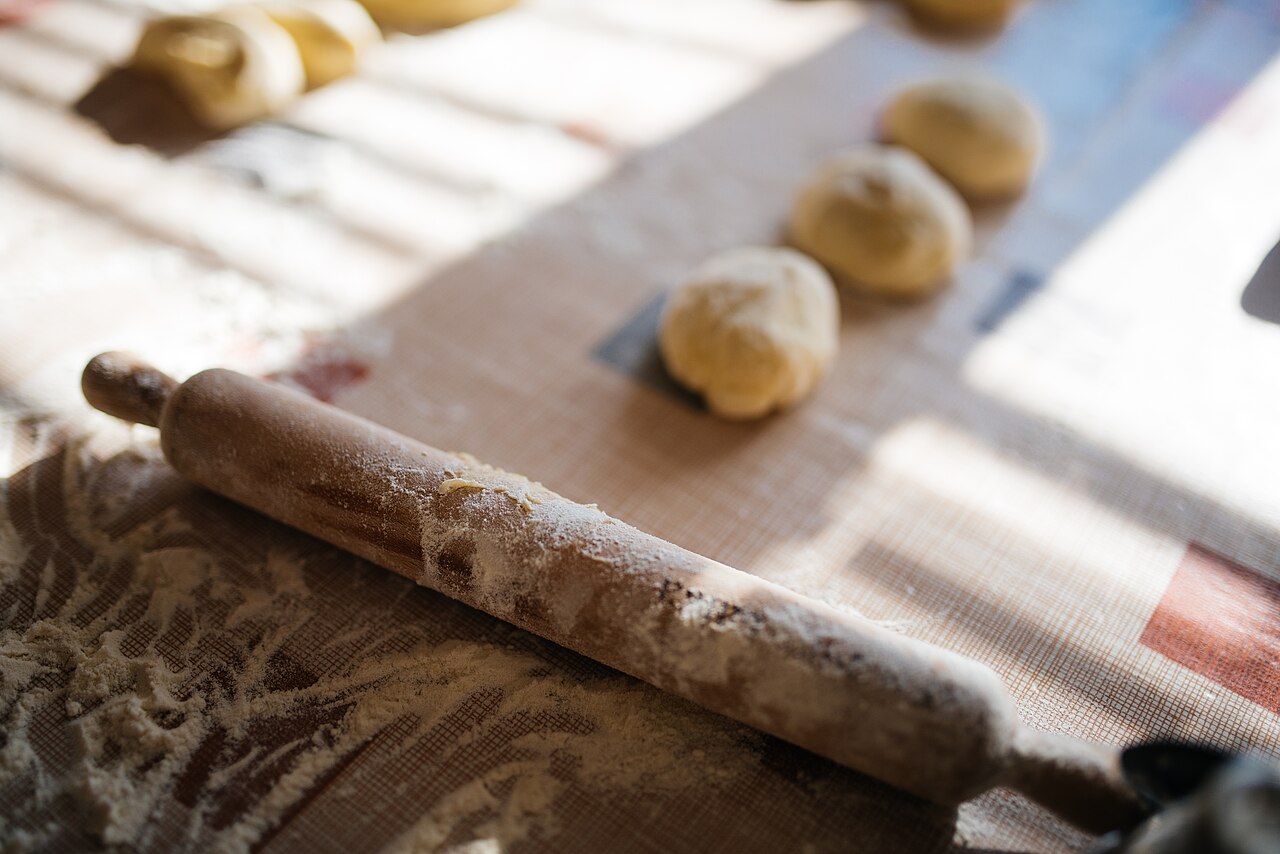
Compare the forms
| Form | Control | Consider it when |
|---|---|---|
| French, tapered and handle-free | Both palms rest on the rod; shift pressure from side to side and pivot the pin. | You want to steer a round of dough while shaping it, such as pie pastry. |
| Handled roller | Hold the handles and roll the barrel back and forth. | A familiar grip and simple forward-and-back motion feel more natural. |
| Straight dowel | A uniform cylinder gives a consistent contact width along its length. | You often roll a large disk or broad sheet and want a full-width pass. |
Choose for the dough you actually make
For small rounds of pie dough or pastry, the French pin’s taper gives your hands a way to guide one side more than the other. King Arthur Baking’s comparison reports that its testers found this helped keep a pie-dough circle neat. Treat that as the result of its test, not a guarantee about every baker or pin.
If you roll mostly cookies, pizza dough, or other pieces with broad back-and-forth strokes, choose the grip you can hold comfortably and the barrel width that fits your board. A handled pin is easy to steer through its grips; a straight dowel has no handles but keeps a uniform shape. Check the actual pin length against your largest usual dough, and leave enough counter space to roll without hitting a wall or appliance.
Check the motion and storage fit
Before buying, mime one rolling pass over the space where you usually work. With a French pin, your palms need room to press and pivot over the rod. With a handled model, your hands need clearance at the barrel ends. For a straight dowel, check that its length fits the counter and drawer. Choose the tool whose grip and reach match your regular dough; follow the recipe for rolling thickness and handling.
Sources: King Arthur Baking’s rolling-pin comparison; its listings for a French pin, straight pin, and handled rolling pins.