Choose a tempura pot by the food that must fit inside it, the maker’s working oil quantity and your hob’s requirements. Full pot capacity is not the same as an approved oil fill. A compact oval or rectangular pan may suit a few long pieces, while a wider round pot gives a different working area; neither shape is automatically the best choice for every batch.
Before comparing thermometers or draining racks, confirm that the pot is intended for deep-frying and suitable for the particular gas or induction setup you use. Then check its dimensions, oil marks and cleaning instructions together.
Start with the food footprint
Think about the pieces you normally cook. A long piece of fish or shrimp needs room along one axis. Several small pieces need a usable area that lets you work around them. The pot’s overall width, including handles, does not describe that cooking space.
For an example of the distinction, Yoshikawa lists its aikata PD3023 frying pot as an oval with a 205 × 160 mm interior, while its total width is 274 mm. The first measurement helps you judge the food space; the second matters on the hob and in the cupboard.
A rectangular option can also suit long ingredients. Wahei Freiz’s Pocofrit range includes several rectangular sizes and accessory combinations. Compare the actual interior measurements of the model you are considering. A family name or a photograph with food in it is not a batch-capacity specification.
Make this decision with your usual cooking in mind. If you normally prepare a small side dish, owning the widest possible pan creates a different oil and storage commitment. If your food barely fits, choosing a compact pan just to use less oil may make handling unnecessarily cramped.
Separate full capacity from oil quantity
A litre figure beside a pot often describes full water capacity. Deep-frying instructions use a working oil amount that leaves the space required by that particular design. Do not fill to the rim, infer an oil level from the full capacity or transfer another pot’s marks to this one.
Yoshikawa’s aikata example makes the difference visible: the maker lists 2.2 L full capacity, an appropriate-oil line at 500 mL and a maximum-use line at 800 mL. These are three different figures for three different purposes. Its manufacturer catalogue also labels the full water capacity separately from the oil guide lines.
Diameter alone does not settle the amount either. In Wahei Freiz’s Agedutsumi range, the 22 cm deep model lists about 900 g of oil, while the 24 cm stepped model lists about 800 g. The larger diameter does not mean the higher stated oil quantity.
Notice the units: those Wahei figures are grams; Yoshikawa’s lines are millilitres. Keep the maker’s units and instructions intact. There is no need to invent an oil-density conversion to compare shopping options. Record the stated quantity for the exact model and use the measurement method its instructions require.
Check the hob as well as the pot
“Induction-compatible” establishes only part of the fit. The hob may have its own rules for base size, pan construction, oil quantity and the use of a deep-frying temperature mode.
Panasonic’s built-in IH guidance distinguishes models with different temperature-control systems. Some require a dedicated tempura pot; others accept a broader range of compatible cookware, with performance affected by the pan. That is why a generic IH symbol cannot settle every frying-mode question.
Read your hob’s deep-frying section before buying. Compare it with the pan’s directions. If one requires more oil than the pan permits, that combination is unsuitable; do not solve the conflict by ignoring one set of instructions. Likewise, an appealing small pan needs a base that the hob accepts.
Use the pan maker’s heat limits too. Wahei specifies medium heat or lower on induction for the Agedutsumi examples. That is a rule for that range, not a universal temperature setting or a cooking-time chart for tempura.
Decide which accessories you will actually use
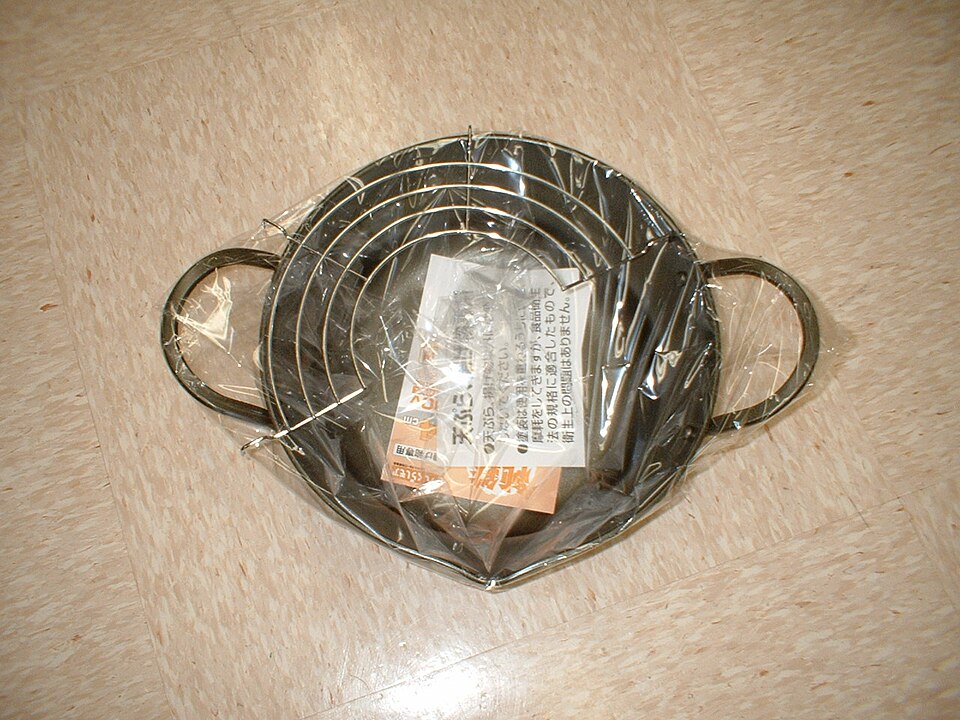
A thermometer helps you read oil temperature, but it does not heat or regulate the oil itself. Check how the supplied thermometer attaches and the oil level at which it is intended to work. Follow the recipe for cooking temperature and the instrument’s instructions for placement; a number on the hob and a thermometer reading are not automatically interchangeable.
A draining rack provides a place for finished pieces to drip, while a separate tray may give more room for a batch. Look at where the rack sits and whether it obstructs access to the pot. If a lid doubles as a tray, check which position the maker intends for each use instead of assuming it should cover the oil during frying.
A crumb skimmer serves another purpose. Kikkoman’s frying-colander guide explains collecting loose batter pieces that would otherwise remain in the oil. A draining rack does not do that job. Choose a skimmer intended for frying and small enough to move around your pan.
Include handling and cleaning in the purchase
Check the total dimensions with handles, not only the cooking diameter. Leave room for the way you will work at the hob, and plan where the pot, rack and thermometer will live afterward. A compact body with permanently wide handles can still occupy a large shelf.
A pouring spout is useful when transferring oil according to the product’s cooling and handling instructions, but it does not make hot oil handling effortless. Read how the maker expects the pan to be held and emptied. Do not choose it solely from a photograph of a clean pour.
Finally, read the care instructions before deciding between materials and coatings. The aikata example is not dishwasher-safe. Another pan may have different directions for its finish, thermometer or removable parts; a general cast-iron or frying-pan seasoning routine may not apply.
A useful shortlist therefore records five things: interior space, working oil instructions, hob approval, access for cooking and draining, and care. Once those fit your routine, accessories become easier to judge. Our Japanese kitchen tools guide covers the other utensils that support the preparation.