“Semi-stainless” describes a practical expectation of corrosion resistance; it does not identify one steel recipe. Treat such a knife as capable of staining and rusting, even when its sides are stainless clad. It can suit a cook who already cleans and dries a knife during preparation, but it should not be bought as a maintenance-free substitute for stainless steel.
Steel names need equal care. SLD is Proterial’s branded steel corresponding to SKD11. The shorter label SKD is incomplete: it must not automatically be expanded to SKD11, SKD12 or SLD.
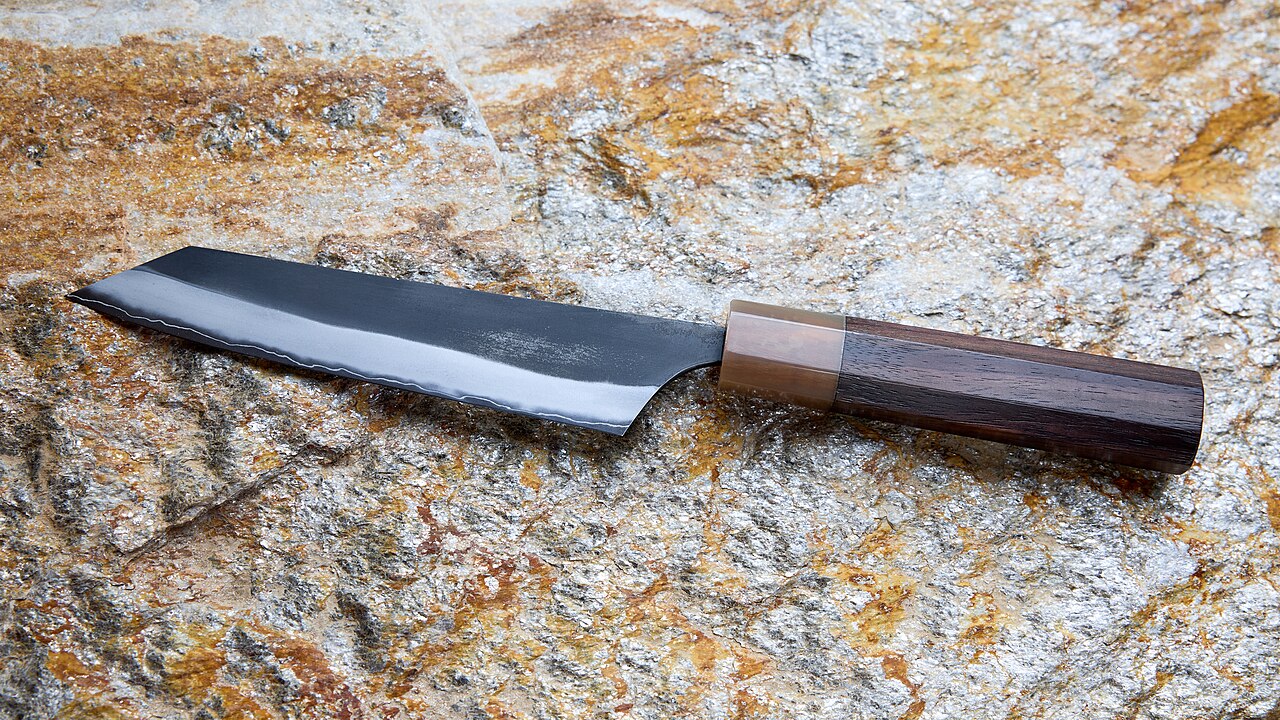
Semi-stainless is a description, not a complete specification
In kitchen-knife listings, the term generally signals less reactivity than a plain carbon-steel blade while retaining more staining potential than the seller’s stainless options. That is an expectation to clarify for the particular knife, not a guaranteed position halfway between two fixed materials.
It says nothing precise about hardness, sharpening effort or resistance to chipping. A knife does not become “halfway tough” or “halfway easy to sharpen” because someone calls it semi-stainless.
Manufacturer use of the term is real: Kikuichi, for example, names a SEM semi-stainless series. The category name alone does not identify its steel as SLD or justify borrowing another maker’s alloy specification. Kikuichi’s SEM range.
When reading a listing, look for the full steel designation, the maker’s own product description and the construction. If a proprietary steel is not disclosed, keep that limitation visible rather than assigning it a familiar grade based on reputation.
SKD11, SKD12 and SLD are not interchangeable
SKD designations belong to a family of tool steels. The number matters. SKD11 and SKD12 are different grades, not two spellings of the same material.
Proterial explains that SKD11 is a Japanese standard designation, while SLD is its own brand corresponding to that grade. Its cross-reference lists SLD with SKD11 and D2. A separate cutting-tool manufacturer’s reference maps SKD12 to the A2 class. Those references establish a distinction; they do not establish that every knife sold simply as “SKD” uses either particular grade. Proterial’s SLD explanation, Proterial grade table, Moldino material reference.
That leaves a useful buying rule: compare complete specifications. A seller’s “SKD versus SLD” comparison may be comparing two product lines, but it has not necessarily identified two exact alloys. Ask which grade the particular knife uses before accepting chemistry or performance figures attached to that comparison.
If no reliable answer is available, you can still assess the knife’s size, grind and care requirements. You simply cannot make a precise grade comparison from the shortened name.
Chromium percentage does not settle the question alone
SKD11 illustrates why a single chemistry number can mislead. Proterial lists roughly 11–13% chromium and 1.4–1.6% carbon, yet expressly does not classify SKD11 as stainless. It also describes lower corrosion resistance than stainless steel.
So a listing that selects the chromium figure and concludes “therefore rustproof” has skipped the steelmaker’s actual classification. Alloy composition and the resulting material structure matter together. A kitchen buyer need not calculate that structure; the useful step is to use the exact grade’s authoritative classification and the finished knife’s care guidance.
The Japanese knife steel guide explains the broader properties. Here, the key consequence is simple: a high-sounding chromium number does not remove the need to clean, dry and inspect a semi-stainless edge.
Stainless sides leave the cutting core exposed
In a stainless-clad knife, the outer layers cover much of the blade’s sides. The core still reaches the cutting edge, because that is the steel doing the cutting. The shiny sides and the narrow exposed band can therefore change colour differently.
Chef’s Armoury’s care instructions for its stainless-clad semi-stainless knives make this distinction explicitly: the cladding resists corrosion, while the exposed core remains susceptible. This is a construction example, not a promise that every semi-stainless knife has stainless cladding. Care for stainless-clad semi-stainless knives.
Before ordering, establish whether the knife is stainless clad, iron clad or made from one steel throughout. The cladding guide explains these layouts. Knowing the outer material helps you understand which areas need attention and why the blade may develop an uneven-looking colour change.
A workable daily care routine
Keep the blade free of lingering food residue during preparation, particularly after acidic ingredients. Hand wash when finished, dry the blade and handle thoroughly, and store the knife only when dry. Do not leave it in a wet sink or enclosed against a damp guard.
A grey or dark change at the exposed edge can be patina. Orange, spreading or rough corrosion needs a different response. The colour alone is not a complete diagnosis, especially around pits or the handle junction. Use the patina explanation to understand normal colour changes and the rust guide for active corrosion.
Do not try to force every blade to remain uniformly bright by repeated aggressive polishing. That can change the finish without solving the habit that caused corrosion. Nor should a patina become permission to leave the knife wet: its presence is not a waterproof coating.
The routine is easier when everyone sharing the knife understands it. If the usual household habit is to leave preparation tools for someone else to wash later, choose a knife around that reality rather than an optimistic interpretation of “semi.”
Decide on the complete knife
A semi-stainless knife can be a good purchase when its shape, grind and maintenance requirements are what you want. The label itself is neither a reason to reject it nor a performance upgrade.
Ask how the actual edge will be maintained and which tasks the maker intends it for. Thin geometry still needs controlled cutting, and a wear-resistant tool-steel origin does not turn a fine kitchen knife into a pry bar or bone cleaver. Industrial die-steel properties are not a demonstration of a finished kitchen edge’s impact tolerance.
Choose it because you want this knife and can follow its care routine. If your main aim is reducing corrosion concerns, a clearly identified stainless alternative may fit that aim more directly. In either case, a full specification tells you more than a reassuring category name.