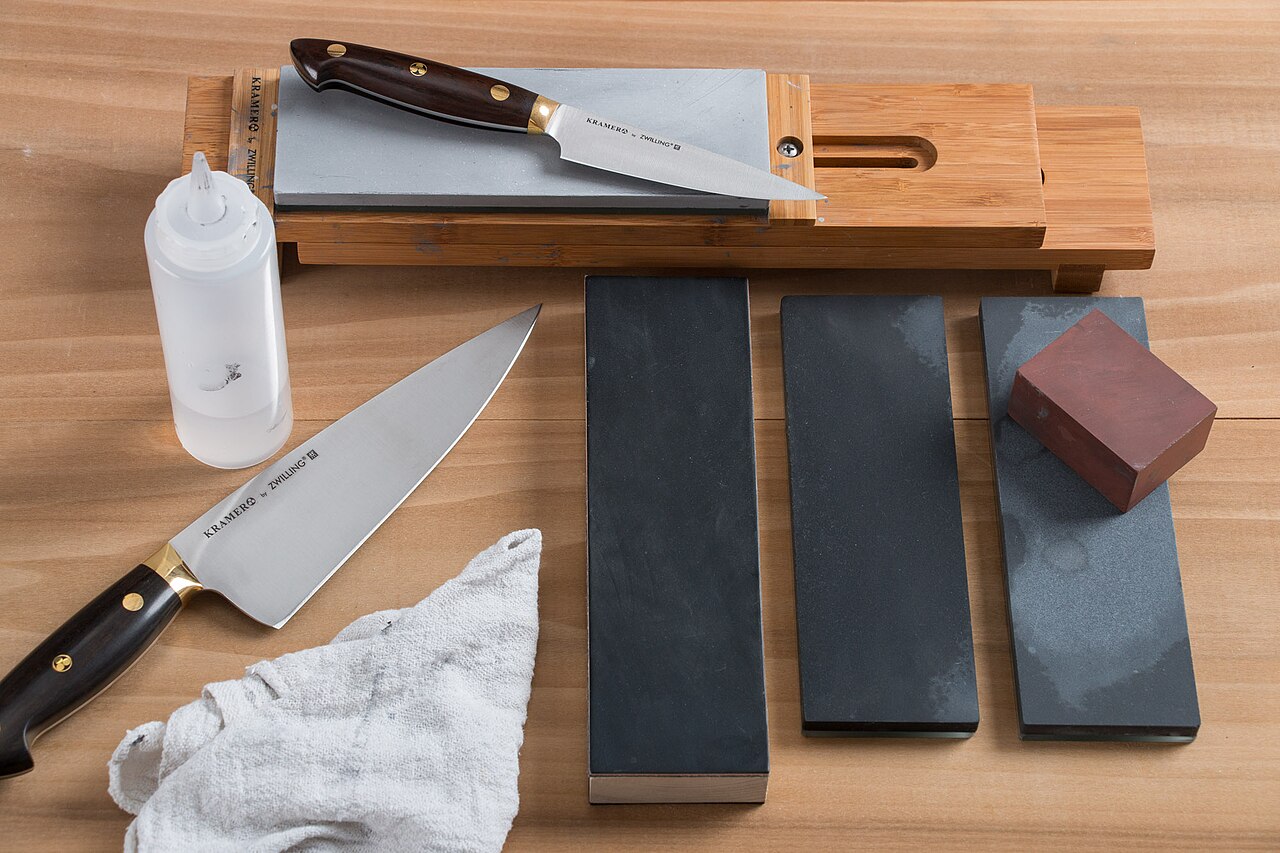
A nagura is a small stone rubbed on a larger sharpening stone to prepare its working surface or produce slurry. Depending on the product, its job may be cleaning, light surface correction or supplying abrasive slurry for sharpening. Those purposes are related, but they are not interchangeable. Identify the small stone and its intended partner before using it.
You do not need a nagura merely because you own a whetstone. A clean, flat stone that works as intended may need no extra rubbing stone at all. The useful question is what problem the accessory is meant to solve.
Three jobs that often get confused
Dressing refreshes a stone’s working surface. A face that has become loaded with sharpening residue or locally rough may need treatment with a suitable dressing tool. Raising slurry deliberately produces a wet mixture of loose particles on which sharpening continues. Flattening restores the overall plane of a stone that has worn hollow.
These can happen together to some extent, but seeing fresh slurry proves none of them is complete. A stone can look clean while remaining dished. It can also be flat yet have a surface texture that needs finishing after coarse lapping.
Think of the intended result before selecting a tool. If the problem is a hollow running along your usual sharpening path, use a proper flatness check and the flattening guide. Rubbing a small block around the hollow is not evidence that the whole face has returned to one plane.
The word nagura does not specify one grit
Small synthetic rubbing stones can have markedly different functions. Suehiro’s GTSF-2 has #180 and #300 faces for correcting small surface irregularities and scratches. Its NGRF-100 page describes a fine tool for raising slurry and cleaning stones in the #8000–#10000-and-above range. These are examples of different intended pairings, not alternatives to apply indiscriminately to the same finishing stone. Suehiro GTSF-2, Suehiro NGRF-100.
That matters if a box contains an unlabelled little block. It might be a maintenance accessory, but its size and colour do not tell you whether to leave its residue on the sharpening face. Identify it from the original product information before treating it as fine sharpening slurry.
Natural nagura introduces another layer of variation. A natural origin does not make an unknown small stone compatible with every synthetic or natural finisher. If your interest is natural-stone sharpening, start with the supplier’s identified pairing and purpose; the natural whetstone guide covers the larger choice. A beginner does not need a collection of unnamed fragments to maintain a kitchen edge.
Using a compatible synthetic nagura
For a product intended to be rubbed wet on a waterstone, begin with a clean station and stable stone. Prepare both according to their water instructions. Suehiro explicitly calls for the rubbing tool to contain sufficient water and for the larger stone’s face to be wet. There is no single soaking time that can be transferred to every nagura and whetstone.
Rub with light, controlled contact over the area being prepared, keeping the small block flat against the face rather than digging a corner into it. Work across the surface instead of repeatedly scrubbing one small spot. Watch what is changing: are you removing loaded residue, smoothing a rough patch or intentionally generating slurry?
Stop when the specified task is achieved. Producing a thick paste is not a universal target, and harder pressure does not establish a better finish. If the tool catches, sheds an unexpected gritty fragment or leaves obvious scoring, stop and inspect the pairing and cleanliness before putting the knife on the surface.
This sequence describes ordinary surface preparation. It does not replace the instructions for a specialised natural-stone slurry progression or authorize a nagura on a stone whose maker advises against it.
Should the slurry stay or be rinsed off?
If you are cleaning a stone or removing a coarse surface defect, rinse away the loosened material before resuming fine sharpening. The aim was to remove unwanted material, not carry it into the finish.
If the rubbing stone is explicitly intended to create sharpening slurry on that particular stone, retain the slurry as directed and keep it workable with water. Do not infer this from the word nagura alone. The particles involved can come from the rubbing stone, the larger stone and material already on the surface, so the mixture is not automatically equivalent to the larger stone’s printed grit.
The same distinction applies between sharpening stages. Wash off coarse residue from the knife and hands before approaching a finer stone. Shapton specifically warns that abrasive left from the previous stage can scratch a blade even when the finishing stone itself is fine. Shapton’s contamination advice.
Scratches, dragging and a stone that seems glazed
A new scratch appearing after surface preparation is a reason to clean and inspect, not to continue until it disappears. Possible things to investigate include loose coarse grit, a dirty nagura face and a tool that is too coarse for the intended work. Keep maintenance tools identifiable so they do not migrate casually between fine and coarse stones.
If the knife slides without the expected cutting action, diagnose the main stone before buying an accessory. Surface loading, lost flatness and sharpening contact are different problems. A nagura cannot correct an angle that never brings the bevel onto the stone, and more slurry cannot prove the edge has been reached.
There is also a clear manufacturer exception: Shapton says its stones do not need a nagura and warns that nagura lapping can leave them rough. Follow its specified lapping or dressing route for the relevant product. This is why “rub a nagura before every session” is poor universal advice.
For a first whetstone setup, buy a nagura only when you can name its job and compatible stone. Knowing why a small accessory belongs in the kit is more valuable than owning it because it appeared in someone else’s sharpening routine.