Choose a hangiri when you regularly season and mix sushi rice. Choose an ohitsu when you want a vessel for holding and serving cooked rice after it leaves the cooker. The first belongs to the preparation stage; the second belongs to the holding and serving stage. For occasional sushi rice, a suitable ordinary bowl can be enough, so buying one wooden tub does not mean you need both.
The useful question is what happens to the rice next. Will you spread it, add vinegar and work it with a paddle, or transfer it into a container for serving? Start there, then choose a capacity and care routine that fit your kitchen.
A hangiri gives you room to mix
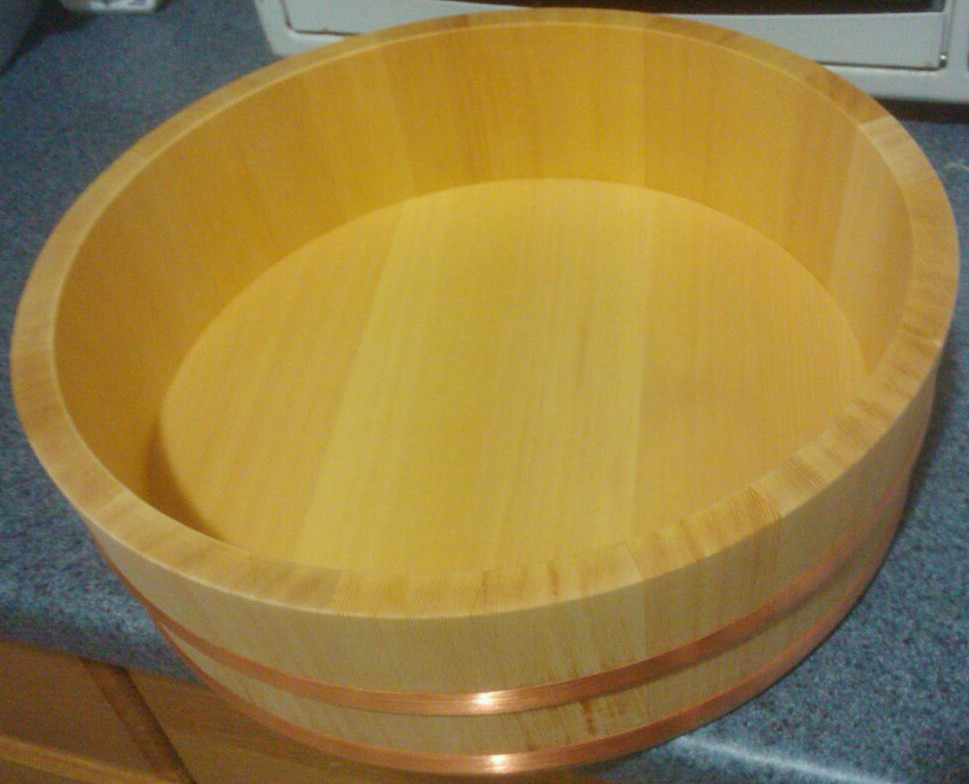
The broad wooden sushi-rice tub is also called a handai. Kikkoman’s handai guide describes its use for mixing freshly cooked rice with sushi vinegar and notes that the wood takes up excess moisture. It can also serve a dish such as chirashi sushi.
Its purpose becomes clearer when you picture the movement. You need access to the rice with a paddle, room to distribute the seasoning, and an open surface from which heat can escape. The tub is a working vessel during that process, not simply a wooden container chosen for presentation.
Check the product description for rice mixing. Retailers may use hangiri or handai, but the name alone is less useful than seeing the intended job, dimensions and capacity. A lidded rice bucket can look related while being organized around a different task.
An ohitsu holds cooked rice
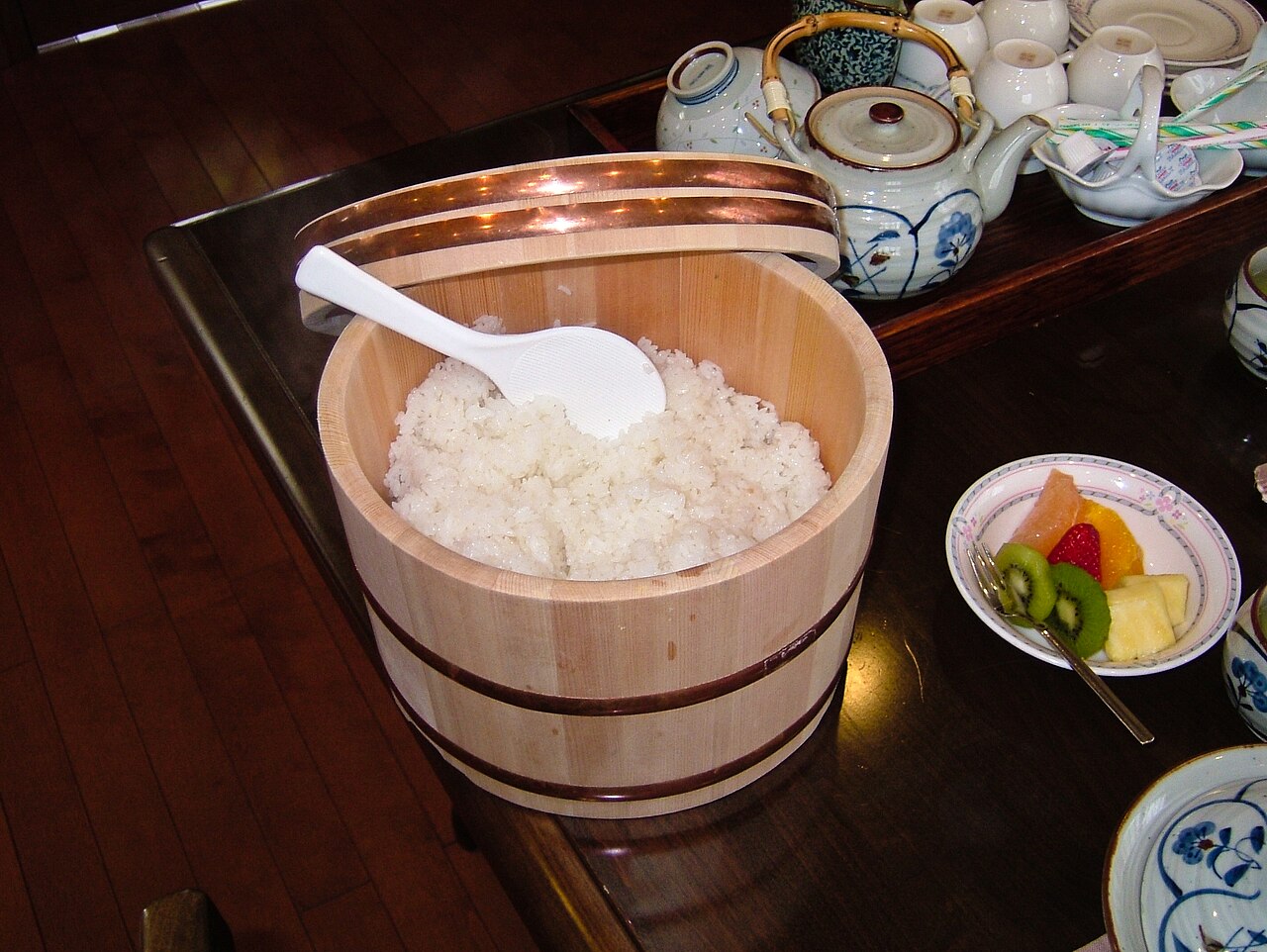
An ohitsu receives rice after cooking. Kikkoman’s ohitsu guide explains how a wooden version absorbs excess moisture and can return moisture as the rice dries. Ceramic and plastic versions also exist, so the word does not guarantee one material or care method.
The basic wooden-ohitsu routine is to wipe the interior before filling, transfer the cooked rice gently, and avoid packing it down with the paddle. Kikkoman also describes placing a cloth between the body and lid. Use the instructions for the specific vessel rather than assuming the same routine applies to every modern version.
This is holding and serving equipment. It does not actively cook the rice or replace the heated keep-warm function of a rice cooker. Choose it because that transfer-and-serve routine is useful to you, not because every Japanese rice meal requires another container.
What making sushi rice in a hangiri looks like
Prepare the sushi vinegar and have the paddle and fan ready before the rice is finished. Wet or damp-wipe the wooden interior as directed, so the rice is less inclined to stick. Add the freshly cooked rice and distribute the seasoning rather than pouring everything into one small spot.
Kikkoman’s chirashi lesson shows a cutting motion with the rice paddle: separate and turn the rice instead of pressing and crushing it. Once the seasoning is incorporated, fan the rice to release the remaining heat. Its method also allows an ordinary large bowl when a handai is unavailable.
The useful stopping point is seasoned rice that has been mixed without being mashed, with excess heat released according to the recipe. A more expensive tub cannot correct the wrong rice-to-water ratio or overly forceful mixing. Choose a recipe for the rice and vinegar quantities; the vessel supports the method rather than defining it.
For occasional hand rolls, start with the bowl you already have and pay attention to the mixing space. If that process becomes frequent and a dedicated open tub would make it easier, you have a concrete reason to buy a hangiri.
Match capacity to the batch you really cook
Look for a capacity expressed in rice cups or go and confirm what the seller means. Diameter alone is not a portion count. A tub for mixing also needs working room, while an ohitsu is selected around the amount of cooked rice it will receive.
A manufacturer’s range illustrates why broad labels such as “home size” are not enough. Yamaco’s published catalogue, on its page numbered 45, lists sawara mixing tubs of roughly 30, 33 and 36 cm for about 3, 5 and 7 go respectively. Those are that catalogue’s product examples, not a conversion rule for all tubs or a claim about current availability.
By comparison, Korin’s hangiri listing gives its 39 cm model a ten-rice-cup capacity and describes its two smallest sizes as home-use options. The lesson is to read the capacity on the particular item, not to borrow another seller’s idea of a small family batch.
Also measure the space for washing and drying. A tub may fit on the dining table yet be difficult to rinse in a small sink. Its diameter matters throughout the ownership routine, not only while the rice is inside it.
Wood care is part of the choice
Wash a wooden rice vessel promptly after use, remove the rice, and give it time to dry with air circulating. Kikkoman warns that damp storage can encourage mold, while excessive dryness can shrink a handai and loosen its bands. Its guidance is to dry in a shaded, ventilated place rather than direct sun.
Korin likewise instructs owners of its tubs to rinse promptly, air-dry completely, and avoid leaving water in them for long periods or using a dryer. First-use treatment and responses to loose bands should follow the particular maker’s directions; a prolonged soak is not a universal repair method for every wooden vessel.
Before buying, identify the drying place as deliberately as the storage shelf. If there is nowhere to leave a large wet tub with airflow, its care will be awkward even if the cooking step is enjoyable.
Choose for the recurring job
For regular sushi-rice preparation, a hangiri has a clear purpose. For plain cooked rice that you want to transfer and serve, an ohitsu is the relevant vessel. If you are experimenting with sushi a few times a year, a bowl is a reasonable starting point.
If rice sticks to a wooden surface, review the pre-use dampening and prompt cleanup. If mixing feels cramped, check the batch against the tub’s stated capacity. If the vessel stays damp in storage, solve the drying problem before the next use. These observations are more useful than assuming you need a different wood species.
Buy the vessel that makes an existing routine easier to carry out and maintain. The broader kitchen tools guide uses the same test for tools intended to stay in service.