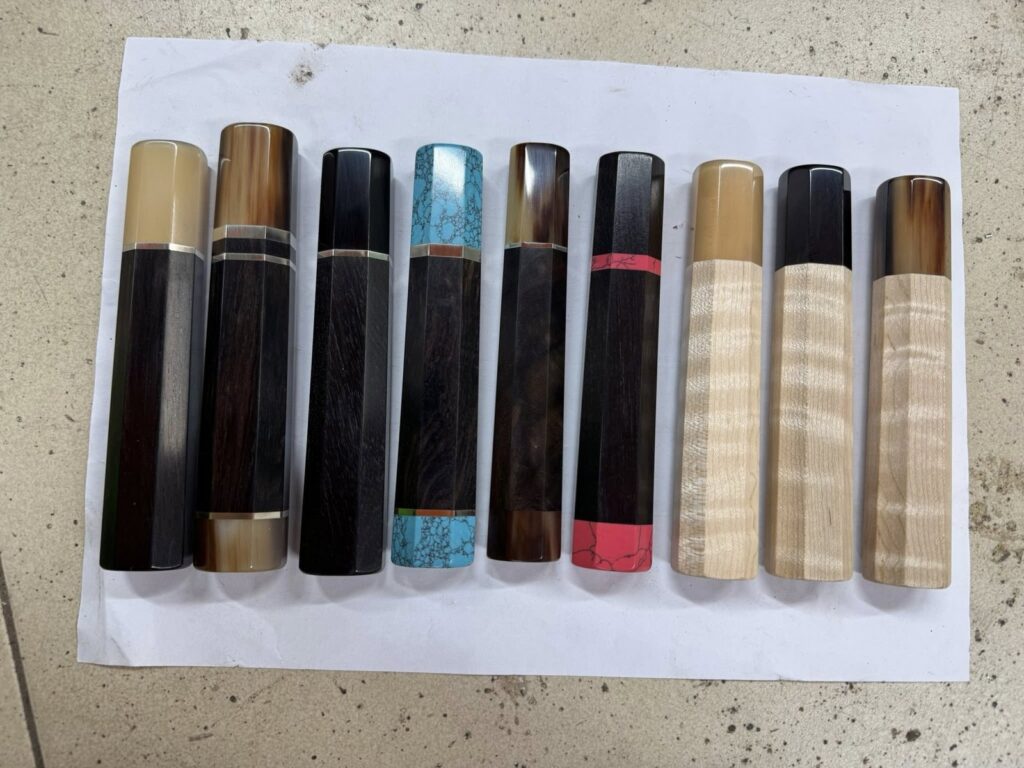
Much of the Japanese kitchen is held together by shape because fit can carry force and leave an object serviceable. A tang is seated in a magnolia haft with a wooden mallet, a saya retained by friction and a small pin, cedar staves clamped by a bamboo or copper hoop, and a box whose dovetails and mortise-and-tenon joints carry the load. What a cook gains is serviceability: the joint can be undone and refitted. Here, “without glue” means shape carries the load; rice-grain paste in fine joinery or adhesive securing or sealing a handle may assist without becoming the structure.
Four objects make that principle visible. Each belongs to a different craft, yet each treats maintenance as part of an object’s life.
The haft and the tap of a mallet
Sakai City describes a blade being inserted into a notch in a “rot-resistant magnolia” haft and fixed by striking it with a wooden mallet. The tang is seated inside the shaped wood, while the horn ferrule braces the opening where the two meet. It is a compact account of the Sakai handle-fitting story: steel, magnolia and horn are brought into a firm relationship by fit and a controlled tap. The full fitting procedure belongs in how to install a wa handle. The point here is simply structural. Near the machi, the haft holds because its interior and the tang have been made to meet closely, without any visible fastener announcing the joint.
The hoop around a wet tub
Akita cedar cooperage turns the same principle into a circle. The traditional-craft specification describes cedar staves held in shape by temporary hoops during assembly. Final hoops of bamboo, copper or brass are then “tightened using hands and feet.” Bamboo nails appear only as auxiliaries, and the specification names no adhesive.
The logic commonly given by coopers is practical rather than doctrinal. Wood exposed to water swells and shrinks. A hoop is a continuous clamp around the staves, able to hold their collective shape as the material changes. It can also be attended to as part of the tub: tightened, repaired or replaced by someone who understands the craft. Glue would ask a fixed seam to govern moving wood. The hoop asks each stave to press against its neighbours and lets the circle share the load.
That does not make the tub simple. Its apparent plainness depends on the accuracy of every edge. If the staves do not meet, the hoop cannot turn gaps into sound joinery.
The geometry inside sashimono
The traditional-craft body defines sashimono as “joining and fitting together boards, rods, and other pieces of wood.” Its descriptions include “a dovetail joint of seven or more panels,” mortise-and-tenon joints and mitres. These are not decorative lines placed over a box. Their interlocking shapes resist the directions in which the object might pull, rack or spread.
Sashimono also exposes the limit of any claim that Japanese joinery simply rejects glue. Wooden pegs made from deutzia may secure the work, and the craft description states: “The adhesive used is made by kneading rice grains well with a spatula.” The honest distinction is not glue against purity. It is structure against assistance. The joint’s geometry carries the load; pegs and rice paste help keep that geometry closed.
A sashimono box can therefore look almost impossibly quiet. Its strength is concentrated in edges that appear to do nothing. Under the surface, one cut answers another.
Glue can still belong
A wa handle may also be secured or sealed with adhesive. Sashimono can use rice-grain paste. A sword saya is traditionally closed with rice paste even though the knife cover’s grip on a blade depends on its fitted interior and retaining pin. None of these facts betrays the principle.
Adhesive can seal an opening, discourage movement or support a joint whose main structure already comes from shape. A handle deliberately sealed by its maker can remain serviceable: serviceability does not require effortless disassembly, only that repair or replacement was not excluded by the object’s construction. Fit over glue is a choice about where strength resides, not a moral ranking of materials.
What belongs in a cook’s hands
Serviceability is a property of an object, not an invitation to take the kitchen apart. A saya’s fit can be checked and its small pin reseated; what a saya is explains that relationship. A loose tub hoop belongs with a cooper. A wa handle can be replaced by someone able to fit it to that particular tang. A box joint is not a lid to pry open merely because its construction can be understood.
The useful habit is attention. Notice which part carries the force, which part merely keeps a joint closed, and which craftsperson the object expects to meet again. The tap of a mallet, the pressure of a hoop and the click of a saya pin are small signs of a larger approach to Japanese kitchen craft: make the pieces answer one another, allow for care, and leave repair imaginable.
An object that can be taken apart is an object that expects to be kept.