Urushi is the tapped sap of the lacquer tree, brushed in thin coats over a wooden base and hardened rather than simply dried. The traditional-craft body explains that moisture is needed for it to “dry,” which is why “hardens” is the clearer word. Wajima’s specification names cypress, zelkova, katsura and magnolia as possible base woods. In daily use, cured urushi is durable. Wash it gently; keep it out of dishwashers, hot-air dish dryers, microwaves and long direct sunlight. If it wears or is damaged, the Wajima entry says it can be re-coated and used again.
Sap gathered a little at a time
Urushi begins with horizontal cuts made in the trunk of the lacquer tree. Sap emerges from those cuts in small quantities and is collected for processing. The tree cannot be treated as an endlessly flowing source, which makes both the material and the skill needed to use it scarce.
A Kyoto museums column conveys that scarcity in one memorable sentence: “It takes ten years of tapping to fill a single tea bowl with lacquer sap.” The same column describes domestically produced lacquer as “a mere three percent” of Japan’s commercial supply. Most lacquer used in the country therefore comes from elsewhere, even when the finished object belongs to a Japanese workshop tradition.
This is not a recent material adopted for nostalgic effect. The Kyoto museums column traces lacquer use in Japan back to the end of the Jōmon period. Its survival in kitchens is easier to understand when urushi is viewed not as a decorative coating but as a working finish that can be renewed.
When red gives way to black
A fifty-year-old lacquer bowl can look more interesting than a flawless new one because some finishes were made to reveal their construction through use. Negoro is the best-known example: red lacquer lies over a black undercoat. Repeated handling gradually exposes irregular patches of black.
The Digital Daijisen dictionary says this appearance, produced through long use, came to be prized by tea people. Makers then began producing the effect deliberately. The result is not simply “damage made beautiful.” It is a particular relationship between two lacquer layers, wear and time. A random chip in another kind of finish should not automatically be romanticised as negoro.
Some makers also describe transparent top coats as brightening with age. That is a maker’s description, not a promise that every old lacquered object will change in the same way. For the broader ageing of steel, wood, stone and boards, see wabi-sabi in the working kitchen. Lacquer has its own patterns of wear and repair.
Raw sap and the surface at the table
A 2006 Japan for Sustainability report describes the lacquer tree as a variety of poison sumac; its raw sap is a skin irritant. That is the truth behind the poison-ivy comparison. It is also important to keep the stages distinct: raw sap is the workshop material; the hardened film is the surface that reaches the table.
That distinction does not require claiming a regulatory food-safety status or describing urushi as flatly “non-toxic.” It explains why handling uncured sap and eating from a finished bowl are not the same exposure.
The traditional-craft body’s Wajima entry records lacquered vessels from the Kamakura period onward, including finds assigned to the Muromachi period. The same entry identifies Wajima-nuri (Wajima lacquerware) as a designated traditional craft. This evidence establishes a long history of cured lacquerware in use, while Wajima remains one tradition rather than a definition of all urushi work.
The objects that carry it
Bowls, chopsticks, trays, spoons and stacked boxes account for much of the lacquer encountered in daily kitchen life. Their finish is handled, washed and put away repeatedly. That ordinary rhythm is precisely why gentle care matters more than treating them as display pieces.
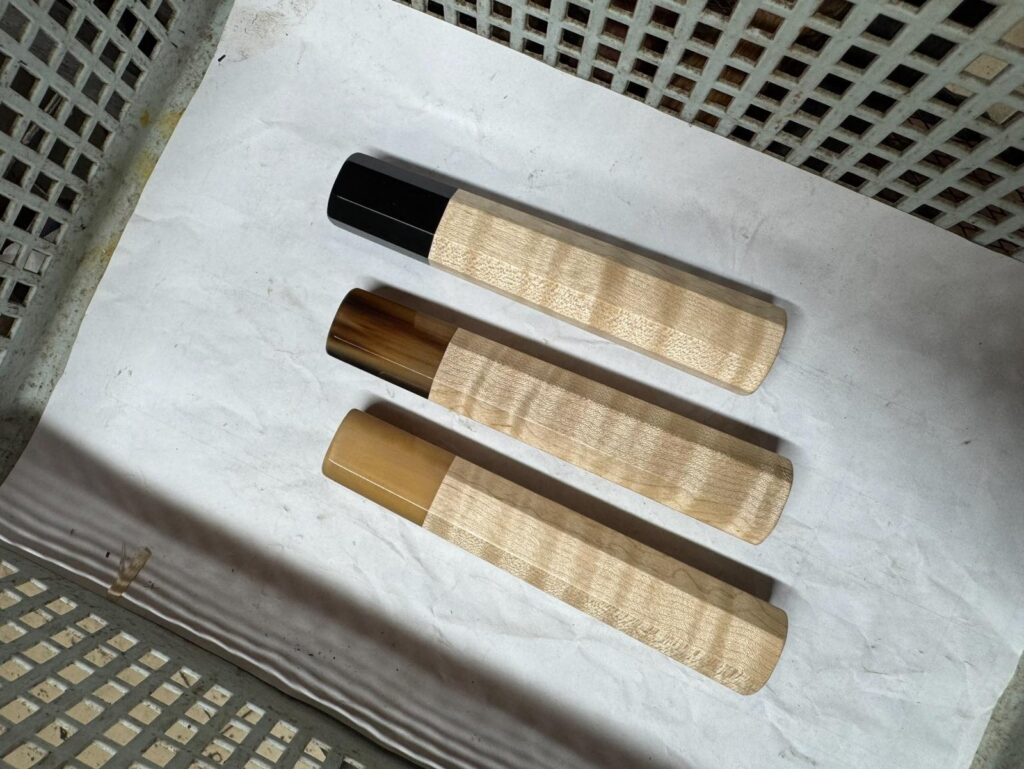
Urushi also appears in the wider world of Japanese knife handles. Some makers use it as a sealing and finishing coat on wooden wa handles, sometimes over a textured or cord-wrapped base. Depending on the construction, the visible result may be a sealed surface, added grip texture or a particular layered look. Those are descriptions of the technique, not properties shared by every lacquered handle.
The underlying wood is a separate subject; why Japanese knife handles are ho wood explains one important handle material. Horn & Grain makes made-to-order Japanese knife handles, but does not sell lacquerware or apply urushi finishes to handles.
Washing without ceremony
Taken together, makers’ care instructions are practical. Wash lacquerware by hand with diluted mild detergent and a soft sponge. After rinsing, wipe it dry with a soft cotton cloth rather than leaving water sitting on the surface. Store it away from long direct sunlight.
Those instructions also give clear limits: no dishwasher, no hot-air dish dryer and no microwave. A dishwasher combines conditions the object was not meant to endure, while a hot-air dryer adds concentrated heat. Saving lacquerware for guests does not solve those problems; washing it appropriately does.
Makers’ care instructions commonly advise against leaving a piece soaking as a habit. That is not the same as declaring that lacquerware must never touch standing water. Some makers suggest a one-off soak in rice-rinsing water when a new piece has a noticeable smell. The special suggestion and the everyday rule can coexist: follow the maker’s instructions for that initial treatment, but do not routinely abandon bowls or chopsticks in the sink.
Daily use can therefore be calm and unremarkable: eat, hand-wash, wipe dry and put away. The object does not need anxious polishing or a ceremonial schedule.
Repair is part of the working life
Wear does not automatically mean a lacquered piece is finished. Re-lacquering is a normal trade service, and the Wajima cooperative accepts pieces for repair. Its traditional-craft entry says damaged lacquerware “can be repaired and used again as if it were new.” That statement belongs specifically to Wajima’s repair practice; it should not be treated as a guarantee for every object or every form of damage.
A 2006 Japan for Sustainability report describes an unnamed chopstick maker offering re-lacquering with a turnaround of three weeks to a month. It also reports that some restaurants rotated half of their chopsticks for re-lacquering every six months, keeping the other half in service. The example shows repair functioning as routine maintenance rather than rescue after total failure.
Whether a particular bowl, tray or pair of chopsticks can be restored depends on its construction, condition and access to an appropriate repairer. Slowly revealed black beneath red negoro lacquer may be part of the intended ageing; a damaged base or unstable coating deserves an informed assessment.
That serviceability belongs within the larger world of Japanese kitchen craft. A useful lacquered object need not be hidden until guests arrive, and a worn one need not be discarded before repair has been considered.