The blade: a blue-grey bloom
A carbon-steel blade that has cooked for years no longer has the blank brightness of new steel. A blue-grey bloom moves across its face, cloudy in places and nearly black in others. It is densest along the belly, where the blade meets the board most often. Higher up, the colour may remain thinner, interrupted by pale scratches and the faint tracks of wiping.
The pattern was not designed. Onions, citrus, damp vegetables, meat, washing, drying and time all passed over the same surface. Each left almost nothing on its own. Together they made a dark geography of ordinary meals. The busiest part of the blade became the most legible: repeated chopping gathered colour near the edge, while quieter areas changed more slowly.
Tilt such a blade beneath the kitchen light and the bloom shifts between smoke, ink and dull blue. Fine sharpening scratches may run beneath it. A brighter patch may mark recent polishing. None of these signs tells a complete story, but they show where attention has been spent: cutting, cleaning, sharpening, returning the knife to the board.
That blue-grey bloom is stable and cared-for; orange rust is damage. For the reader interested in how the surface forms, rather than only how it looks, there is a closer account of carbon-steel patina.
The handle: polished by one grip
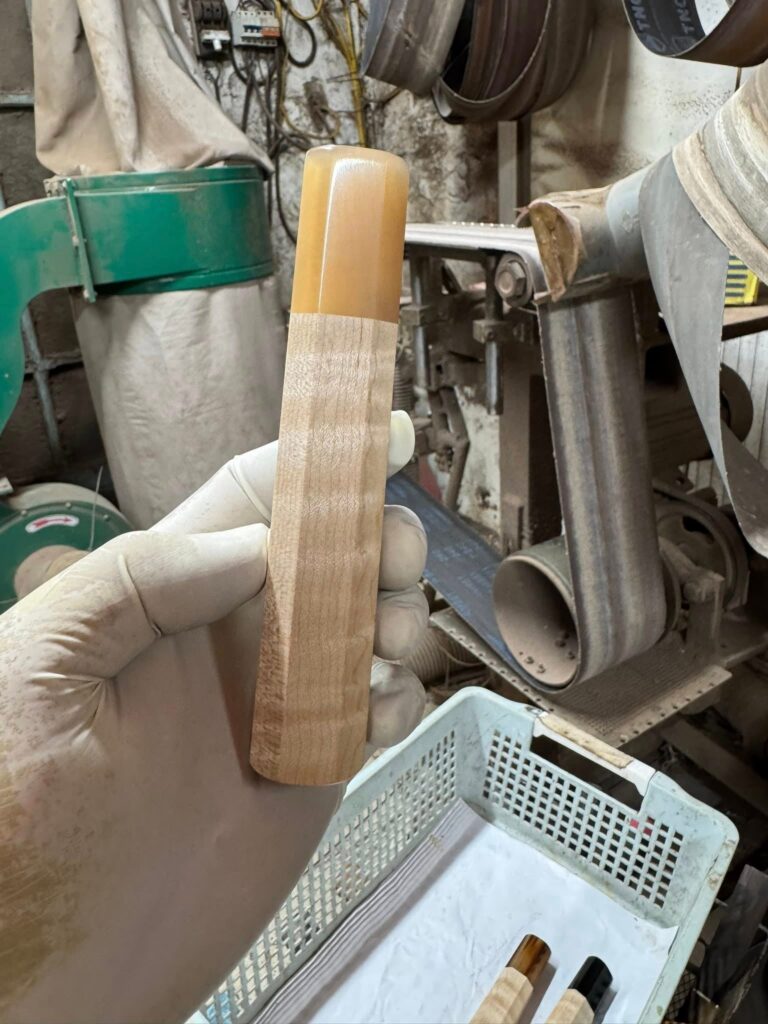
A wooden wa handle begins with clear planes. Its facets meet in crisp lines; the grain has an even finish; the whole shape seems equally present. Years of the same hand disturb that neatness in a remarkably precise way.
The wood grows darker and glossier exactly where the pinch grip lands. The thumb and forefinger polish one area near the blade. The remaining fingers leave subtler traces farther back. Tiny differences in pressure accumulate until the handle carries a quiet portrait of how it is held. One cook may leave a broad burnished patch; another may mark only two narrow planes.
Facet edges soften where skin crosses them again and again. The change is gradual enough to escape notice in daily use. Then, under raking light, the handle reveals a sheen that no unused surface has: not a coating sitting above the grain, but wood made smooth by contact. Small dents interrupt it. The end may remain comparatively crisp because the hand seldom reaches it.
The handle does not become shapeless. Its original geometry remains, but strict edges give way to familiar ones. The glossy patch says that the knife was not merely owned or displayed. It was reached for so consistently that a repeated grip became visible.
The stone: a hollow made by sharpening
A sharpening stone can develop a shallow hollow through its centre. Wet it and the dish becomes easier to see: water settles in the low area while the outer surface catches the light. Run a straight edge across it and a thin gap appears beneath, a small absence created by many sharpening strokes.
That hollow is the negative image of every edge the stone restored. Steel travelled across the wet surface, leaving dark swarf and carrying away a little of the stone with it. The central working area received the greatest share of those passes. Slowly, use translated movement into shape.
The dish records concentration rather than carelessness. It shows where hands found their rhythm, where pressure settled, where a dull edge repeatedly became keen enough to return to food. Even after the stone is rinsed clean, its surface retains a softness and irregularity that a new, flat block does not possess.
A dished stone still gets flattened; its marks are beautiful because the tool is kept working. Flattening removes the hollow, then sharpening begins another. Maintenance and wear alternate, each making the other necessary. A cracked handle or a chipped edge is a repair, not an aesthetic.
The board: a grey working centre
A wooden cutting board may be honey-coloured around its margins and scarred to grey at the centre. The change describes a working zone more accurately than any drawn boundary. Knife marks cross and recross there until individual cuts disappear into a fine, pale field.
Near the edges, the grain may still be easy to follow. In the middle, chopping, scraping, washing and drying have softened the contrast. Long slicing lines meet short rocking cuts. A few deeper grooves remain distinct, while thousands of lighter marks merge into texture. The board has not acquired an ornamental pattern; it has acquired the pattern of dinner being made in roughly the same place.
Its surface cannot identify a particular onion, bunch of herbs or loaf of bread. It offers no tidy chronology. What it shows is repetition: ingredients gathered toward the centre, the knife returning to its useful area, scraps swept away, the board cleaned and brought out again.
The quieter rim makes the marked centre more vivid. One part of the board has waited; another has participated. Between them lies a map drawn without intention, renewed whenever the next meal begins.
A name for the view
Leonard Koren’s Wabi-Sabi: for Artists, Designers, Poets & Philosophers (1994) places imperfection, impermanence and incompleteness at the centre of wabi-sabi—a compact frame for the blade, handle, stone and board above.
Look again
The next time the kitchen is quiet, look at the objects already there. Turn a knife until its darker steel catches the light. Notice whether the handle shines beneath the thumb. Wet the sharpening stone and see where water gathers. Look across the board rather than down at it.
There may be nothing dramatic to find. The most affecting changes are often slight: one softened edge, one cloudy patch, one shallow dip. They become visible when an object is given the kind of attention usually reserved for something new.
That second look belongs within the wider world of Japanese kitchen craft: not as a search for flawless objects, but as a closer encounter with the tools that make an ordinary kitchen feel inhabited.