Is a sujihiki just a Japanese carving knife? Not quite. They share a job: making long slices of cooked meat. But they were built to different briefs. A Western carving knife belongs with the roast and the table—sturdier, more tolerant, and comfortable working near joints and bone. A sujihiki belongs primarily at the board—thinner, usually harder, lower, and equally useful on raw proteins. It is the same stroke under a different contract. If the carving knife in your block appears only for three holiday meals a year, keeping it is almost certainly the right answer.
The same job, two design briefs
A carving knife is designed around serving a roast. That may mean working at a kitchen counter, but it may also mean carving at the table, with a fork in the other hand and a platter rather than a large board underneath. The knife must follow the contours of a bird, ham, or joint while remaining manageable around bones and awkward angles. It is commonly sturdier than a Japanese slicer and more tolerant of incidental contact near bone, though neither knife is intended to cut through bone. For the actual joint-by-joint method, see our turkey carving guide.
“Carving knife” also names a small family rather than one exact shape. There are often pointed carvers that can work around joints, round-tipped slicers with hollow-ground or granton-style faces, and some blades with a little flex. Their details vary, but the shared brief is practical service: turn a cooked roast into neat portions without making the occasion feel like delicate knife work.
The sujihiki begins with a different ideal: a clean slice made at the board in one long drawing motion. Its blade is typically around 240–300 mm, giving enough edge length to travel through a large piece of food without short, repeated strokes. The blade is usually narrow from spine to edge, which makes it agile during a pull cut but gives less knuckle clearance than a general-purpose chef’s knife.
Both knives can produce attractive slices of roast. The difference lies in what surrounds that cut. The carving knife anticipates the platter, the fork, the joint, and the possibility of less-than-perfect contact. The sujihiki anticipates a stable board, a boneless target, and a deliberate stroke. Neither brief is inherently better.
What does the sujihiki change?
The clearest change is thinness. A thinner blade has less material to push through dense protein, so it creates less resistance as it passes through a roast, ham, or boneless cut. That can make a long draw feel smoother and leave cleaner cut faces, especially when the goal is a fine, even slice rather than a thick serving portion.
A sujihiki is also lower in height than most general-purpose knives and often lower than a substantial carving knife. The narrow blade presents less surface area to the food, which further reduces drag. Combined with its length, that geometry makes thin slicing possible without requiring a sawing motion.
Steel is part of the design difference too. A sujihiki is typically harder than a conventional Western carving knife, allowing it to support a fine edge through careful slicing work. The cost is familiar: it offers less forgiveness of twisting, bone contact, lateral pressure, and casual treatment. Using the tip to pry around a joint, turning the blade while it is embedded, or knocking the edge against a platter can be more consequential.
The carving knife’s extra tolerance is not evidence of an inferior edge. It is useful capacity built into a tool expected to work in a messier setting. The sujihiki’s thinness is not evidence that the Western design is crude. It is specialization for a cleaner cutting environment.
This is the wider Japanese vs German knives trade-off applied to one particular pair: finer geometry and typically harder steel in exchange for more deliberate handling. Here, the trade is especially visible because both knives can perform the same headline task.
Where do raw and cooked foods divide their territories?
Cooked meat is the overlap. Either knife can slice a boneless roast, portion a ham, or cut rested beef for serving. If that were the only work under consideration, condition and familiarity might matter more than category: a sharp carving knife already in the block is more useful than a neglected slicer acquired for its name.
The sujihiki gains ground when the work extends to raw proteins. Its long edge and low-drag geometry suit portioning boneless meat before cooking, dividing larger cuts into steaks, and making clean slices through fish at home. That does not turn ordinary home preparation into sashimi mastery or make the sujihiki a substitute for single-bevel yanagiba technique.
This added range matters because raw protein exposes the value of a continuous, low-pressure cut. Repeated short strokes can roughen a surface or compress a soft fillet. A sufficiently long, sharp slicer can travel through with fewer interruptions. It remains a slicing tool, however—not a cleaver, boning knife, or answer for cutting joints.
The carving knife retains clear home advantage around a hot roast. Its handle and blade are meant to work naturally with a carving fork, and its sturdier construction is reassuring when the food shifts, a joint is nearby, or the cut must happen on a serving platter. For the cook who associates slicing primarily with turkey, holiday beef, or an occasional ham, that is not a compromise. It is the intended use.
Should the sujihiki replace the carving knife?
For a household that brings out its carving knife three times a year—for turkey, a holiday roast, and perhaps a ham—the answer is no. The existing knife already matches the task, and changing to a sujihiki offers little meaningful benefit. Sharpening the carving knife before the occasion is likely to matter more than replacing its design.
A sujihiki begins to earn space when slicing becomes routine. Weekly roasts, regular preparation of raw boneless proteins, home fish portioning, or frequent entertaining can justify a dedicated blade that moves easily between raw preparation and cooked service. Someone who values very thin, clean slices may also appreciate what its geometry makes easier.
That does not automatically make the carving knife redundant. A cook may prefer the sujihiki at the board and still choose the more tolerant carver for a bone-in bird at the table. Keeping both is sensible when those roles genuinely recur; keeping both merely because they come from different traditions is not.
The decision changes if the comparison is no longer with a carving knife already in the block. If the real question is whether a long slicer deserves space beside a Japanese chef’s knife, the relevant comparison is gyuto vs sujihiki. That is a Japanese-line-up decision, not a reason to replace a carving knife that already handles its occasional job well.
Where handles enter the picture
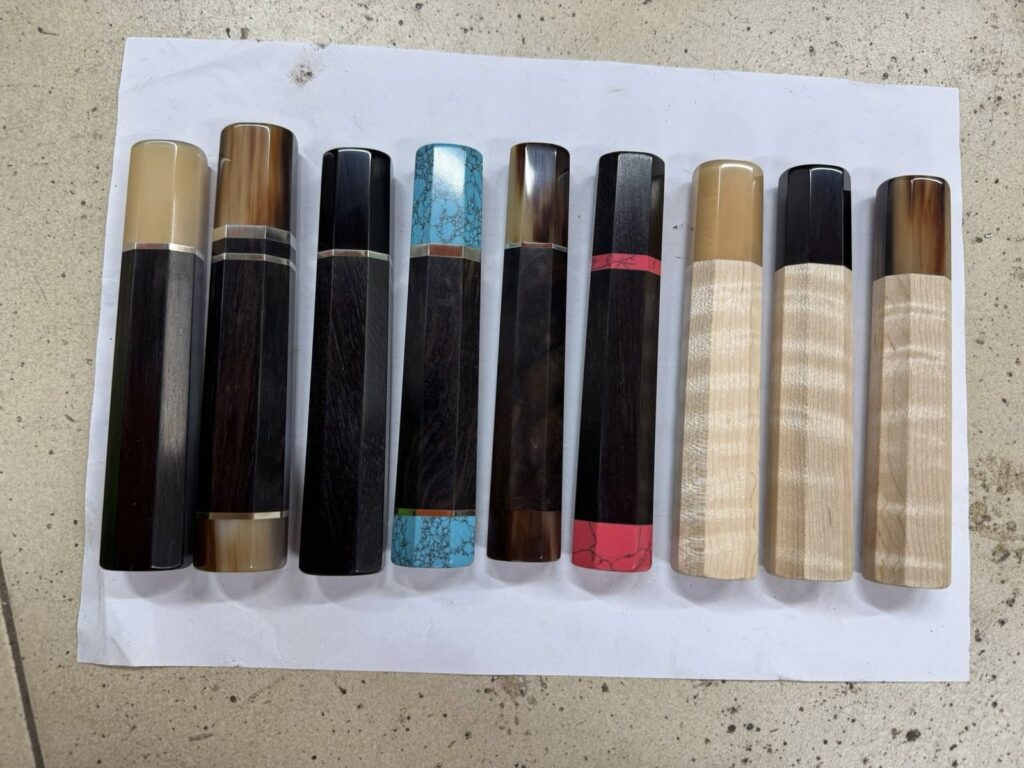
Long slicers from either tradition are often re-handleable, depending on their construction. For context on the tang, machi, and other terms involved in fitting a handle, see the anatomy of a Japanese knife; when a compatible knife needs a made-to-order handle, that is where we come in.