To slice (or carve) a tri-tip, let the cooked roast rest for a few minutes, find the direction of the grain, and cut thin slices across it. Then watch the grain as you go: the Beef Checkoff’s test kitchen notes that on a tri-tip the grain changes direction toward the thicker part of the roast, so you turn the meat or your knife to keep cutting across it. Beef Checkoff recipes slice it about 1/4 inch thick.
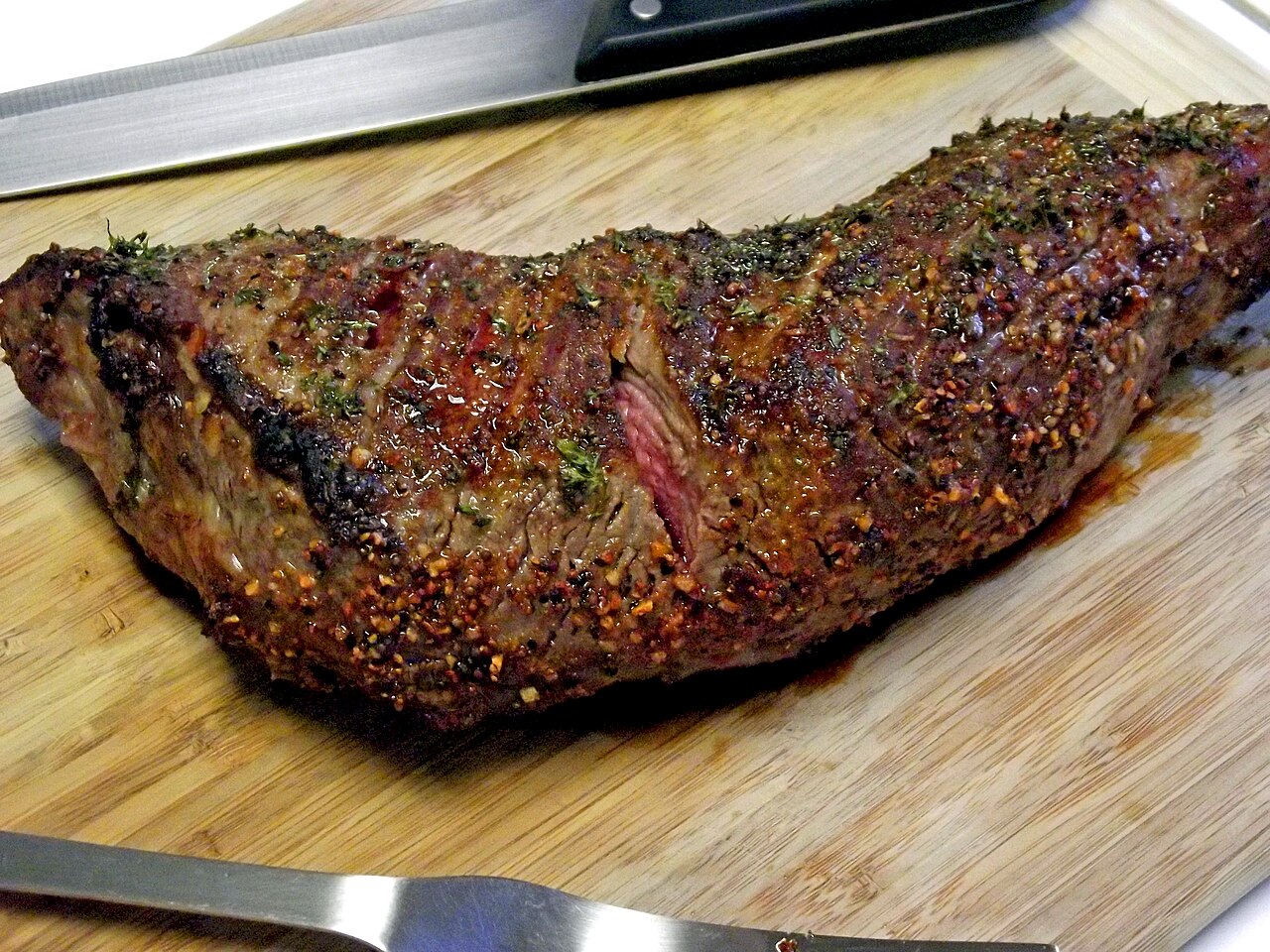
Why tri-tip needs a second look
Tri-tip is a boneless, triangular cut from the bottom sirloin; Beef. It’s What’s For Dinner says its triangular shape gives it the name, and its advice for both the roast and the steak is to “roast or grill then slice across the grain.” The Beef Checkoff’s barbecue cut guide is firmer: tri-tip “must be sliced diagonally across the grain to retain optimal tenderness.” South Dakota State University Extension calls slicing across, perpendicular to, the grain “very important.”
The catch is that the fibers do not run one way through the whole triangle. The Beef. It’s What’s For Dinner test kitchen tip says to watch for the grain change while you cut, because it changes direction toward the thicker part of the roast, and to cut the opposite direction of the grain. A slice that was across the grain at the thin end can end up running along it by the time you reach the thick end.
Rest and set up
Rest times in the sources are short: Beef. It’s What’s For Dinner recipes rest a tri-tip roast 5 to 10 minutes or at least 10 minutes, and SDSU Extension rests it 10 to 15 minutes uncovered. USDA’s safe minimum for beef roasts is 145°F with a 3-minute rest (as SDSU Extension lists it), which the Beef Checkoff also gives as medium rare.
Use a board long enough for the whole roast and a row of slices, with a groove or tray for the juices; our carving board guide compares sizes. SDSU Extension’s advice is not to waste those juices: it puts the slices in a covered container and pours the juice from the board back over them.
Step by step
- Read the grain. Look at the surface for the lines of the fibers. If a dark crust hides them, cut one slice from the thin tip and look at the cut face.
- Start at the thin tip. Slice across the grain, on a slight diagonal if you like; the barbecue cut guide calls for diagonal slices across the grain.
- Keep the slices thin. SDSU Extension slices about 0.2 inch thick, five slices per inch; Beef Checkoff recipes use 1/4 inch, or 1/2 inch for a smoked roast.
- Check as you go. Look at each cut face. When the fibers start to show as long lines along the slice instead of short ends across it, the grain has turned.
- Turn and continue. Rotate the remaining piece (or angle the knife) until you are cutting across the fibers again, and keep slicing to the end.
Some cooks find it easier to cut the roast in two where the grain changes, then slice each piece separately. That is the same approach Virginia Cooperative Extension’s carving guide gives for a chuck roast, whose fibers do not all run in the same direction: separate the muscles and carve each one across its own grain.
The knife for this job
A tri-tip has no bone, and it is short enough for an ordinary chef’s knife or gyuto to slice in long strokes; our gyuto vs chef’s knife guide explains that the two do the same job. If you slice roasts often, a longer slicer helps: a sujihiki is a long, narrow double-bevel knife made for boneless meat (see what is a sujihiki), and sujihiki vs carving knife compares it with a Western carver. Draw the knife through in long strokes with a relaxed pinch grip (see how to hold a Japanese knife) instead of pressing straight down.
For a wa handle, our wa handle size guide puts a 196–255mm gyuto or a 210–255mm sujihiki in the Chef size and a 256–360mm sujihiki in Long. For a larger beef roast, see how to carve roast beef.
Sources: Beef. It’s What’s For Dinner, Smoked Tri-Tip (test kitchen tip) (grain changes toward the thicker part; rest at least 10 minutes; 1/2-inch slices); Beef. It’s What’s For Dinner, Tri-Tip Steak (shape and name; slice across the grain); Beef. It’s What’s For Dinner, Lemon-Garlic Grilled Tri-Tip Roast (stand 5 to 10 minutes; 1/4-inch slices; 145°F medium rare); BBQ Beef Cut Guide (sliced diagonally across the grain); SDSU Extension, How to Grill Amazing Beef Tri-Tip (rest 10 to 15 minutes; about 0.2-inch slices; keep the juices); SDSU Extension, Is It Done Yet? (145°F plus 3-minute rest, citing USDA FSIS); Virginia Cooperative Extension, Meat Carving (458-002) (carve muscles separately when fibers run in different directions).