To carve roast beef, let the cooked joint rest according to its recipe, then slice thinly across the grain. Keep the roast steady on a large board and use a sharp knife you can control. A boneless joint and a rib roast need different setups.
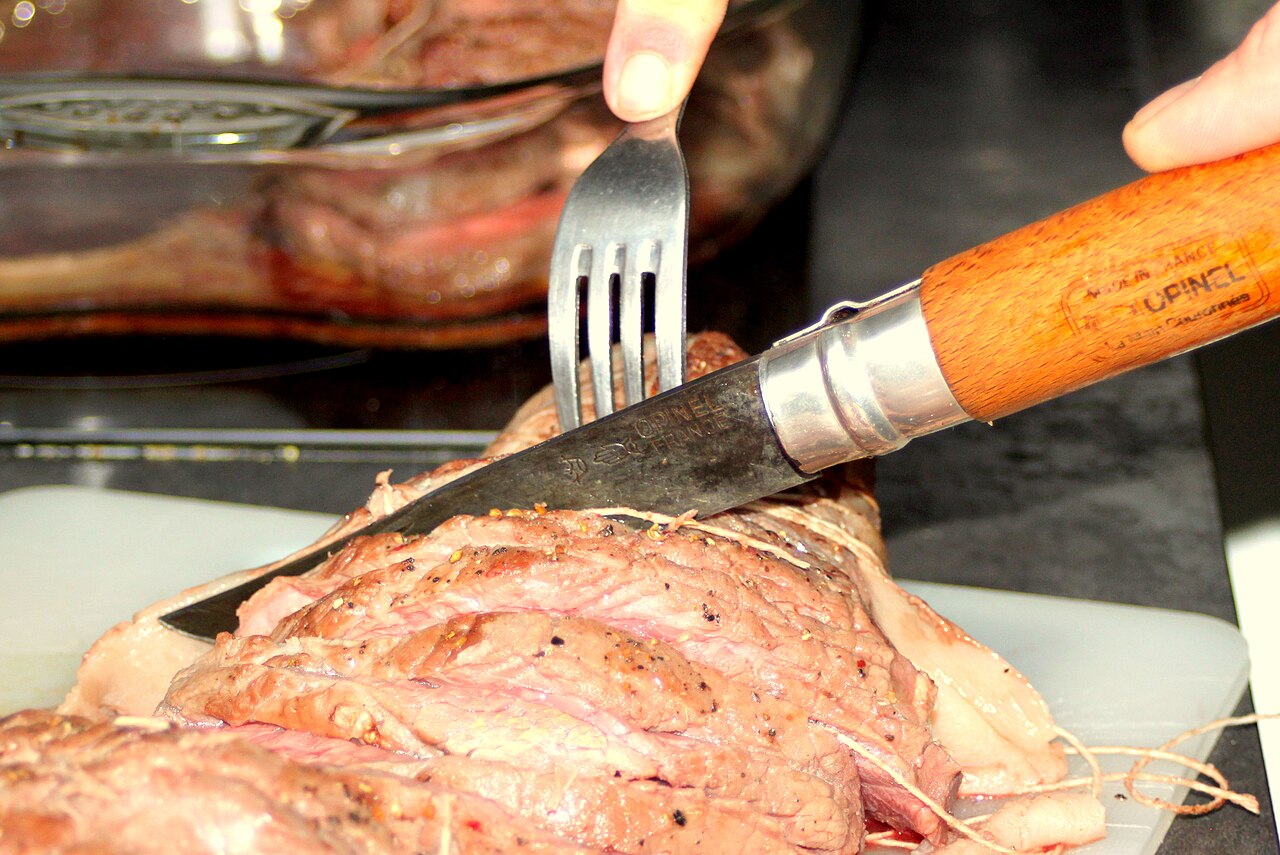
Set up the board and roast
Use a board that stays secure and has room for the joint and your knife strokes. Set a platter beside it for the slices. A rim or juice groove can catch runoff; keep a tray nearby if you want to save the carving juices. For listed board sizes and groove options, see our carving-board guide.
Use a sharp carving knife or a large knife you can guide comfortably. If you steady the meat with a fork, rest the back of the fork against it rather than piercing the roast; tongs are another option. These setup points follow Beef. It’s What’s For Dinner’s roasting and carving guidance.
Carve a boneless roast across the grain
- Look for the direction of the long muscle fibers on the cooked surface. That direction is the grain.
- Turn the roast so you can cut across those fibers, rather than making slices that run along them.
- Starting at one end, cut thin, even slices through the joint. Keep the roast supported and reposition it if it shifts.
- Move slices to the platter as you go, leaving the remaining joint stable on the board.
Beef. It’s What’s For Dinner recommends slicing across the grain and notes that cuts such as top round and sirloin tip are served in thin slices. If the browned surface hides the fiber direction, make a small first slice and check the cut face; orient the remaining joint so your next slices cross those fibers.
For a chined rib roast
This short method assumes the chine, or back bone, has already been removed. Stand the rested joint with its ribs pointing upward. If it will not balance securely, lay it down with the ribs uppermost.
- Place the knife between the meat and the ribs.
- Keep the blade against the bones and work along them to release the meat from the rib rack.
- Set the boneless meat flat and slice thinly across its grain.
This follows Leiths’ roast-rib carving method for a chined joint. If the backbone is still attached or the joint cannot sit securely, ask the butcher how it was prepared and use a detailed method for that joint before carving.
If you are comparing a Western carving knife with a sujihiki for long slicing strokes, our sujihiki and carving-knife comparison explains the different design roles.