A few controlled cuts cover most everyday prep. Start with a board that stays still, tuck the guiding hand into a claw, and work slowly. Then choose a piece size that suits the recipe: cut names are useful references, not rules every cookbook uses the same way.
Set up for control
Use a clean knife and board on a stable surface. If the board shifts, stop and secure it before continuing. Curl the fingertips of your guiding hand inward, with the knuckles facing the blade and the thumb tucked behind them. Let the knuckles set the next slice; move the hand back only after the blade clears the food. Begin slowly enough to keep control.
A rocking motion is one option for some knives and cuts, not a rule for every blade. Use a motion that feels controlled with the knife you have; do not force its tip down if the blade shape does not suit that path.
Common cuts at a glance
Use this as a quick comparison, then follow the ingredient guide for the cut you want. These are reference examples, not a single standard; use the size in your recipe when it specifies one.
10 cuts shown
| Cut | Shape or use | Reference dimensions | Try it with |
|---|---|---|---|
| Slice | Flat pieces cut across an ingredient; thickness depends on the recipe or task. | No fixed size. | Cucumber slices; cabbage slices. |
| Chop | Rough pieces when the recipe does not call for uniform cubes. | No fixed size. | Butternut squash. |
| Mince | Very fine pieces; gather and cut again if the recipe calls for a finer result. | No fixed size. | Garlic; ginger. |
| Chiffonade | Fine ribbons made by stacking and rolling leaves, then slicing across. | No fixed size. | Fresh herbs. |
| Julienne | Thin, even matchsticks. | 1/8 × 1/8 in, about 2–2 1/2 in long (USU: 2 1/2 in; ICE: about 2 in).About 3 × 3 mm, 51–64 mm long. | Carrots; cucumber. |
| Batonnet | Thicker, even sticks; cut across the sticks for dice. | 1/4 × 1/4 in, about 2–3 in long (USU: 2 1/2–3 in; ICE: about 2 in).About 6 × 6 mm, 51–76 mm long. | Celery sticks. |
| Brunoise | Very small cubes, often made by crosscutting fine sticks. | About 1/8 in cubes.About 3 mm cubes. | Onion dice; choose the finer size your recipe needs. |
| Small dice | Even cubes. | 1/4 in cubes.About 6 mm cubes. | Onion; celery. |
| Medium dice | Even cubes. | 1/2 in cubes.About 13 mm cubes. | Cucumber. |
| Large dice | Even cubes. | 3/4 in cubes.About 19 mm cubes. | Butternut squash. |
Metric figures are rounded conversions. Reference sizes follow ICE and Utah State University Extension; their stick lengths differ.
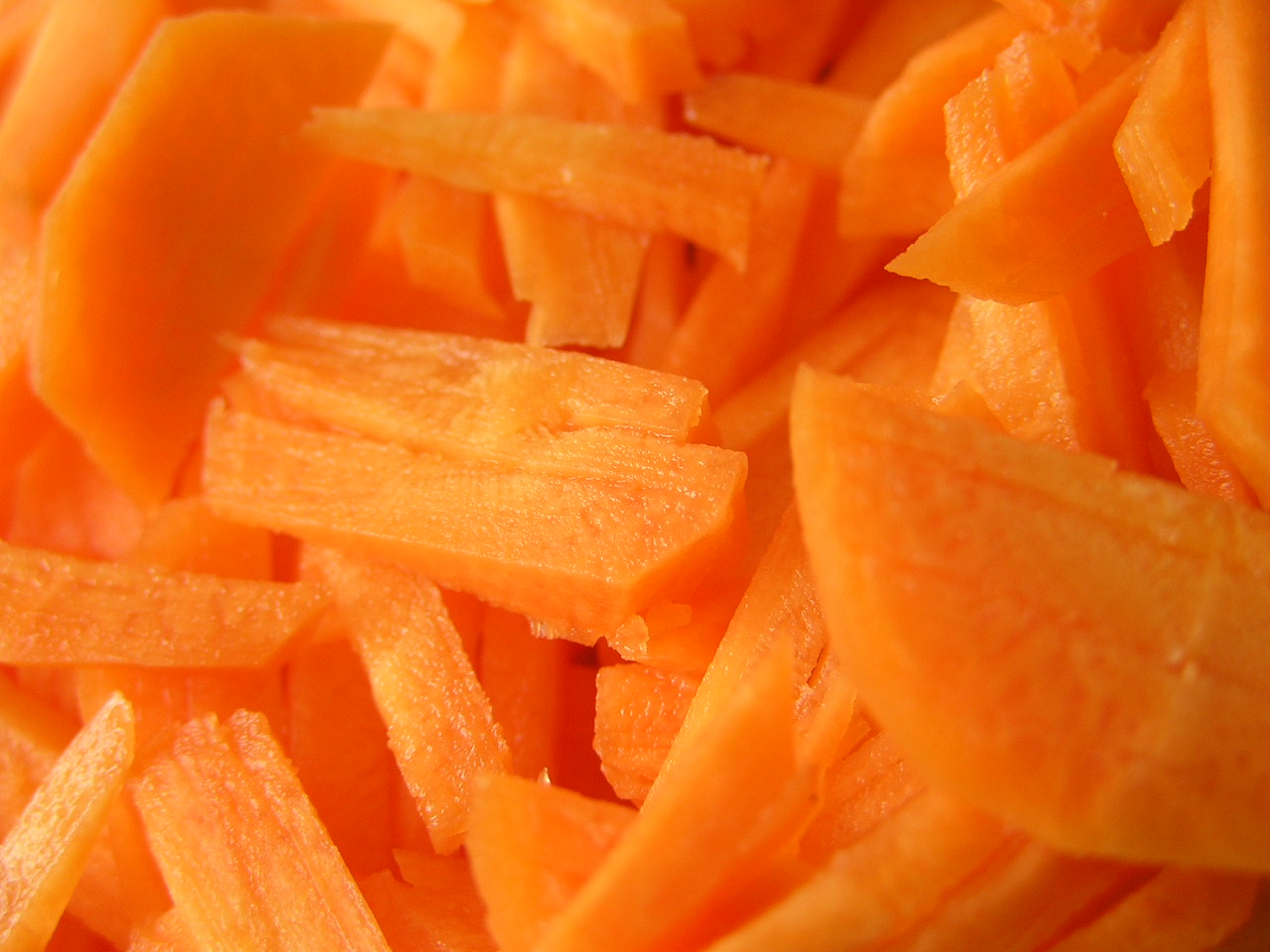
Practise with one carrot
- Trim the ends and cut the carrot into a few manageable lengths. If it rolls, slice a thin piece off one side and rest it on that flat face.
- Cut each piece into planks, keeping their thickness as even as you can. Stack only a few stable planks and cut lengthwise into sticks.
- For small dice, make even 1/4-inch square sticks, line them up, then cut across them at the same spacing. Pause and reset the claw whenever the pieces or your hand shift.
Compare the pieces as you go. If sticks taper, make a flatter base or smaller planks; if dice vary, line the sticks up before crosscutting. Let your first plank set the thickness for the next ones. If the carrot curves sharply, do not chase it with the blade; cut a stable flat face or switch to a straighter piece. Save irregular trimmings for a dish where exact shape does not matter. There is no timer or mastery target here: slow, repeatable cuts are a better place to begin than speed.
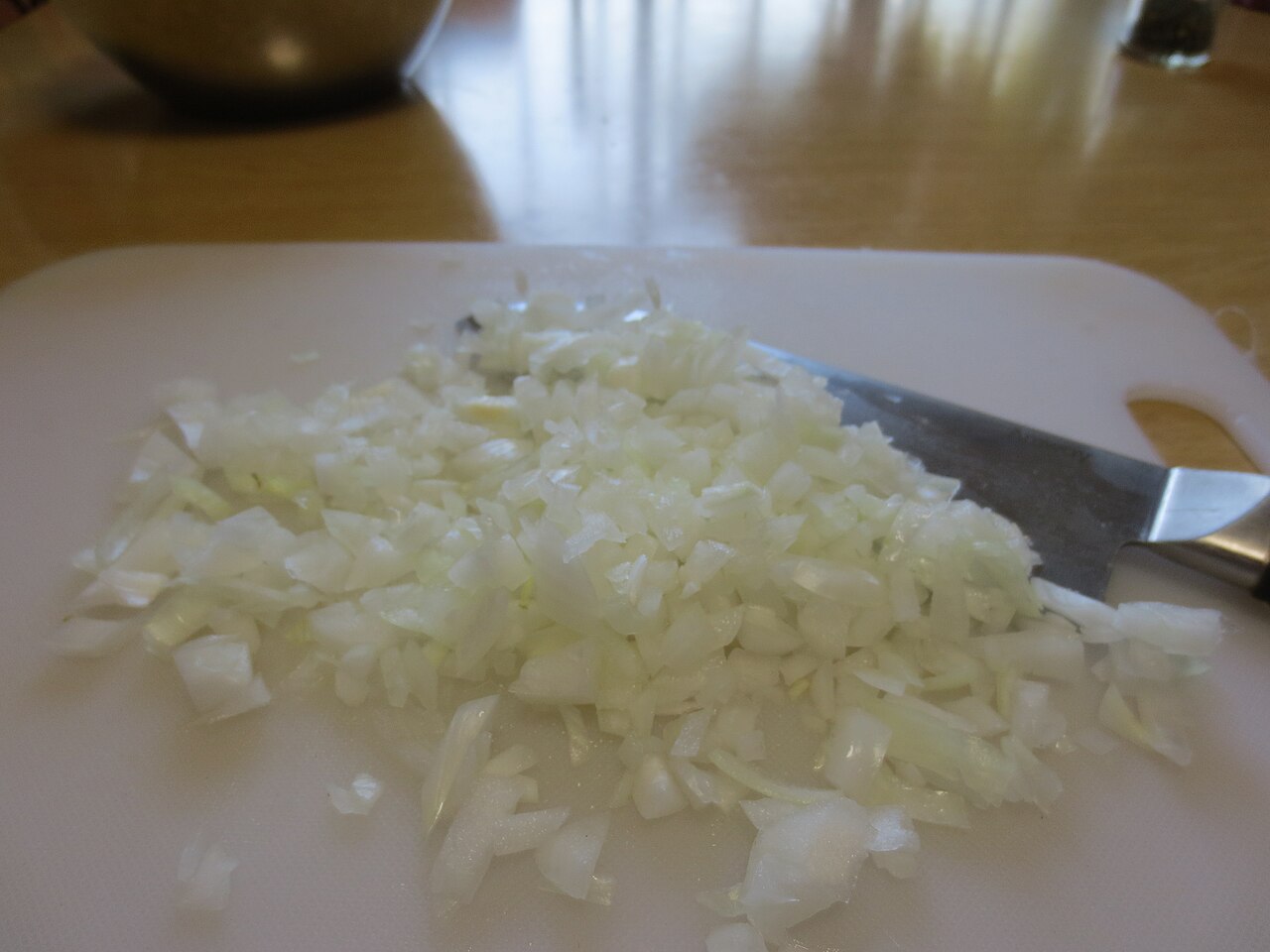
Find a guide for the ingredient on your board
- Small pieces: dice an onion, mince garlic, slice or mince ginger, or cut green onions into rounds or bias pieces.
- Strips and everyday vegetables: julienne carrots, cut a cucumber into slices, dice or julienne, cut celery into sticks or dice, or cut cabbage for shreds, slices or wedges.
- Other shapes: slice, wedge or dice a tomato, cut potatoes for fries, cubes or wedges, or prepare butternut squash.
- Fruit: cut cantaloupe into wedges, slices or cubes, cut kiwi into coins, slices or wedges, core and cut an apple for wedges, cubes or pie, and cut grapefruit into halves, sections or membrane-free segments.
- Leafy herbs: prepare basil, parsley, cilantro, dill, thyme and rosemary by species.
- For a roast: carve a bone-in or boneless leg of lamb.
A chef’s knife or santoku can handle many everyday cuts; choose the one you can control comfortably. For grip differences among Japanese knives, see how to hold a Japanese knife. For Japanese vegetable cut names and shapes, see Japanese vegetable cutting techniques.
Sources: Institute of Culinary Education, “5 Essential Knife Cuts” (examples of julienne, batonnet, brunoise and dice dimensions). Utah State University Extension, “Knife Skills” (cut terms and reference dimensions); Virginia Cooperative Extension, FST-268, “The Basics of Knife Skills” (clean setup, claw grip and slow practice); USU Extension, “Preserve Your Fingers: Vegetable Cutting Knife Safety” (stable cutting surface); Victorinox, “Sharpen your knife skills” (julienne, dice and chiffonade technique).