To cut celery, pull the stalks (ribs) apart, rinse out the soil at their base, and trim off the leafy tops and the pale bottom ends. Then cut each rib to the shape you need: long sticks for snacking, thin crescents for salads, or a small dice for soups and stuffing. For dice, split wide ribs lengthwise into strips first, then cut across them.
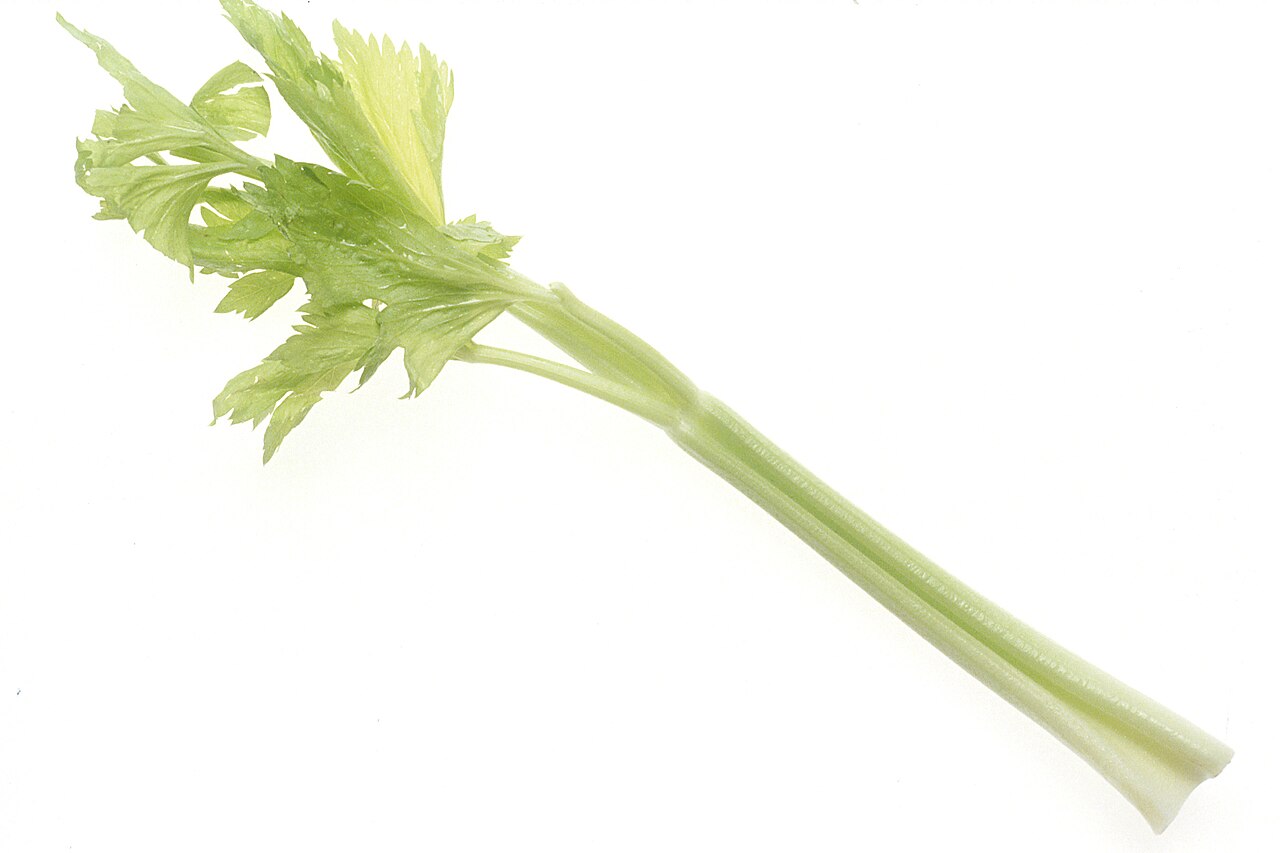
A bunch of celery is a cluster of ribs joined at a solid base. Utah State Extension’s celery guide notes that dirt is often lodged between the individual stalks, which is why the bunch is separated before washing rather than rinsed whole. Purdue Extension suggests choosing stalks that are pale to bright green and crisp when you pull them apart.
Separate, wash and trim
Utah State’s guide is to separate each stalk, rinse it thoroughly under running water, then trim off the leaves and the bottom white area. Purdue cuts off the base before washing. Wisconsin Extension’s fact sheet separates the ribs, cuts off both ends and points out that the leaves are edible, for use in soup, stuffing, salad and other cooked dishes, so set them aside instead of throwing them out.
Step by step
- Cut sticks. Cut each trimmed rib into pieces of the length you want. For thick outer ribs, Wisconsin Extension halves the rib lengthwise first, then cuts each half to length.
- Slice crescents. Lay a rib on the board so it does not rock and slice straight across. Utah State Extension’s knife-skills handout names celery as an example of the slicing cut: middle of the blade, tip on the board, pushing down and away.
- Cut strips for dice. Cut the rib into manageable lengths, then cut each length lengthwise into strips as wide as the dice you want.
- Dice. Gather the strips into a bundle and cut across them at the same spacing. The same handout defines a small dice as ¼-inch cubes and a medium dice as ½-inch cubes.
- Julienne, if a recipe asks for it. The handout defines julienne as strips ⅛ inch by ⅛ inch by 2½ inches. Celery’s curve makes the first cut the hard part: trim the rib into flat lengths before slicing the thin strips.
Cuts by dish
| Dish | Cut | Note |
|---|---|---|
| Snacks and dips | Sticks | Halve wide ribs lengthwise |
| Salads | Thin crescents or small dice | Wisconsin’s apple and celery salad uses diced celery |
| Soups, stews, sauces | Dice | Part of a mirepoix |
| Stuffing | Small dice, plus chopped leaves | Leaves are edible |
Utah State’s guide describes mirepoix, the French flavor base for soups, stews, meat and sauces, as 1 cup diced onion, ½ cup diced carrot and ½ cup diced celery cooked in a little oil or butter until tender. For the onion in that mix, see our guide to dicing an onion.
Keep your fingers clear
Mississippi State Extension’s knife basics ask you to tuck the fingertips of your guiding hand toward your palm and to give rounded food a flat surface. A celery rib is curved, so if it rocks with the hollow side up, turn it over or trim a thin strip from the back before slicing.
Storing celery
Purdue says celery can be stored unwashed in a plastic bag in the refrigerator drawer for up to five days; Utah State gives 1 to 2 weeks in a plastic bag in the crisper, away from fruits. Utah State adds that frozen celery loses its crispness and is then suitable only for cooked dishes.
The knife for this job
Celery is many straight board cuts through a crisp, fibrous vegetable, which suits a nakiri’s flat edge and down-and-forward stroke; see how to use a nakiri. A santoku works the same way, and a gyuto gives you a longer edge; nakiri vs gyuto compares the two. In our wa handle size guide, a 150–190mm nakiri or santoku takes the Mid-size handle and a 196–255mm gyuto the Chef size.
Sources: Utah State University Extension, Fruit and Vegetable Guide Series: Celery (soil between stalks, trimming, mirepoix, storage, freezing); Purdue Extension FoodLink, celery (selection, base, storage); University of Wisconsin Extension, Celery fact sheet (halving ribs, leaves, salad); Utah State University Extension, Knife Skills handout (slicing cut, dice and julienne sizes); Mississippi State University Extension, Kitchen Knife Basics (curled fingertips, flat surface).