A santoku is a compact Japanese all-purpose kitchen knife. Its name means “three virtues”, which Korin explains as its ability to handle meat, fish and vegetables. Most are about 165–180mm long and double bevel, with a fairly flat edge, a tall blade and a tip that curves down to meet the edge. It suits push cuts and everyday prep on a home-sized board.
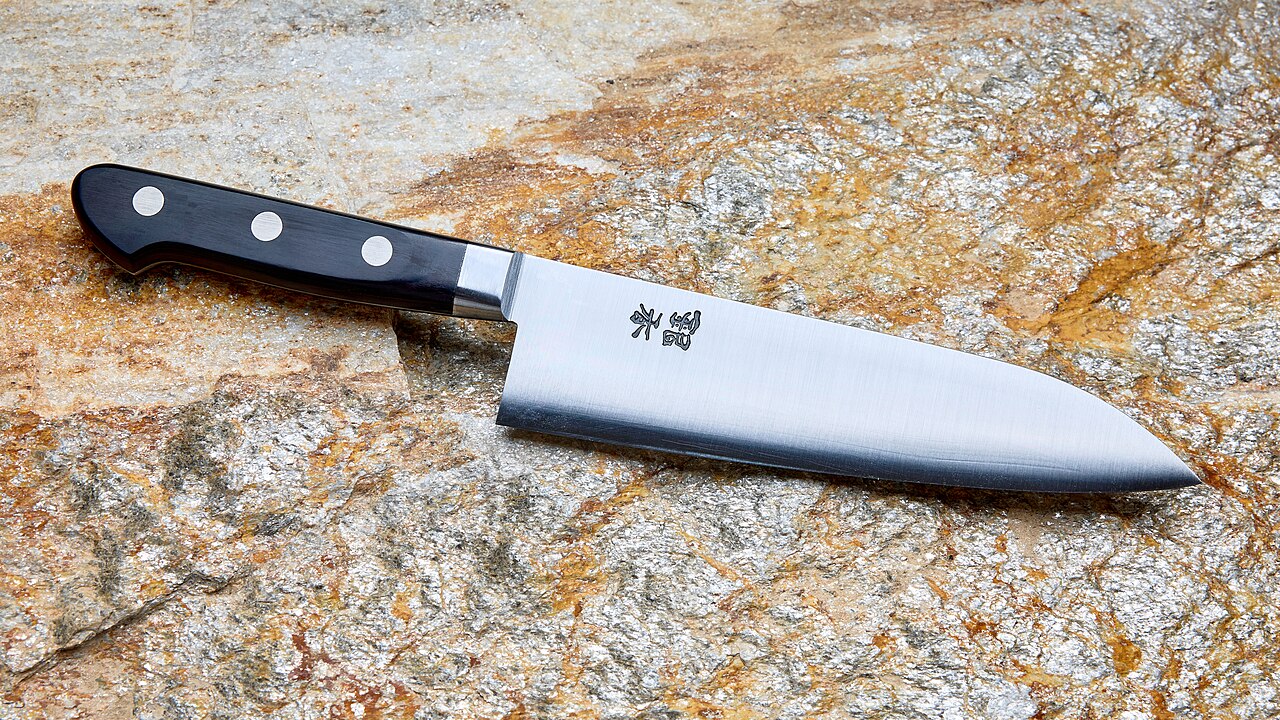
Santoku at a glance
Every figure below is as the maker or seller lists it:
| Spec | What the sources list |
|---|---|
| Name | “Three virtues”: meat, fish and vegetables (Korin) |
| Blade length | 165–180mm for home and professional use (TOJIRO); 170 and 180mm (Masamoto); Korin’s santoku listings are 180mm |
| Bevel | Double bevel: Korin lists its Togiharu Molybdenum Santoku at 70/30 and its Kaguya Wa-Santoku at 50/50 |
| Profile | A wide blade, “more parallel to the chopping board than the Gyuto”, with a round tip (Masamoto) |
| Weight, two 180mm examples | 167g (Togiharu Molybdenum) and 147g (Kaguya Wa-Santoku), both Korin |
| Typical use | Meat, fish and vegetables in daily cooking (TOJIRO); not for hard ingredients (Masamoto) |
Sources: Korin’s santoku style page, Togiharu Molybdenum Santoku and Kaguya Wa-Santoku; TOJIRO’s knife guide (archived copy); the Masamoto Sohonten catalogue. These describe particular knives; other makers vary.
What the shape does
A santoku’s edge stays fairly flat for most of its length. Masamoto describes the blade as wider and more parallel to the board than a gyuto’s, and calls it an ideal shape for cooks who cut a lot of vegetables. That flat run puts a long stretch of edge on the board at once, so the knife works best travelling down and forward through the food rather than rocking on a curved belly.
The height helps too. Korin notes that the tall blade keeps your knuckles well above the board. At the front, Wikipedia’s santoku article describes a “sheep’s foot” tip, where the spine curves down to meet the edge. There is less point for fine work than on a gyuto or a bunka.
TOJIRO describes the santoku as combining the good points of a chef’s knife and a nakiri. Masamoto adds a limit: the santoku is not meant for hard ingredients. Bones and frozen food need other tools; why Japanese knives chip explains what goes wrong.
Santoku vs its nearest neighbours
Gyuto. A gyuto is the longer Japanese chef’s knife with a more pointed tip; TOJIRO suggests 160–240mm for home use. If you are choosing between the two, gyuto vs santoku works through board space and cutting style.
Nakiri. A nakiri has a straight edge and a square front, made for vegetables. The santoku keeps a usable tip for meat and fish; see santoku vs nakiri.
Bunka. A bunka is close to a santoku in size but has an angled, finer tip. Bunka vs santoku covers that difference, and our guide to what a bunka is describes it on its own.
Who it suits
A santoku suits a cook who wants one compact knife for mixed home cooking, works on a smaller board and prefers push cuts to rocking. If you often cut large roasts or squash, a longer gyuto gives more edge. If this will be your first Japanese knife, how to choose your first Japanese knife covers the other decisions, from steel to care.
Handle size for this knife
On our wa handle size guide, a santoku of 150–190mm takes the Mid-size · santoku, bunka, nakiri size, with a starting handle length of about 115–125mm. That is a starting range, confirmed against your own knife before the build begins. On our product pages you enter the knife type and blade length and the size recommender picks the tier. Then build the handle in the handle configurator, choosing wood, ferrule, end cap, shape and size.