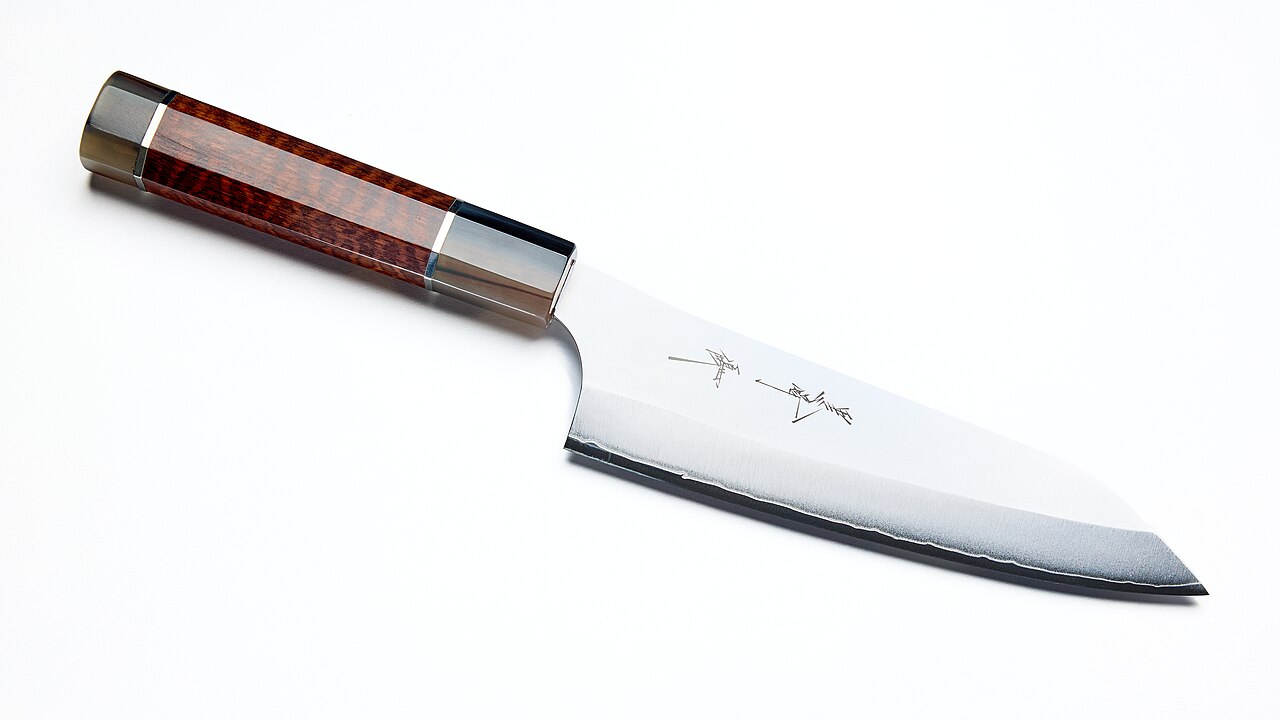
A bunka is a Japanese all-purpose kitchen knife: a compact, double-bevel blade, usually about 170–180mm, shaped much like a santoku but with an angled, pointed front often called a K-tip. It handles the same everyday mix of vegetables, boneless meat and fish, and the finer tip adds control for scoring and trimming.
Bunka at a glance
Every figure below is as the maker or seller lists it:
| Spec | What the sources list |
|---|---|
| Name | Bunka bōchō, literally “cultural kitchen knife” (Wikipedia) |
| Blade length | 170 and 180mm in Masamoto’s bunka/santoku line; a 180mm bunka at Korin; 170mm for the Masakage Yuki bunka at Knifewear |
| Bevel | Double bevel: Knifewear lists the Masakage Yuki bunka as “Double (50/50)” |
| Profile | A santoku-like flat edge with “a more angular, straight tip” instead of the curved sheep’s-foot tip (Wikipedia) |
| One example | 170mm blade, 47.5mm high, 2.7mm thick, 131g (Knifewear, Masakage Yuki) |
| Typical use | General prep; Knifewear calls this bunka “a cross between the Nakiri and Gyuto” |
Sources: Wikipedia’s Japanese kitchen knife article for the name and tip; the Masamoto Sohonten catalogue; Korin’s santoku style page, which lists its bunka; Knifewear’s Masakage Yuki Bunka 170mm. Knifewear is a retailer and notes that handmade knives vary, so its measurements are only an example.
Where the K-tip matters
Most of a bunka’s edge does the same work as a santoku’s: a long, fairly flat run that suits push cuts and chopping straight down. The difference is the front. Where a santoku’s spine curves down to a rounded point, a bunka’s spine drops at an angle to a fine, low tip. That point is useful for scoring, trimming around a pepper’s core or starting a precise cut in an onion.
The fine tip is also the part to protect. Avoid prying with it, twisting it in hard food or letting the knife fall tip-first; why Japanese knives chip covers the usual causes of damage.
“Bunka” names a family rather than one exact shape. Masamoto also makes a thinner variation, the usukuchi bunka, with a pointed tip for delicate vegetable peeling, cutting and decorative work, listed at 190mm. Check the individual knife’s length, height and thickness rather than the name.
Bunka vs its nearest neighbours
Santoku. Same size class and the same job; the tip is the main difference. Bunka vs santoku compares them in detail, and our guide to what a santoku is describes the santoku on its own.
Gyuto. A gyuto is longer, with a conventional point. In Knifewear’s Masakage Yuki line the 170mm bunka and the 210mm gyuto share height, thickness, steel and bevel; see bunka vs gyuto.
Kiritsuke. A kiritsuke has a similar angled front on a longer blade, and the traditional version is single bevel. Kiritsuke, explained separates the two.
Who it suits
A bunka suits a cook with a small board who wants one compact knife and will use a fine point for detail work. If you already own a santoku, a bunka mostly changes the tip, not the job. If your board has room and you often slice large produce or roasts, a 210mm gyuto gives you more edge.
Handle size for this knife
On our wa handle size guide, a bunka of 150–200mm takes the Mid-size · santoku, bunka, nakiri size, with a starting handle length of about 115–125mm. That is a starting range, confirmed against your own knife before the build begins. On our product pages you enter the knife type and blade length and the size recommender picks the tier. Then build the handle in the handle configurator, choosing wood, ferrule, end cap, shape and size.